A display or clearance cabinet should be evaluated as the specific item being sold, not as a new example of a catalog photograph. Confirm which pieces are included, examine accessible surfaces and operation, and understand who will dismantle, package and move it. The lower purchase price is meaningful only after missing parts and necessary work are understood. A clearance label alone describes neither condition nor completeness.
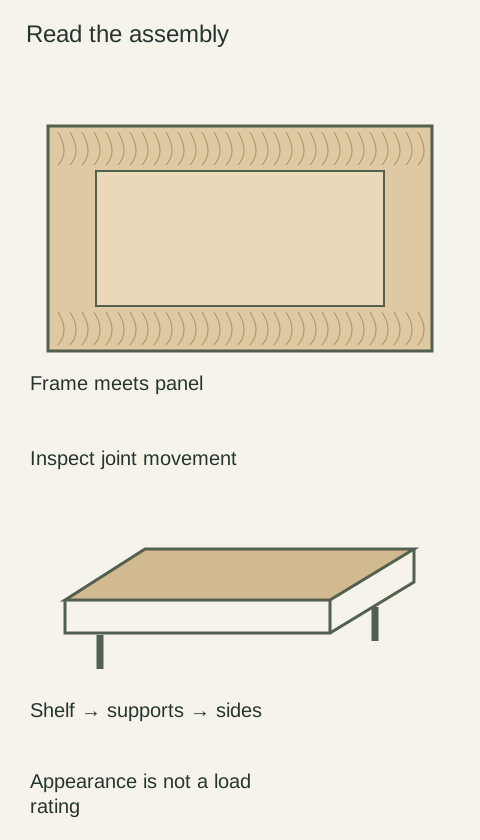
Diagram Use component identities to record condition and completeness. This reference diagram shows no actual clearance item or inspection result.
Identify the actual set being offered
Ask the seller to list the cabinet units, fronts, shelves, hardware, panels and trim included in the price. Identify props and neighboring display pieces that are excluded. A countertop, handle or decorative panel visible in the showroom may belong to a separate offer. Photograph the exact items with their labels so the purchase record does not depend on a general promotional image.
IKEA US describes As-Is products that can include discontinued, gently used and former display items, with condition information attached to individual pieces. The useful principle is item-specific disclosure, not an assumption that all clearance goods share the same history. This does not establish a usaKT clearance program or any seller's current inventory.
Inspect the front, edges and accessible interior under ordinary light, and note chips, scratches, stains or repaired areas by location. Ask to see accessible sides and backs that the display arrangement currently hides. If part of the cabinet cannot be inspected before removal, record that limitation rather than marking the entire unit as checked and undamaged.
Look for previous cutouts, drilled holes, shortened trim and modifications made for the display. Their effect depends on the intended use and actual construction. Do not assume a small cosmetic repair will address loose joints, damaged attachment areas or swelling. Ask an appropriate installer to assess concerns that affect reuse before treating them as minor touchup work in the budget.
Check operation and component completeness
With the seller's permission, open and close doors and drawers normally and observe rubbing, uneven gaps, missing catches or inconsistent movement. Ask which hardware is installed and whether all corresponding parts stay with the unit. Normal operation during a brief viewing does not establish a load rating or the long-term condition of every concealed component.
Compare the included shelves, supports, brackets and fittings with the relevant product instructions where available. Do not rely on an unlabelled bag of loose parts as proof of completeness. Identify any missing item and confirm a suitable replacement source and cost before purchase. A familiar hinge appearance does not establish that a spare from another product will fit.
Review the condition after dismantling
Ask who removes the display, whether it will travel assembled or in parts, and how its condition will be documented at handoff. Confirm that the proposed method follows the actual product's requirements. Cabinet connections, finished edges and separately fitted panels can be exposed during removal; the condition seen while installed may not describe the condition of the packed goods you receive.
Imagine a display looks complete from the front, but its fitted end panel is fastened to surrounding display construction rather than included as a reusable cabinet part. Before buying, clarify whether the panel comes with the set and whether it can be removed intact. If that remains unknown, compare a replacement-panel allowance openly rather than assuming the pictured finish will arrive ready to reuse.
Compare the usable purchase and record acceptance
Add confirmed missing-part costs, dismantling, packaging, transport and any required repair to the purchase comparison. Keep unknown work marked as unknown. Obtain the seller's written conditions for the particular item, including how disclosed condition and any post-removal difference will be handled. Do not assume the normal terms for an unopened product automatically apply to this display sale.
At collection, match the actual set against the agreed inventory and condition record, including newly visible surfaces. Record differences before proceeding through the seller's handoff process. Preserve product identities and instructions for the installer. A worthwhile clearance purchase is an understood, usable set at an understood total, not merely a large discount attached to a cabinet that cannot be completed as planned.
Pure White
Cream White
Light Warm Gray
Gray
Navy
Black
Oak Tone
Dark Walnut Tone
Design study These finish studies are design references, not a list of currently orderable colors. Screens and lighting change the appearance; compare a physical sample before choosing.See all finish options →
The sample shows the door frame, a separate center panel, the face frame and the cabinet box. Each component has its own place in this Shaker construction.
Shaker construction: door frame, center panel, face frame and cabinet box. The cutaway helps locate these parts; confirm each material in the specifications for the selected cabinet.
01 / Door frame
The Shaker door has rails and stiles around a separate center panel. The frame and center panel are different components; confirm their materials in the specifications for the selected cabinet.
02 / Face frame
The face frame surrounds the opening at the front of the cabinet box and sits behind the doors. The face frame, door frame and cabinet box are separate parts.
03 / Cabinet box
The sample exposes the cabinet sides, interior surfaces and layered edges. The image does not establish the wood species or material specification of a selected cabinet.