Before submitting a custom cabinet order, ask when cancellation stops being available and how a request must be made. Keep the answer with the product list you are accepting. A cabinet that has not shipped may already have entered a stage that restricts cancellation. If plans change after ordering, identify the exact items immediately and obtain the seller's response rather than assuming the order is stopped.
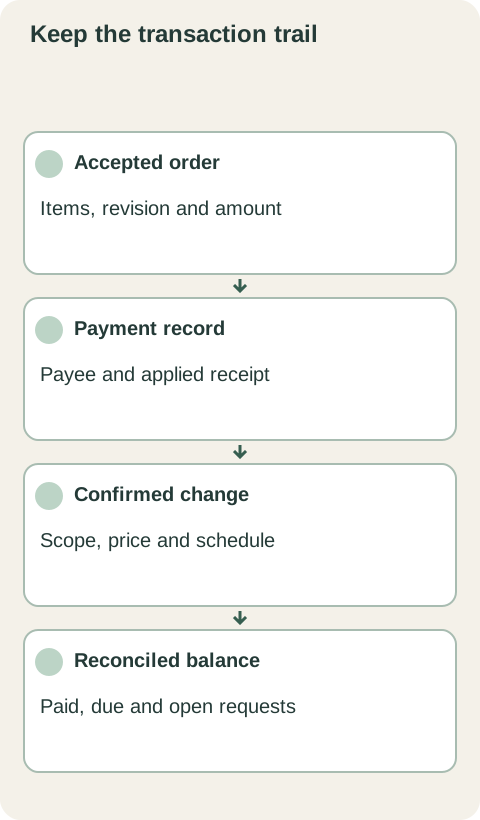
Diagram Record affected items and confirmed adjustments. The diagram gives no cancellation window, refund amount or return permission.
Identify which items are custom for this transaction
Ask the seller which items are produced or modified for your selection and which are supplied from existing stock. Standard-looking doors can still be made for a particular size or finish. A catalog photograph or familiar style name does not tell you whether the specific item can be returned to stock or offered to another buyer.
Check the order as a mixed list. A custom panel, a cabinet box and a separately sourced pull may follow different processes. Ask whether cancellation conditions apply to the whole package or to individual lines. Do not assume that the simplest accessory determines the conditions for all the cabinets, or that the word custom describes every component in exactly the same way.
Ask what event closes the cancellation opportunity
Find out whether the seller's cutoff is tied to submission, confirmation, processing, manufacturing or another specified event. Ask how you can verify the applicable status. The expected delivery date is not a substitute for that information. A long wait until arrival does not establish that nothing has been prepared or that a change remains possible throughout that period.
Barker Cabinets says its custom orders cannot be canceled after processing and batching. This is a seller-specific example of a production-related restriction, not a cancellation rule for usaKT or the industry. Obtain the actual seller's conditions for the order you are considering.
Send an unambiguous request through the stated route
If you decide to request cancellation, provide the order reference and identify whether the request concerns the entire order or named lines. State the requested action plainly. Asking how cancellation works is different from requesting that the seller cancel specified items. Follow the seller's stated communication route and preserve the message and its sending time in the order history.
Ask for confirmation of receipt and a decision on the request. If shipment or processing also needs to be stopped, ask what is possible; do not infer that a cancellation inquiry has already created a hold. Avoid placing a replacement order based only on silence or an automatic acknowledgment when you are relying on the first order being canceled.
Understand the result for products and money
Request an itemized outcome: which products are canceled, which continue and what amounts or adjustments the seller confirms. If only part of the order can be canceled, check whether remaining components still form a useful purchase. A cabinet without a required custom panel may leave an unresolved project even though some money is expected to be returned.
Imagine a buyer discovers an incorrect custom panel selection after ordering. The seller accepts cancellation of that panel but leaves the cabinet order active. The buyer needs a separate plan for the missing panel and an updated order record. Treat any refund or credit as pending until confirmed and applied; do not invent a standard processing charge or promised refund period.
Close the request without confusing it with a return
Save the seller's decision, revised order status and financial adjustment together. If cancellation is declined, record that outcome and ask what practical alternatives remain. Refusing a delivery is not a substitute for obtaining an agreed cancellation, and this guide does not establish what happens financially if a buyer does so. Work from the seller's specific response to the actual order.
Before a future purchase, resolve measurements, finish selection and required component quantities before submission, then reread the cancellation conditions for that transaction. A screenshot of the checkout terms and an identifiable accepted order make the record easier to follow. The aim is to understand the commitment before placing it and to leave any later cancellation with a definite, documented result.
Pure White
Cream White
Light Warm Gray
Gray
Navy
Black
Oak Tone
Dark Walnut Tone
Design study These finish studies are design references, not a list of currently orderable colors. Screens and lighting change the appearance; compare a physical sample before choosing.See all finish options →
The sample shows the door frame, a separate center panel, the face frame and the cabinet box. Each component has its own place in this Shaker construction.
Shaker construction: door frame, center panel, face frame and cabinet box. The cutaway helps locate these parts; confirm each material in the specifications for the selected cabinet.
01 / Door frame
The Shaker door has rails and stiles around a separate center panel. The frame and center panel are different components; confirm their materials in the specifications for the selected cabinet.
02 / Face frame
The face frame surrounds the opening at the front of the cabinet box and sits behind the doors. The face frame, door frame and cabinet box are separate parts.
03 / Cabinet box
The sample exposes the cabinet sides, interior surfaces and layered edges. The image does not establish the wood species or material specification of a selected cabinet.