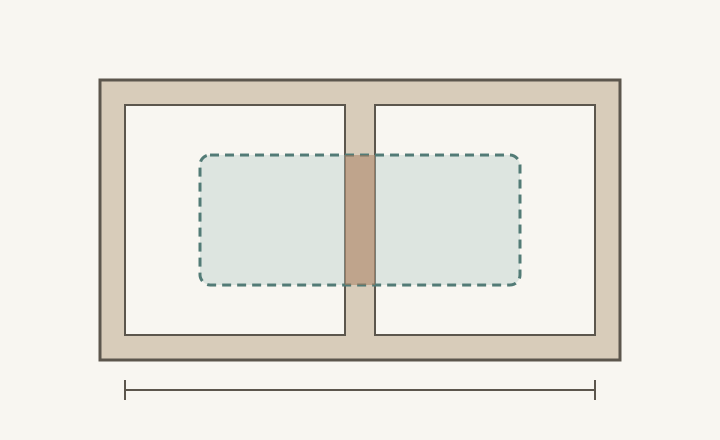
Check the center stile before assigning a wide tray or appliance to a cabinet
A continuous interior can sit behind divided openings. Identify the center member and verify the permitted construction before assuming a large item can enter or that the member can be removed.
Choose the cabinet around the opening the item can actually use, with its center member in the intended operating state. Interior shelf width does not prove that a wide tray, roasting pan or stored appliance can enter. If the plan works only after removing a piece, that removal is an unresolved product question until the cabinet maker confirms the specific construction and permitted arrangement.
Identify what stays when the doors open
Open the actual doors or obtain an unambiguous drawing of the selected cabinet. Identify a member attached to the cabinet frame separately from a strip carried by a door, a shelf divider or the meeting edges of paired doors. A closed elevation can make these arrangements look similar, although they leave different access paths when opened.
Record what is fixed, what moves with a front and what the product documentation explicitly describes as removable. A visible screw or a narrow strip is not enough to classify a part. Do not assume it is decorative, temporary or unnecessary from a photograph. If its role is unknown, retain it in the planning drawing rather than erasing it to make the item fit.
Trace entry separately from the resting position
Draw the item with handles, rim and any attached parts that remain during storage. Show the usable opening beside the center member, including the open doors and hinges. Then follow the item into its final position. A broad interior behind the frame cannot be counted as a broad entrance through the frame.
ABCD
Diagram The dashed outline represents a proposed straight entry that fails at the center member. The lower line spans the interior-side width across both openings; it does not turn them into a continuous entrance. No dimensions or construction approval are implied.
A
The center member remains in this example.
B
The proposed object is wider than the left opening.
C
Its outline crosses the center member rather than passing through the right opening.
D
A combined span cannot replace the separate usable openings.
Turning an item may be a valid alternative, but check the complete turn with the shelf, cabinet depth and other stored contents present. A thin tray may behave differently from a bulky appliance with a fixed handle. Being able to insert something into an empty cabinet once is also different from retrieving it during ordinary use without unloading the surrounding group.
Clarify what an approved removable arrangement requires
If a selected product has a documented removable member, establish when and how the manufacturer intends it to be removed and restored. Determine whether that action is part of routine access or an exceptional setup operation. The storage plan must include the actual operating state, not simply the most open photograph available.
For an existing cabinet without that confirmation, do not make cutting or detaching the member the assumed solution. Ask the maker or a qualified cabinet professional to identify the assembly and evaluate a proposed alteration. This page does not determine its structural role or authorize changes. Choosing another storage location can resolve the task without depending on an unanswered construction question.
Test a serving tray against the actual entrance
In a hypothetical kitchen, a wide serving tray lies comfortably across the shelf behind paired doors. The proposed drawing therefore labels this its home. When both doors open, a fixed center stile remains. The tray cannot enter straight, and the turning route is occupied by the bowls that must stay beside it. The shelf assignment was based on the resting position alone.
Compare storing the tray upright in a verified neighboring compartment, changing the retained bowl arrangement, or selecting a cabinet whose documented entrance suits the tray. Keep the displaced contents in the comparison. A sketch with the center stile deleted is not another verified option unless the corresponding product construction has actually been confirmed.
Save the opening and operating state with the assignment
Keep the cabinet identity, open-front drawing, center-member status and the item’s entry and return route together. Where a product-approved removable part is involved, record the applicable instructions and the agreed normal state. Recheck after changing the front or cabinet model. The useful outcome is a repeatable home for the item, with no hidden dependence on an unapproved modification.
Pure White
Cream White
Light Warm Gray
Gray
Navy
Black
Oak Tone
Dark Walnut Tone
Design study These finish studies are design references, not a list of currently orderable colors. Screens and lighting change the appearance; compare a physical sample before choosing.See all finish options →
A note saying left or right is incomplete without a viewpoint. Mark the hinges, handle and intended standing position on the same cabinet, then verify the selected opening arrangement.
A drawer-shaped panel below the sink does not promise a drawer. Compare a fixed front with a compatible tip-out by the items it would hold, the complete mechanism and the routine for taking them out and putting them back.
The sample shows the door frame, a separate center panel, the face frame and the cabinet box. Each component has its own place in this Shaker construction.
Shaker construction: door frame, center panel, face frame and cabinet box. The cutaway helps locate these parts; confirm each material in the specifications for the selected cabinet.
01 / Door frame
The Shaker door has rails and stiles around a separate center panel. The frame and center panel are different components; confirm their materials in the specifications for the selected cabinet.
02 / Face frame
The face frame surrounds the opening at the front of the cabinet box and sits behind the doors. The face frame, door frame and cabinet box are separate parts.
03 / Cabinet box
The sample exposes the cabinet sides, interior surfaces and layered edges. The image does not establish the wood species or material specification of a selected cabinet.