Before ordering cabinets to meet a promotion deadline, determine exactly what must happen by that deadline and whether your selected products are ready for acceptance. Saving a cart, receiving a quote, making a payment and having an order accepted are different events. A discounted package is still a specific purchase; the offer does not resolve uncertain measurements, unfinished finish choices or missing components for you.
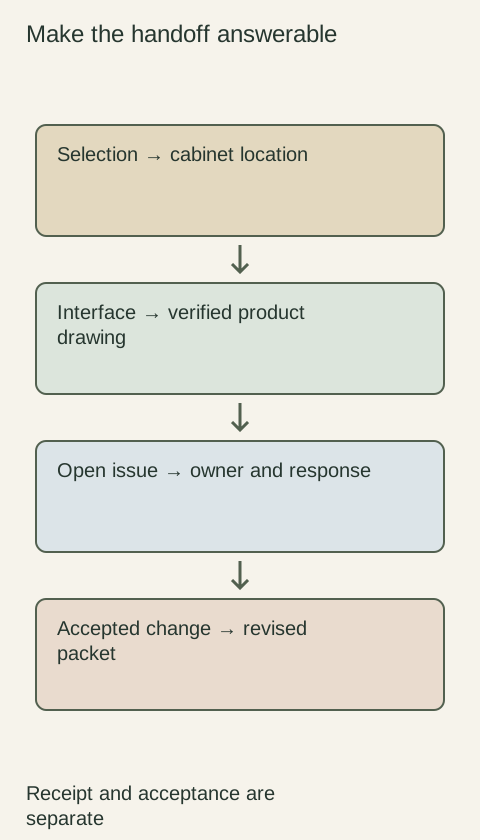
Diagram Use the specification record to identify unresolved choices. The diagram does not advertise a promotion or reserve a price.
Identify the action that qualifies
Read the offer's actual instructions and ask the seller which event establishes qualification. Is the relevant action submitting a complete order, having it accepted, completing a purchase or filing a later claim? Confirm the applicable deadline and time zone when timing is material. Do not treat a countdown banner as a complete explanation of the transaction that must occur.
KraftMaid's sample-rebate instructions distinguish qualifying purchases, required documentation and claim-submission timing. That manufacturer example shows why an offer can involve more than a purchase date; it is not a cabinet discount or rebate promised by usaKT. Use the conditions of the offer actually being considered.
A quote can show a promotional amount while the order still contains unconfirmed selections. Identify the exact product series, door style, finish, quantities and required finishing pieces. Ask whether dimensions and any necessary field information have been accepted by the responsible people. Do not submit a guessed item merely to make the list look complete before the offer expires.
Check the choices that can affect several lines at once. An undecided finish may leave doors, end panels and trim unresolved. A missing hardware decision may affect preparation. Record these as open product decisions, not small administrative tasks. An order is ready when the selected content is clear enough for the seller to supply the intended package under its actual process.
Calculate the offer on the final eligible scope
Ask the seller to apply the offer to the actual selected list, identifying exclusions and conditions. A headline discount may not apply to every component or service. Compare the net amount for the completed scope and show any later rebate separately from a reduction already applied. Keep required but unpriced work visible rather than assuming the promotion covers it.
If you change the list to meet a qualifying condition, examine whether the added products are genuinely needed for the project. Ask how substitutions, later additions or deletion of an item affect eligibility. Do not assume that a saved promotional quote protects every later revision. The useful figure is the accepted net amount for what you intend to buy, with its remaining conditions disclosed.
Test the deadline against an unresolved decision
Imagine the buyer has approved the door profile but has not seen the chosen finish beside a fixed stone surface. Ordering a custom color simply to meet the promotion could leave an appearance decision unresolved at commitment. Ask whether the seller offers a documented way to preserve pricing while finishing the selection, and whether that arrangement changes release or cancellation conditions.
If no such arrangement is offered, compare proceeding with the current confirmed selection against waiting until the choice is resolved. Do not invent the price of a future sale or assume another promotion will appear. The question is whether the present order is an acceptable purchase on its own, not whether a countdown makes an incomplete choice feel urgent enough to approve.
Verify qualification after submission
If you proceed, retain the offer version, accepted product list and the seller's confirmation showing how the benefit applies. Check that the qualifying event actually occurred through the stated process. A draft quote or a message saying the request was received may not be the confirmation the offer requires. Ask for clarification if the status is unclear rather than recording the benefit as secured.
Where a later claim is required, keep the needed receipts and assign responsibility for submission and follow-up. After any order revision, reconfirm its effect on the offer before comparing the new amount with the old one. This leaves a defensible buying decision: a ready product order, a known qualifying event and a benefit recorded according to its actual conditions.
Pure White
Cream White
Light Warm Gray
Gray
Navy
Black
Oak Tone
Dark Walnut Tone
Design study These finish studies are design references, not a list of currently orderable colors. Screens and lighting change the appearance; compare a physical sample before choosing.See all finish options →
The sample shows the door frame, a separate center panel, the face frame and the cabinet box. Each component has its own place in this Shaker construction.
Shaker construction: door frame, center panel, face frame and cabinet box. The cutaway helps locate these parts; confirm each material in the specifications for the selected cabinet.
01 / Door frame
The Shaker door has rails and stiles around a separate center panel. The frame and center panel are different components; confirm their materials in the specifications for the selected cabinet.
02 / Face frame
The face frame surrounds the opening at the front of the cabinet box and sits behind the doors. The face frame, door frame and cabinet box are separate parts.
03 / Cabinet box
The sample exposes the cabinet sides, interior surfaces and layered edges. The image does not establish the wood species or material specification of a selected cabinet.