Buying cabinets yourself can give you control over selections and the order. It also puts coordination in your hands. Before comparing a direct purchase with a contractor-supplied package, decide who will verify the room, translate the drawing into cabinet items, receive the shipment and resolve missing pieces. A low cabinet subtotal does not answer those questions. A complete purchasing brief does.
Start with the work you are actually buying
Describe whether you are replacing cabinets within the existing layout or changing the room. Mark appliances and plumbing that will remain, and identify unfinished decisions. KraftMaid’s project-scope guide separates replacement from larger renovation work; use that distinction to explain your own project. Cabinets, installation and countertop work need separate scope lines. Listing a countertop in a project brief does not mean the cabinet seller supplies it. Keep a running list of work that still needs a price or an assigned person.
The word direct describes a sales arrangement, not a material specification or a guaranteed discount. Read who issues the quote, receives payment and supplies replacement parts. Then identify the cabinet line, door style, finish, construction and assembly condition. Manufacturer purchasing arrangements differ. KraftMaid’s own FAQ, for example, explains its retailer-based cabinet ordering; that model does not establish how another seller operates. For usaKT.com, use the written quote for the actual order rather than assuming factory pricing, a showroom visit or a design-service entitlement.
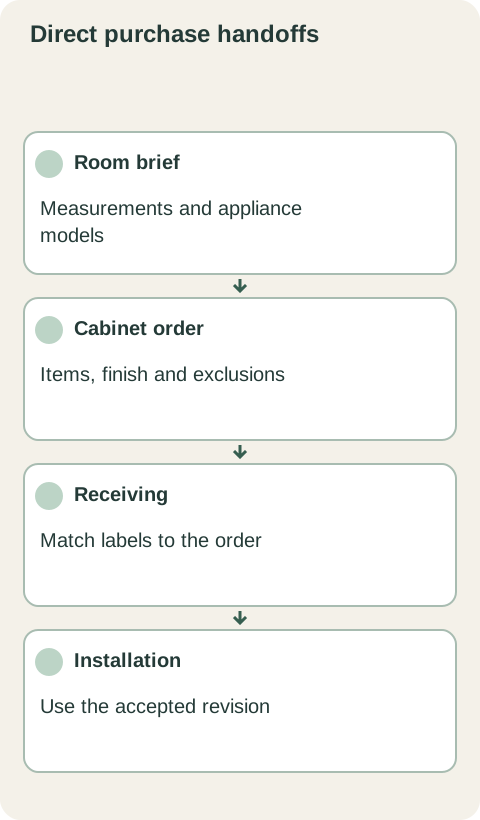
Diagram A purchasing workflow: each handoff needs an owner and a written record.
Build an order that an installer can check
Send a dimensioned room sketch, appliance model information and photos labeled by wall. A cabinet list should connect each item to a location on the drawing. Include finished ends, fillers, toe kicks, moldings, handles and interior accessories. Have the installer review the plan before release, especially wall conditions, corner openings and appliance interfaces. Receiving guidance from KraftMaid emphasizes inspecting the delivered order; a complete list makes that inspection useful. A rendering alone cannot show whether the needed end panel was purchased.
Write the names or roles responsible for final field measurements, order approval, assembly, delivery receiving and installation. If you purchase the cabinets while a contractor installs them, agree on what the contractor needs before accepting the work. That may include current product drawings and the fastening instructions for the selected system. Record substitutions as changes to the cabinet list. A verbal agreement about a wider drawer cabinet is easy to lose when several people are working from different images.
Compare the whole package and the workload
Request the destination ZIP code and receiving conditions be included in the delivery discussion. Separate freight from unloading, inside carry and installation; nationwide delivery does not define those services or their charges. Add any paid design, assembly or site work to your comparison only when it has been quoted. Leave unresolved amounts visible. A contractor-supplied alternative may include coordination you would otherwise perform, while a self-purchased order may suit an owner who already has an installer and a settled plan.
Release an order you can trace later
Reconcile the accepted quote with the latest drawing and item list before payment or release. Save the finish identification, approved substitutions, exclusions, payment schedule and receiving procedure together. Ask how later requests for a missing panel or a damaged front should identify the original order. Once delivery arrives, compare labels and contents with that record before the installation sequence depends on them. The useful outcome is an order file that another person can read without reconstructing the purchase from scattered messages.
Prepare the installer’s acceptance packet
Before committing, give the proposed installer the exact cabinet list, product instructions and photographs of the receiving route. Ask them to mark any item that cannot yet be priced or fitted from the supplied information. Bring those questions back into the order rather than leaving them in a separate conversation. If you will assemble the cabinets yourself, confirm that the chosen product arrives in the expected form and that you can identify its components. Then decide which tasks you will do and which require an agreed service. This turns owner purchasing into a practical work plan.
Before you release the order
Name the person who verifies the room and approves the cabinet list.
Identify finishes, accessories and exposed ends by item.
Save the accepted scope and receiving procedure with the quote.
Compare coordination and installation separately from the cabinet subtotal.
Finish references
Pure White
Cream White
Light Warm Gray
Gray
Navy
Black
Oak Tone
Dark Walnut Tone
Design study These finish studies are design references, not a list of currently orderable colors. Screens and lighting change the appearance; compare a physical sample before choosing.See all finish options →
Choose the service that covers the decisions your remodel actually needs. Compare product choices, room coordination, drawings and compensation before paying for overlapping work.
A microwave on a table is not a complete meal arrangement. Decide what you will prepare, where the supplies will live and how cleanup works before the old kitchen is removed.
A smaller first order is useful only if it leaves a finished, usable kitchen and does not force expensive work to be repeated. Separate genuinely independent additions from connected cabinet and countertop work.
The sample shows the door frame, a separate center panel, the face frame and the cabinet box. Each component has its own place in this Shaker construction.
Shaker construction: door frame, center panel, face frame and cabinet box. The cutaway helps locate these parts; confirm each material in the specifications for the selected cabinet.
01 / Door frame
The Shaker door has rails and stiles around a separate center panel. The frame and center panel are different components; confirm their materials in the specifications for the selected cabinet.
02 / Face frame
The face frame surrounds the opening at the front of the cabinet box and sits behind the doors. The face frame, door frame and cabinet box are separate parts.
03 / Cabinet box
The sample exposes the cabinet sides, interior surfaces and layered edges. The image does not establish the wood species or material specification of a selected cabinet.