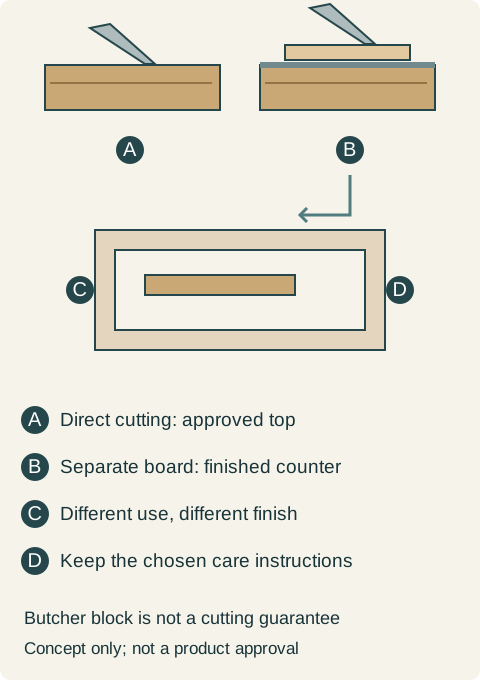
The words butcher block do not tell you whether a countertop is intended to be cut on directly. A wood counter may be selected as a working cutting surface or as a finished piece of kitchen furniture. The finish and the manufacturer's stated use decide which route is appropriate; the block-like appearance alone does not.
Pick the use before the finish
John Boos distinguishes an oil-finished top intended for cutting from its Varnique option for a furniture-like surface that is not used for direct chopping. Its guidance also calls for periodic oil care on the cutting option. That is a named manufacturer's distinction, not permission to cut on any wood top treated with something called oil.
The current Maple Full Length Edge Grain Countertop page makes the noncutting boundary explicit for the Varnique-finished product. This is why a product title or a photograph of thick hardwood is not enough to establish its working use.
Ask for the finish identity and direct-cutting statement for the exact top being quoted. A showroom may display similar wood in both types. Matching the species and color while changing the finish can change the permitted routine. Keep that choice in the order instead of leaving it as a last-minute aesthetic selection.
The decision also affects what will sit on the counter. With a noncutting top, the separate cutting board is a working item that needs a usable location and storage. With a top approved for direct cutting, the household accepts the specified care and the appearance of a used cutting surface. Neither route eliminates the need to follow the selected product's instructions.
Walk through a real preparation task
Imagine a household that wants a wood island mainly for serving meals, doing homework and setting out groceries. Food preparation happens at a separate work area, and the family already uses a removable cutting board. It chooses the furniture-like finish and keeps direct cutting off the island. Buying a cutting-oriented top would not add a function the family needs there.
Now consider a cook who wants the island itself to be the cutting station. The proposed quote supplies the noncutting finished version because its photograph looks similar. The cook rejects that substitution and asks for the manufacturer's direct-cutting option with its care instructions. A loose bottle of oil added to the delivery does not convert the quoted finished product into the correct one.
Do not resolve the disagreement by promising to sand off the finish later. That would change the supplied component and its treatment. If the intended use is already known, buy the appropriate top rather than planning an unapproved conversion after installation.
Teaching example Two use concepts: direct cutting on a top specifically approved for it, or cutting on a separate board above a noncutting finished top. The drawing does not identify an approved coating or installation detail.
Include the removable board in the cabinet plan
For the furniture-like route, place the intended board on the proposed work area before finalizing nearby storage. Confirm that the board can be put away conveniently and taken out without moving everyday cookware. A board that is awkward to retrieve is more likely to stay permanently on the counter, changing the appearance that motivated the finish choice.
Also consider the return trip after use. The storage location must suit the board's own care instructions rather than assuming a freshly washed board can immediately be enclosed anywhere. This is a layout question; the countertop article does not replace cleaning or drying instructions for the board.
If the island combines preparation and seating, mark which surface the cook will actually use. A wood appearance extending across the whole island does not mean every area has the same finish or working permission. Any mixed treatment should be expressly specified and approved as a complete top, not improvised by treating adjacent patches differently.
Compare completed tops, not just the wood species
The quote should identify construction, finish, finished edges and intended use together. Clarify whether cutouts and the attachment arrangement are included in the supplied design. A finish suitable for the chosen routine does not itself establish that the top can bridge an unsupported seating area or be attached by any convenient method.
Keep the current care instructions with the final product selection. Do not copy a universal oiling interval or infer that a furniture-like finish can never be damaged. The useful result is a top whose working role matches the household: either an approved cutting surface with its care routine, or a finished counter used with a separate board.
Pure White
Cream White
Light Warm Gray
Gray
Navy
Black
Oak Tone
Dark Walnut Tone
Design study These finish studies are design references, not a list of currently orderable colors. Screens and lighting change the appearance; compare a physical sample before choosing.See all finish options →
A patterned surface and a patterned slab body are different features. Compare an actual cut edge and sink opening before choosing the fabrication detail.
The sample shows the door frame, a separate center panel, the face frame and the cabinet box. Each component has its own place in this Shaker construction.
Shaker construction: door frame, center panel, face frame and cabinet box. The cutaway helps locate these parts; confirm each material in the specifications for the selected cabinet.
01 / Door frame
The Shaker door has rails and stiles around a separate center panel. The frame and center panel are different components; confirm their materials in the specifications for the selected cabinet.
02 / Face frame
The face frame surrounds the opening at the front of the cabinet box and sits behind the doors. The face frame, door frame and cabinet box are separate parts.
03 / Cabinet box
The sample exposes the cabinet sides, interior surfaces and layered edges. The image does not establish the wood species or material specification of a selected cabinet.