Kitchen banquette: built-in cabinet bench or upholstered furniture?
Decide whether the breakfast nook needs fitted cabinetry or a complete furniture seat. Compare the occupied table, upholstery, useful storage and future changes before adding a bench to the cabinet order.
Choose a built-in cabinet banquette when its fitted shape, coordinated woodwork and genuinely useful storage justify a fixed installation. Choose an upholstered furniture bench when a complete seat suits the table and the household prefers furniture that can be replaced or rearranged without rebuilding the surrounding cabinetry. Neither choice is automatically more comfortable or more economical. The comparison is between completed dining places, not an empty cabinet box and a photograph of a furnished nook.
Begin with the table you intend to keep or buy. Set out its base, the bench occupants and any chairs opposite. A banquette can look compact because there are no chair backs to pull away from one wall, yet people still need a practical way to enter, leave and reach the table. A long bench does not promise independent access to every seat. Ask the people who will use it to try the arrangement.
A fitted cabinet bench has a separate seating brief
A cabinet maker can coordinate a bench with nearby door profiles, end panels and base details. That visual continuity is valuable in a small kitchen where the nook is always visible. But the box must be specified as part of an assembly intended for sitting. A spare wall cabinet turned on its side is not an established seating design. Have the maker resolve its support, attachment and intended use.
Decide whether the seating surface will remain wood, receive loose cushions or be upholstered as part of the finished assembly. Include that choice before finalizing the cabinet dimensions. A back cushion moves the sitter forward; a seat cushion changes the sitting surface. Judging the bare box and adding padding later can leave a different relationship to the table than the one approved.
Ballard's custom banquette cushion document describes separately made cushions for its named banquettes or a similarly sized bench. This is a distinct purchase from a complete upholstered seat. It illustrates why the proposed cushion and the actual supporting bench must be considered together.
Do not equate separate cushions with machine-washable covers. Ask how the selected fabric, cover, filling and bench finish are meant to be cleaned. If covers can be removed, establish their permitted care method and how they go back on. If a cushion cannot be removed, include access to seams and the back edge in the cleaning trial.
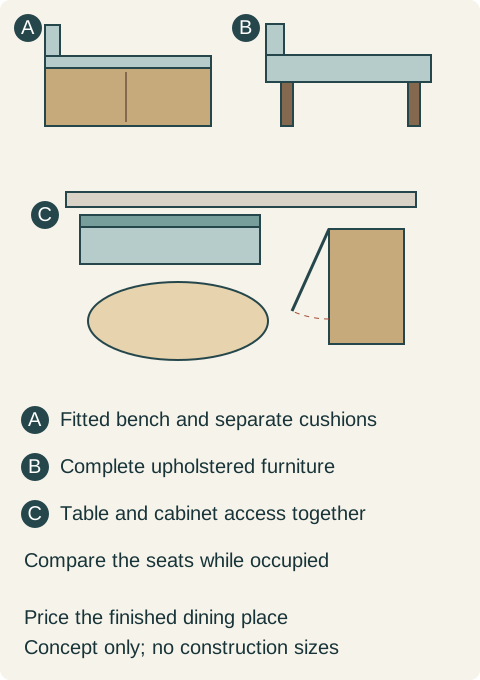
Teaching example Conceptual alternatives: A is a fitted cabinet bench with separate cushions; B is an upholstered furniture bench with its own legs; C keeps the table and nearby cabinet opening in the same room plan. These are purchase types, not construction or clearance drawings.
A furniture banquette comes with its own frame and upholstery
Room & Board's Ava description lists a hardwood frame with webbing suspension and a tight seat and back. It also offers separate pieces for combining a dining nook. This named example shows why an upholstered banquette is not simply a cushion placed on a storage cabinet.
Inspect the complete furniture dimensions and construction. Its back may stand forward of the wall because of its shape, baseboard or the selected placement. Its legs and upholstered edges can occupy space that a drawing of the nominal seat misses. Compare the actual assembly rather than assuming furniture will fit the exact outline of a fitted cabinet proposal.
Check what combining pieces means for the selected product: which ends are finished, how a corner is formed and whether the maker supplies any connections. The word modular does not mean arbitrary pieces can be mixed securely or reconfigured in every direction. If rearrangement is a reason for buying it, show the specific second arrangement that the components can actually form.
Look at the visible back if the furniture may move away from the wall. Evaluate the table and floor relationship in that alternate position too. Being movable does not make a heavy bench convenient to shift every evening; use the handling method intended for the furniture and keep routine plans realistic.
Count only storage that improves the dining routine
A fitted bench may provide storage, but the dining layout determines when it is accessible. Check a proposed drawer or lid with the actual table and cushions. If spare linens go there between meals, that can be useful. If someone must stand up whenever the family needs napkins, nearby cabinet storage may serve the same objects better.
Do not reject a furniture bench solely because it lacks storage below the seat. First name what would need a new home. An adjacent cabinet with suitable available space can make the missing compartment unimportant. Equally, if the household has a clear shortage that a well-designed bench resolves, do not discard that benefit just to obtain a softer-looking elevation.
Keep nearby cabinet access in the meal trial. Test the door or drawer normally used during dinner with the bench occupied and the table in place. The seating purchase should not make a previously useful cabinet inconvenient. Changing bench type will not solve an access problem caused by an oversized table occupying the same route.
A household buys furniture and leaves the cabinet order smaller
In a hypothetical remodel, the owners want an upholstered breakfast nook beside a new kitchen. The initial cabinet proposal includes a fitted bench with storage below. A trial shows that their serving linens already fit in a nearby dining cabinet, while the proposed under-seat compartments would be awkward to use around the retained table. They do not have other contents that need those compartments.
They compare a complete furniture banquette at the same table, including its back, legs and upholstery. The selected arrangement works for their normal meals, and the specified pieces can also form the alternative arrangement they want when they change the dining area. After confirming the finished exposed sides and the manufacturer's assembly requirements, they choose the furniture option and remove the fitted bench from the cabinet order.
Their purchase includes the actual fabric and care information, not a promise that any light-colored performance fabric will behave alike. They accept losing under-seat storage because it had no important assignment. The adjacent cabinet remains the place for table linens, and its opening is checked with the new seating occupied.
Compare complete orders before choosing
For fitted cabinetry, include the seating assembly, visible ends, installation, cushions or upholstery and any storage fittings you actually intend to use. For furniture, include all required pieces, the selected covering, delivery and assembly where applicable. Compare those scopes with the same table and daily use; neither bare component price settles the decision.
Keep a record of the selected upholstery, cushion construction and care instructions alongside the cabinet finish information. They may belong to different makers and need different treatment. A future re-covering or furniture replacement should not require guessing how the original seat was specified. The best choice leaves the household with a place it wants to sit, not merely another cabinet volume.
Pure White
Cream White
Light Warm Gray
Gray
Navy
Black
Oak Tone
Dark Walnut Tone
Design study These finish studies are design references, not a list of currently orderable colors. Screens and lighting change the appearance; compare a physical sample before choosing.See all finish options →
Storage under a dining bench is useful only when its opening can operate around the table, cushions and people. Choose the access method before assigning daily dishes to it.
A dining table and a cabinet island use the middle of the kitchen differently. Compare ordinary meals, preparation, chairs, storage and complete purchase scope before giving the space to either.
A coordinated table does not have to copy a cabinet door. Agree on the shared wood character and details while giving the table its own chair, support and finishing requirements.
The sample shows the door frame, a separate center panel, the face frame and the cabinet box. Each component has its own place in this Shaker construction.
Shaker construction: door frame, center panel, face frame and cabinet box. The cutaway helps locate these parts; confirm each material in the specifications for the selected cabinet.
01 / Door frame
The Shaker door has rails and stiles around a separate center panel. The frame and center panel are different components; confirm their materials in the specifications for the selected cabinet.
02 / Face frame
The face frame surrounds the opening at the front of the cabinet box and sits behind the doors. The face frame, door frame and cabinet box are separate parts.
03 / Cabinet box
The sample exposes the cabinet sides, interior surfaces and layered edges. The image does not establish the wood species or material specification of a selected cabinet.