

Buying cabinets
Bottom freezer or top freezer: which daily storage should be easiest to reach?
Choose the compartment arrangement with the actual fresh and frozen loads, then compare door use, landing space and the complete cabinet surround. Neither format is a universal upgrade.
Choose which repeated retrieval belongs lower
Choose a bottom-freezer refrigerator when the accepted higher fresh-food arrangement improves the household’s repeated tasks enough to accept the actual lower freezer use. Choose a top-freezer model when its upper frozen storage and lower fresh-food organization work better for the family, or when that complete candidate offers the preferred fit and cost. The decision should follow the food and the people, rather than a claim that one layout is inherently more modern.
List the fresh and frozen items retrieved repeatedly, plus the largest occasional containers that matter. Separate frequency from difficulty. A light item retrieved often and a large container retrieved occasionally create different tasks. Do not let a simple count of door openings stand in for the actual handling.
The format describes location, not every operating detail
Whirlpool defines the two formats by the vertical location of fresh and frozen compartments. It also identifies lower-freezer versions with door or drawer access. Bottom freezer does not uniquely describe the opening action.
Reading note: Whirlpool — Top Freezer vs. Bottom Freezer Refrigerators, configuration definitions.
Check the exact candidate. For a drawer, follow the contents from the accessible upper layer to the bottom area. For a door, inspect its shelves and the way you reach the interior. Do not assume that looking down into a drawer guarantees that every package can leave without moving something else.
The fresh compartment needs the same scrutiny. Place representations of ordinary covered leftovers, produce containers and tall bottles on the intended shelves. A higher compartment does not make every shelf equally convenient. The particular drawer and door-bin arrangement may matter more than the category label.
Test a mixed food task, not an empty reach
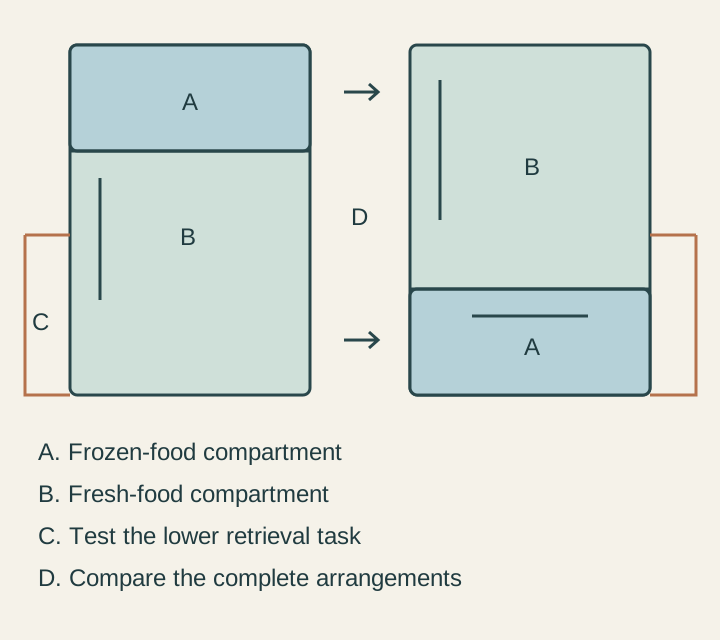
Rehearse retrieving the items used in one ordinary meal and putting away a mixed grocery load. Use empty representative containers for movement and fit. If assessing a filled load, keep the trial cold, stable and within the person’s accepted ability; the empty test alone does not establish loaded handling.
Follow both compartments through the task. Someone may strongly prefer daily fresh-food access while accepting an occasional lower freezer lift. Another household may use frozen ingredients throughout the day and prefer them above. Neither preference should be inferred from age or a general household description. Let the intended people perform the actual sequence.
Include internal visibility. Can the user identify the needed package, reach it and return the items moved to retrieve it? If the accepted plan depends on a removable basket or particular shelf spacing, keep that configuration with the purchase rather than assuming all interiors of that format behave alike.
Buy a surround that works with the doors
Put both appliance candidates into the same room plan with their documented installation spaces, actual handles and opening movements. Show the neighboring pantry, side panel, upper cabinet and landing counter. Matching advertised widths do not establish matching body depth, height or door clearance.
A top-freezer proposal needs its real hinge arrangement and supported opening. A lower drawer needs room for extension and the person approaching its contents. Reversing a door is an available option only where the exact model supports it; do not use a hypothetical reversal to make an otherwise conflicting cabinet plan look viable.
Check removal of the prescribed shelves or bins for ordinary care as well as daily food access. A door that opens enough to retrieve a carton may not provide the movement required for a larger internal component. Preserve the accepted access in the surrounding cabinet drawing rather than resolving it later by trimming an already ordered panel.
The landing counter connects both compartments
Identify where groceries wait and where retrieved food is set down. Keep the actual open door or drawer present while tracing the route. A nearby counter can be on the inconvenient side of an open leaf, and a wide freezer drawer may occupy the standing position someone assumed would remain clear.
Avoid giving each separate test an empty counter if real cooking leaves it occupied. Show a practical sequence for a grocery bag, the containers being put away and food already taken out. Moving the refrigerator to improve this connection may alter the pantry and preparation run; include that room change in the price.
The cabinet above the refrigerator also deserves a job. If one candidate changes its usable height or access, reassign the actual contents rather than treating the space as decorative filler. Food-storage preference should be evaluated together with the storage the rest of the kitchen gives up.
Compare complete prices without category assumptions
Price the accepted appliance, required accessories, delivery, connection work and different cabinet or counter work. Use current identified offers. A general statement about which category costs less cannot settle two actual proposals with different equipment and construction.
Likewise, do not assign a universal energy, reliability or maintenance advantage from the compartment position. Review any documented product information you intend to use for the exact candidates. The value comparison here concerns the household task and finished kitchen; it is not a prediction of future repair costs.
Imagine a hypothetical household that retrieves fresh ingredients repeatedly but uses a small frozen reserve only occasionally. Its bottom-freezer candidate passes the actual freezer-container trial, while the higher fresh compartment improves the ordinary meal sequence. The revised surround preserves the neighboring pantry and useful landing counter. The owners accept the complete quoted cost and choose that arrangement.
A family with frequent frozen-food use could choose the top-freezer candidate after the same review. Keep the model, interior configuration, door arrangement and cabinet boundaries together in the approval. The right vertical allocation is the one whose less convenient tasks remain acceptable while its repeated benefit is genuinely used.
Sources & further reading
- Whirlpool — Top Freezer vs. Bottom Freezer Refrigerators, configuration definitions