Bosch AutoAir or CrystalDry: choose a dishwasher around the end of the meal
Automatic door release and mineral-assisted drying change different parts of dishwasher use. Compare the actual load, the end-of-cycle kitchen and the complete appliance before paying for a drying feature.
Consider Bosch AutoAir when automatic door release fits the kitchen after a cycle and the resulting routine suits your dishes and unloading schedule. Consider a CrystalDry-equipped candidate when its mineral-assisted drying addresses a meaningful need in the household's normal load. Buy the complete dishwasher that works for that load and room. A drying name alone cannot establish rack fit, cabinet compatibility or how every container will emerge.
Start with what causes trouble now. Are ordinary plates ready to put away, while a particular group of lunch containers needs attention? Does the dishwasher finish while people are still walking through the kitchen? Is the machine emptied soon afterward or left until morning? Those are different problems. Identifying the recurring one makes a showroom comparison more useful than asking which technology has the larger advertising percentage.
AutoAir changes the door state at the end
Bosch describes AutoAir as automatically releasing the door at the end of the drying cycle so fresh air can enter. It is an appliance-controlled step, not a direction to open the machine yourself during a running cycle.
That released position belongs in the kitchen review. Ask to see how the selected model behaves and represent that position in the actual room. It is different from a fully lowered door for loading, but it is also different from the closed front shown in a cabinet elevation. Include nearby doors, ordinary walking and the cabinet normally used at that time.
Do not invent a shared opening distance from a photograph. The selected appliance, installation and permitted settings control the behavior. If automatic opening is central to the purchase, understand when the feature operates with the intended cycle and what the applicable instructions allow. Do not assume that every program or every similarly numbered model behaves alike.
Keep the surrounding installation as specified. A drying feature is not permission to omit required protection or disregard the cabinetry conditions in the installation instructions. Equally, the existence of an opening step is not evidence that properly installed AutoAir machines necessarily damage cabinets. Resolve the real arrangement rather than treating a general fear or a promotional assurance as the entire decision.
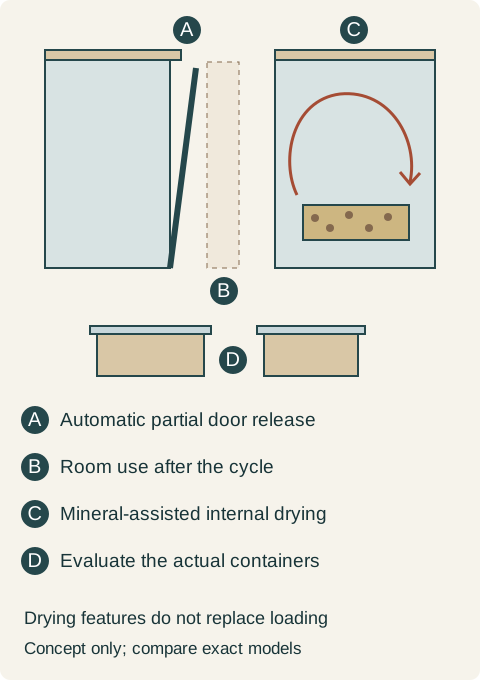
Teaching example Conceptual comparison of functions, not product internals or installation dimensions. A represents a door released partly open for AutoAir; B marks the room space that must remain suitable in that state. C represents mineral-assisted drying inside the appliance and D represents the actual containers being evaluated. The closed outline around C locates the internal process; it does not assert the door behavior of every model with mineral drying. No arrow specifies an actual vent position.
CrystalDry works on moisture inside the appliance
Bosch describes CrystalDry as using natural minerals to collect moisture and release heat, with heated air circulating within the tub. Its stated purpose includes drying plastics; that description does not promise identical results for every material or container shape.
This is a different mechanism from the AutoAir door-release step. Do not turn that distinction into an unsupported rule about every appliance sold with mineral drying. Check the selected candidate's own door behavior, cycles and settings. Technology names can identify the drying process without specifying every feature bundled into a particular machine.
The cited Bosch use manual tells users not to obstruct the mineral container's intake or outlet with dishware. It also identifies water trapped in recesses as a cause of wet items. Those limitations belong in a realistic loading trial.
An internal drying system does not make an upside-down rim disappear. Look at the shapes that retain water, the permitted orientation and how the whole load sits together. If a container can only fit by obstructing an area the manual says to keep clear, that is not a successful arrangement. Moving one troublesome item must not create a new problem for the plates or utensils beside it.
Compare dishes at the point when you normally put them away
Bring representative, dishwasher-suitable containers, lids, plates and glasses to the purchase discussion. Confirm their care requirements instead of assuming that every plastic piece belongs in either machine. Use the relevant loading guidance and include the normal quantity of dishes. A demonstration with a few isolated items cannot settle how the household's daily group will work.
Distinguish visible pooled water from a surface that needs more drying. These observations help describe the problem without diagnosing an appliance from a showroom photograph. Ask what demonstration or documented product information supports the proposed benefit for that kind of load. A claim about a mixed test load is not a guarantee for a specific recessed lid.
Compare the intended cycle and unloading point consistently. An item inspected immediately after one program and another inspected much later do not provide a fair basis for choosing the appliance. This guide sets no universal waiting time. The useful comparison follows the selected machines' instructions and the household's actual routine.
Also decide what happens to any items that still need attention. If the family accepts leaving a small group on a suitable drying area, that space belongs in the kitchen plan. If clearing that area is the reason for buying a new dishwasher, the proposed machine should be evaluated against that goal rather than accompanied by the same unresolved counter clutter.
One household keeps automatic opening in the purchase
In a hypothetical kitchen, the family runs its regular load after the last meal and empties it the following morning. Its everyday dishes are mostly plates, bowls and glasses, with a small group of dishwasher-suitable containers. The current annoyance is remembering an extra end-of-cycle action, rather than a need to fit more dishes or store a large collection of plastic lunch boxes.
The owners compare complete AutoAir and CrystalDry candidates using a permitted arrangement of their representative dishes. Both accommodate the same load. For the AutoAir proposal, the actual released-door position also works in the room: the neighboring cabinet still opens, and ordinary passage does not depend on someone closing the dishwasher immediately.
The family chooses the AutoAir-equipped machine. It accepts the automatic partly open state and keeps a small existing drying place for an occasional recessed lid that still needs attention. The complete CrystalDry proposal costs more in this hypothetical purchase, and its additional drying mechanism does not solve a recurring task important enough to justify that difference for these owners.
This choice does not claim AutoAir performs as well on every material or that CrystalDry lacks value. It states what was bought and what compromise remains. If the household instead relied on a large daily group of containers that had to be put away promptly, the comparison would need to focus on that different load and the supported results for it.
Do not lose the rest of the dishwasher while buying a feature
Compare the supplied racks, utensil arrangement, controls and permitted load as part of the actual candidates. A drying upgrade that removes a useful rack arrangement may create more work than it saves. Conversely, another model may be preferred for both its drying system and its loading layout. Record both benefits rather than assigning the entire difference to the drying label.
The front treatment also needs to remain correct for the chosen machine. A preferred cabinet panel, handle or finish may narrow the candidates, and switching models can reopen the installation review. Do not transfer a front or assume the old opening arrangement works merely because both products are described as built-in dishwashers.
Complete the purchase with a known end-of-cycle door state, a workable daily load and a realistic destination for the items being unloaded. AutoAir and CrystalDry then become understandable choices within a kitchen routine, rather than promises that a single feature will eliminate every drop of water or every handling step.
Pure White
Cream White
Light Warm Gray
Gray
Navy
Black
Oak Tone
Dark Walnut Tone
Design study These finish studies are design references, not a list of currently orderable colors. Screens and lighting change the appearance; compare a physical sample before choosing.See all finish options →
A top cutlery tray can free part of the lower rack, but the complete arrangement still has to fit glasses, plates and cookware together. Compare actual rack configurations before paying for an extra layer.
Coordinate the cabinet grid with the actual appliance, panel and hinge arrangement. A closed front can look correct while its lower edge meets the toe kick during opening.
The closest cabinet is useful only if it can be reached and opened while unloading. Map the actual clean-dish destinations with the appliance door and racks in use.
The sample shows the door frame, a separate center panel, the face frame and the cabinet box. Each component has its own place in this Shaker construction.
Shaker construction: door frame, center panel, face frame and cabinet box. The cutaway helps locate these parts; confirm each material in the specifications for the selected cabinet.
01 / Door frame
The Shaker door has rails and stiles around a separate center panel. The frame and center panel are different components; confirm their materials in the specifications for the selected cabinet.
02 / Face frame
The face frame surrounds the opening at the front of the cabinet box and sits behind the doors. The face frame, door frame and cabinet box are separate parts.
03 / Cabinet box
The sample exposes the cabinet sides, interior surfaces and layered edges. The image does not establish the wood species or material specification of a selected cabinet.