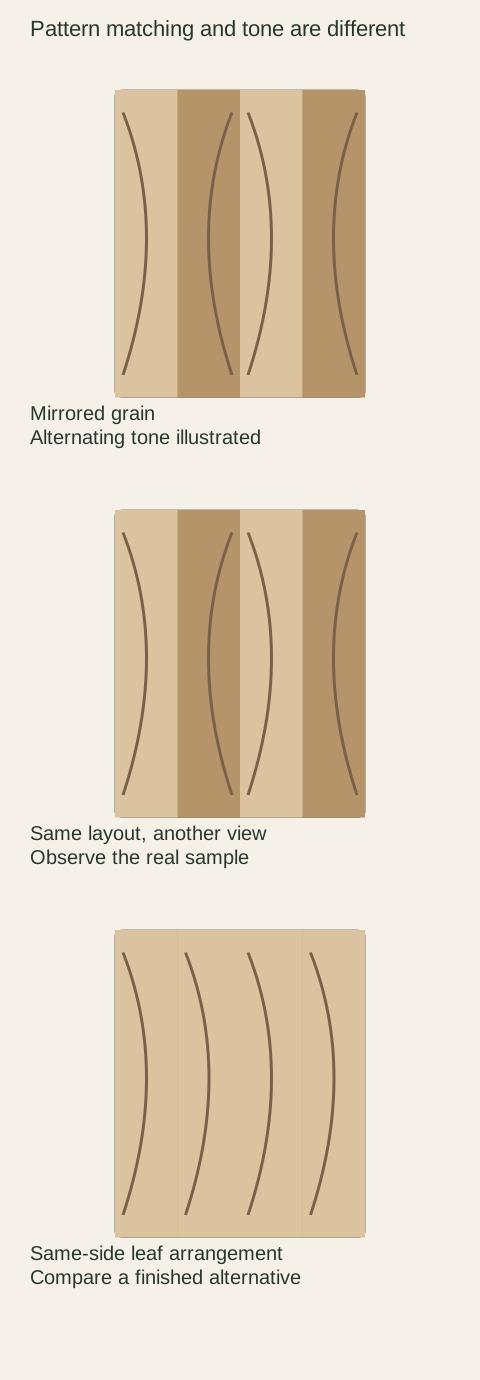
A cabinet panel can have a carefully mirrored wood pattern and still show alternating light and dark strips. Before calling it uneven stain, check whether the changes follow the veneer leaves and whether the appearance changes with your viewpoint. The useful purchase decision is whether you accept the complete finished panel, not whether a small patch has an attractive grain.
Understand what book matching promises
Columbia Forest Products explains that book matching turns alternate veneer leaves over. Differences between the exposed sides can produce alternating light and dark bands, sometimes called a barber-pole effect. Slip matching keeps the leaves similarly oriented and can help avoid that effect.
That explanation concerns the arrangement and surface characteristics of veneer. It does not certify the cause of every stripe on a finished door. A visible seam, coating problem, underlying panel issue or ordinary color variation may need a different assessment. Identify the material and the manufacturer's description before attaching a technical name to a photograph.
Map the bands before changing the lighting
Place the sample upright and find the boundaries between veneer leaves if they are visible. Sketch where the light and dark areas occur. Do they alternate in regular strips, follow a mirror pattern, or appear as an isolated patch? Keep the observation descriptive. A regular arrangement gives the supplier more useful information than a message saying the whole door looks wrong.
Diagram The tonal differences are exaggerated for explanation. This drawing does not predict a real panel's color, stain absorption or behavior under light.
Photograph the full panel with its label and take a detail that includes the edge of a band. Avoid cropping so tightly that nobody can tell which part of the door is shown. If the seam cannot be identified from the finish, record that uncertainty. Do not scrape a surface or remove a coating to prove where one leaf ends.
View the finished panel along the real approach route
Keep the sample in one position and move between the room entrance, the working counter and the seating area. Then observe it under the ordinary lighting settings planned for the room. Record where the difference is strongest. This is an appearance review, not a laboratory test or proof that every band has a lighting-only cause.
A panel beside a window may be seen from an oblique angle on every trip into the kitchen. A sample photographed straight on under diffuse display lighting does not represent that experience. Conversely, a striking close-up taken at an unusual angle may exaggerate a condition that does not bother you in normal use. Make the decision from the relevant viewpoints rather than the most dramatic image.
Mirror symmetry and even tone can compete
Decide which quality matters more in the intended location. You may enjoy a formal mirrored grain pattern even when its strips differ somewhat in tone. Or you may want a quieter field in which the overall tonal rhythm matters more than a repeated mirror. Neither preference requires declaring the other arrangement a manufacturing failure.
Ask to compare a finished alternative that uses a different matching arrangement if the selected supplier offers one. Keep the species, proposed finish and panel orientation as comparable as possible. A raw veneer sheet is useful for discussing layout but cannot settle how the finished cabinet face will appear. Changing several variables at once can make an alternative appealing without identifying what improved.
A worked comparison on a pantry wall
Imagine a pantry wall intended to read as a calm wood surface from the dining table. The approved small swatch contains part of a single veneer leaf. A larger bookmatched sample introduces a repeating light-dark rhythm that becomes conspicuous across the tall front. The swatch was not necessarily the wrong color; it simply did not show the relationship between neighboring leaves.
A sensible comparison includes the complete bookmatched sample and a supplier-supported alternative with a quieter tonal rhythm. View both where the pantry will stand. If mirror symmetry is the main attraction, you may keep it and accept the observed variation. If the wall should recede, a different arrangement may better serve the brief. Record which complete sample supported that decision.
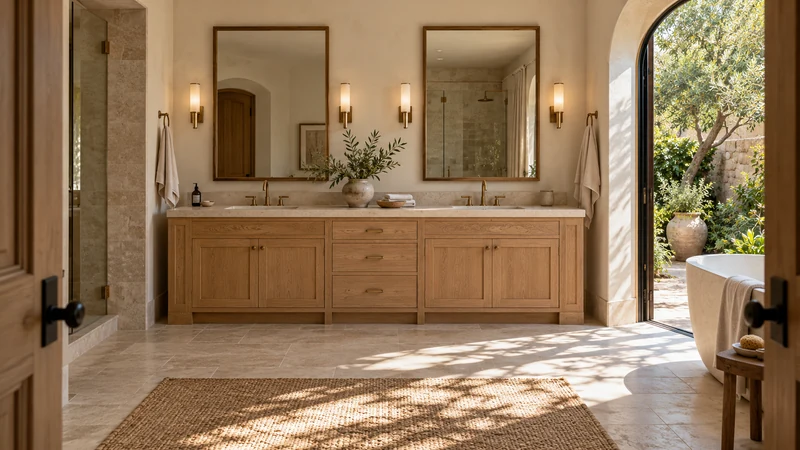
Design study The room study helps locate a group of visible fronts. It does not document bookmatched veneer, actual finish uniformity or a supplied product.
Do not confuse this with front-to-front grain continuity
Matching describes how leaves are arranged within a face, while a separate question concerns how doors and drawers relate to each other. A slip-matched face does not automatically continue its grain through the next drawer. A group of sequential fronts can still contain a bookmatched pattern within individual panels. State both requests when both matter.
Mark the fronts that should be assessed together on the elevation. Include the direction of each piece and any exposed end that is part of the composition. Keep a replacement expectation alongside that drawing: a future front may match the species and general finish without reproducing the same local grain. A finish code alone is not a map of the original veneer.
Approval needs the finish and a useful viewing record
Retain a sample that contains the relevant relationship between leaves, with its material, finish and sample identity. Add photographs of the entire sample in the positions that influenced the choice. The photos document the review; they are not a color authority. Note any material difference between the sample and the actual order instead of treating all veneered panels as interchangeable.
Ask the seller what appearance range the sample represents and how concerns are reviewed before installation. A verbal promise of perfect uniformity is difficult to reconcile with a sample that already shows a visible tonal pattern. If the desired result cannot be documented or supplied, revise the selection while the choice is still open.
Receiving a panel that looks different
Compare the delivered part with the retained sample in comparable conditions before drilling, finishing or relocating fronts. Capture the part label, the whole group and the objectionable strip. State whether the difference was present in the sample, appears only from a particular view or is a new isolated condition. This gives the supplier a concrete question to investigate.
Do not try to darken a pale strip with a touch-up product or sand the darker leaf to make the tones agree. That changes the finish and can obscure the original concern. Request a product-specific assessment. The source explanation helps you ask a better question; the approved specification and the actual condition still determine what response is appropriate.
Pure White
Cream White
Light Warm Gray
Gray
Navy
Black
Oak Tone
Dark Walnut Tone
Design study These finish studies are design references, not a list of currently orderable colors. Screens and lighting change the appearance; compare a physical sample before choosing.See all finish options →
The sample shows the door frame, a separate center panel, the face frame and the cabinet box. Each component has its own place in this Shaker construction.
Shaker construction: door frame, center panel, face frame and cabinet box. The cutaway helps locate these parts; confirm each material in the specifications for the selected cabinet.
01 / Door frame
The Shaker door has rails and stiles around a separate center panel. The frame and center panel are different components; confirm their materials in the specifications for the selected cabinet.
02 / Face frame
The face frame surrounds the opening at the front of the cabinet box and sits behind the doors. The face frame, door frame and cabinet box are separate parts.
03 / Cabinet box
The sample exposes the cabinet sides, interior surfaces and layered edges. The image does not establish the wood species or material specification of a selected cabinet.