Mixing bathroom metal finishes: assign the faucet, mirror, lights and pulls a role
Choose a dominant visual family and a deliberate accent across the whole vanity wall. Repetition, size and placement matter more than counting metal pieces.
A mixed-metal bathroom works best when you can explain where each finish belongs. Start with the metal you intend to keep or repeat, then decide which object or group deserves a contrast. Map the faucet, cabinet hardware, mirror frame and lights together before ordering. Matching every object is a valid alternative, but buying a different favorite finish for each category does not automatically produce a considered mix.
Begin with the least flexible purchase
An existing shower assembly, a retained faucet or a required lighting product may narrow the palette before cabinet pulls are chosen. Mark those items as fixed. Do not propose changing a working assembly merely to satisfy a color sketch without including the real replacement scope. If everything is new, choose the fixtures for their tasks and compatibility first, then compare their offered finishes.
Show towel hardware, door hardware and visible shower framing on the same room view. They need not all match the vanity group, but they will still be seen. A new brass mirror can look deliberate above a cool-toned faucet and still feel unrelated to a large dark shower frame if the latter never appeared on the design board.
Delta gives a bathroom example combining a black faucet with brass or aged-brass hardware and lighting. That supports considering a deliberate contrast; it does not prescribe that particular pairing for every room or establish an exact match across brands.
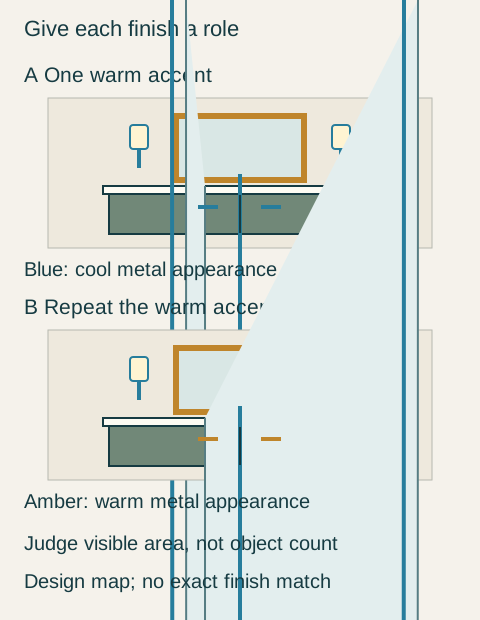
The first arrangement can keep faucet, lights and cabinet pulls in a related cool metal appearance while using one warm mirror frame. This makes the mirror a distinct object. It may be exactly right when the frame is important and the rest of the wall should remain quiet. There is no requirement to add warm pulls solely to prove the mirror belongs.
Teaching example Original finish maps for the same vanity wall. A keeps the faucet, lights and pulls cool-toned and uses a warm mirror frame. B repeats warm tones at the mirror and pulls while retaining cool-toned faucet and lights. The larger frame can dominate even when it is only one object. Colors identify design roles, not exact finishes.
The second arrangement repeats the warm appearance at the mirror and cabinet pulls, with faucet and lights remaining cool-toned. The lower repetition connects the mirror to the vanity and creates a more distributed contrast. It is a different visual decision, not a correction that every single-accent room needs.
Consider visible area and shape, not a mathematical count. A wide mirror frame can carry more visual weight than several small knobs. A polished curved faucet can catch attention differently from a broad brushed frame. Replacing a slim frame with a heavy one may change the balance even when the inventory still contains the same number of warm and cool pieces.
Keep shape and surface from becoming extra variables
Use the same mirror dimensions, cabinet front and lighting positions while first comparing finish distributions. Otherwise the favorite scheme might win because its mirror is larger or its lights are better placed. Once the distribution is clear, refine shapes with the complete wall visible.
Related color names do not establish related appearances. Compare actual samples for tone, sheen and texture beside the cabinet and top. Decide whether adjacent pieces should look closely matched or intentionally distinct. A gold-painted frame, a brass-tone faucet and a brass pull are not the same material simply because the mood board uses one yellow square for all of them.
Care and expected change also belong to each actual finish. Do not select an unlacquered piece on the assumption it will remain identical to a coated neighboring product. If changing appearance is welcome, include that in the intended relationship; if a close stable appearance matters, ask the suppliers what the selected finishes actually represent.
A retained cool faucet and a warm mirror
In a hypothetical renovation, a homeowner keeps a suitable cool-toned faucet and selects a dark painted vanity. The preferred mirror has a substantial warm frame. The first scheme repeats the cool appearance in the lights and pulls, leaving the frame as the only warm object. The second gives the vanity warm pulls while retaining the same faucet, lights and mirror.
On the complete elevation, the homeowner likes how the second scheme brings the warm accent down to the cabinet. They choose it after comparing physical pull and frame samples together. The samples are accepted as coordinated rather than described as an exact cross-brand match. A warm light fixture is tried on the board but rejected because the upper wall then feels too dominated by the warm group.
The resulting purchase is specific: retained cool faucet, cool lights, warm mirror frame and warm cabinet pulls, with existing room hardware shown in the final view. The cabinet's pull locations still receive their ordinary grip and mounting review. No plumbing component is substituted just because a similar decorative finish is available.
If the single-accent proposal had looked better, leaving the pulls cool would have been equally defensible. The useful outcome is a finish assignment that survives the complete room view and actual sample comparison. Put that assignment beside the product identities so a later substitution can be judged by the role it changes, not merely by whether its name contains brass, nickel or black.
Pure White
Cream White
Light Warm Gray
Gray
Navy
Black
Oak Tone
Dark Walnut Tone
Design study These finish studies are design references, not a list of currently orderable colors. Screens and lighting change the appearance; compare a physical sample before choosing.See all finish options →
The sample shows the door frame, a separate center panel, the face frame and the cabinet box. Each component has its own place in this Shaker construction.
Shaker construction: door frame, center panel, face frame and cabinet box. The cutaway helps locate these parts; confirm each material in the specifications for the selected cabinet.
01 / Door frame
The Shaker door has rails and stiles around a separate center panel. The frame and center panel are different components; confirm their materials in the specifications for the selected cabinet.
02 / Face frame
The face frame surrounds the opening at the front of the cabinet box and sits behind the doors. The face frame, door frame and cabinet box are separate parts.
03 / Cabinet box
The sample exposes the cabinet sides, interior surfaces and layered edges. The image does not establish the wood species or material specification of a selected cabinet.