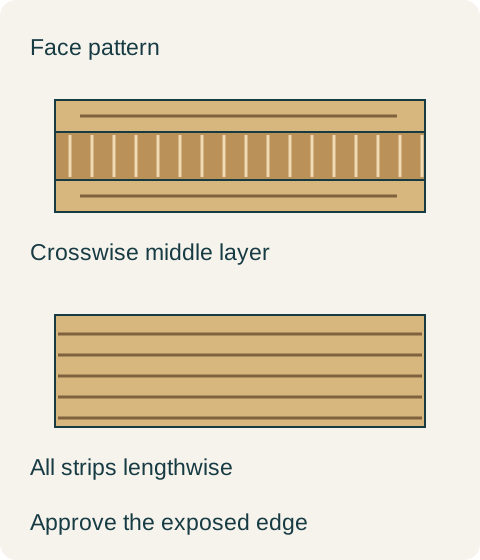
A bamboo cabinet quote should name the panel construction as well as its face grain. A narrow striped face can accompany different internal layouts. If a proposed substitute changes the core direction, it changes the component specification even when the front looks familiar. The exposed edge can reveal a difference that a face-only sample hides.
The strips on the face and the strips inside do different jobs
Plyboo describes a cross-core construction with a perpendicular middle layer and lengthwise surface layers. It also describes linear constructions whose strips all run along the panel length, without an inner cross-ply core. These are named manufacturer constructions, not interchangeable definitions of every product sold as bamboo plywood.
The same manufacturer uses edge-grain and flat-grain language for the bamboo strip surface presented to view. That concerns how the strips are assembled and seen; it is a separate question from whether an internal layer runs across them. A quotation that says only vertical-grain bamboo leaves the layup unresolved.
A cut edge can expose a crosswise band or a different linear arrangement; neither appearance alone is a defect. But appearance cannot override the application limit: Plyboo expressly does not recommend its linear panels for European-style single-piece cabinet doors because they lack a cross-ply core. Its guidance instead describes narrower furniture stock, exposed frame construction or suitably supported systems. This is a substantive restriction on the named panel, not a preference about edge color.
Teaching example Conceptual bamboo layups and cut-edge views. Layer proportions and colors are illustrative; no stiffness, movement or load result is shown.
Keep the approved cross-core panel when the edge is part of the design
Suppose a hypothetical kitchen has already been designed around a particular cross-core bamboo panel for slab fronts. The buyer approves a finished front and its exposed layered edge. A later offer substitutes a linear panel to produce a less interrupted edge pattern. The buyer retains the original cross-core construction and the approved visible edge, removing the substitute from the order. The decision preserves the reviewed component and avoids using a linear panel that the manufacturer does not recommend for this single-piece door.
If the buyer instead dislikes the layered edge, a valid redesign could cover that edge while retaining the approved panel construction. In this hypothetical order, that option was declined because the exposed layers were part of the chosen appearance. A material change and an edge treatment are different ways of changing the look; their fabrication scopes should be compared separately.
A bamboo surface still needs a finishing and preparation scope
Plyboo advises color pairing panels and checking moisture before fabrication, with acclimation related to the final site conditions where needed. A bamboo label does not remove those preparation decisions or establish a uniform finished color. Include the selected coating and a completed edge sample in the panel package rather than assuming that raw sheets are finished cabinet fronts.
Record the product construction, face direction, edge treatment and finished sample together. If the design later needs a different span, size or assembly, reassess that component using its actual product information. Do not use the strip pattern, a claim about bamboo hardness or the number of visible layers as a substitute for the required component performance. The purchase is an identified panel made into an approved cabinet part.
Pure White
Cream White
Light Warm Gray
Gray
Navy
Black
Oak Tone
Dark Walnut Tone
Design study These finish studies are design references, not a list of currently orderable colors. Screens and lighting change the appearance; compare a physical sample before choosing.See all finish options →
Hardwood plywood can have a veneer, fiberboard or particleboard core. Choose the core for the actual component, then verify the complete panel and connection details.
Plywood has directional properties despite its cross-laminated construction. Identify the actual panel and its design direction before rotating a shelf cut to suit the visible grain.
Thin banding covers a panel edge; solid lipping adds a separately specified wood member. Compare the finished outline, profile and assembly before treating thicker edging as an upgrade.
The sample shows the door frame, a separate center panel, the face frame and the cabinet box. Each component has its own place in this Shaker construction.
Shaker construction: door frame, center panel, face frame and cabinet box. The cutaway helps locate these parts; confirm each material in the specifications for the selected cabinet.
01 / Door frame
The Shaker door has rails and stiles around a separate center panel. The frame and center panel are different components; confirm their materials in the specifications for the selected cabinet.
02 / Face frame
The face frame surrounds the opening at the front of the cabinet box and sits behind the doors. The face frame, door frame and cabinet box are separate parts.
03 / Cabinet box
The sample exposes the cabinet sides, interior surfaces and layered edges. The image does not establish the wood species or material specification of a selected cabinet.