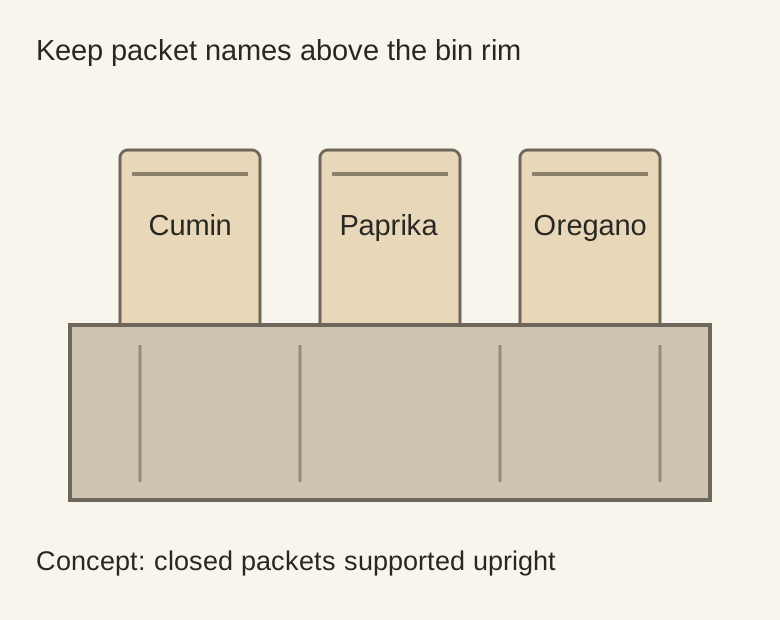
Spice packets behave differently from jars. A full pouch may stand neatly, then collapse as it empties and disappear under its neighbors. A shallow supported row can keep the names visible, but only if the bin rim, packet closure and drawer height work together. Choose storage around the packages you use, including partly empty ones, instead of judging the arrangement with unopened packets alone.
Keep the information you need with the ingredient
Check where each packet puts its name, dates and instructions. Folding a top over can hide the name; trimming packaging to fit a bin can remove information you meant to retain. Follow the package’s storage and closure directions, and preserve the identifying information when arranging the collection. A neat row is not useful if several similar powders become difficult to distinguish.
Decide whether you will keep the packets in their original packages or use a suitable container system. Do not choose decanting only to make every package look the same. It adds a transfer and labeling task, and the container still needs to suit the ingredient and its directions. For a changing assortment, supporting the original packets may be the simpler arrangement.
Support the row when a packet is nearly empty
Use the tallest normally closed packet to check the available height. Include the folded top or clip, not just the printed pouch body. Then test a nearly empty packet in the same compartment. If it drops below the bin edge, a lower front or a different divider arrangement may make the label easier to retain in view.
Diagram The drawing explains label visibility, not container compatibility or food storage conditions. Test your own closed packages, including partly empty ones.
A long open row can slump into the space left when a packet is removed. Try smaller groups or dividers that support the remaining packets without squeezing their closures. The support should make the next selection easier. Avoid packing the row so tightly that taking a packet tears its packaging or pulls the neighboring bags out with it.
Choose a grouping that matches the way you look
Arrange by the search you actually make: a named ingredient, a frequent cooking group or a clear label order. Keep similar-looking packages distinguishable. A category that makes sense only while you are sorting may slow down someone else who is trying to find an ingredient during cooking.
For example, try finding a partly used cumin packet while the paprika and oregano remain in place. Remove it, close it according to its packaging and return it. Does it keep a visible position when it contains less? This simple trial tests the failure that a display of full packets misses. It also reveals whether clips snag adjoining packages.
Give duplicates and fresh purchases a known destination
Keep track of the opened working packet and any unopened reserve without treating the printed dates as interchangeable. Follow the package information when selecting what to use. A separate reserve position can prevent buying another package simply because the partly empty one has slipped beneath the front row.
Before specifying the drawer or pantry accessory, record the closed packet height, useful label position and chosen bin outline. Test removal with the drawer at its ordinary extension or the pantry door open normally. Include space to lift the bin out for cleaning under the applicable care instructions. The finished layout should remain recognizable as packages empty, get replaced and return from use.
Pure White
Cream White
Light Warm Gray
Gray
Navy
Black
Oak Tone
Dark Walnut Tone
Design study These finish studies are design references, not a list of currently orderable colors. Screens and lighting change the appearance; compare a physical sample before choosing.See all finish options →
Choose whether the bin will be used inside the cabinet or lifted onto the counter. That choice changes the required opening, lid movement and working surface.
The sample shows the door frame, a separate center panel, the face frame and the cabinet box. Each component has its own place in this Shaker construction.
Shaker construction: door frame, center panel, face frame and cabinet box. The cutaway helps locate these parts; confirm each material in the specifications for the selected cabinet.
01 / Door frame
The Shaker door has rails and stiles around a separate center panel. The frame and center panel are different components; confirm their materials in the specifications for the selected cabinet.
02 / Face frame
The face frame surrounds the opening at the front of the cabinet box and sits behind the doors. The face frame, door frame and cabinet box are separate parts.
03 / Cabinet box
The sample exposes the cabinet sides, interior surfaces and layered edges. The image does not establish the wood species or material specification of a selected cabinet.