An arched detail can soften a kitchen without turning every cabinet into a curved piece of furniture. The useful choice is the complete door family: where the curved line appears, what the drawers look like, and how the tall cabinets join the composition. Start there rather than deciding that all arches are dated or all square fronts are modern. A shape you like on a sample still has to work across the fronts you are buying.
Locate the curve before comparing styles
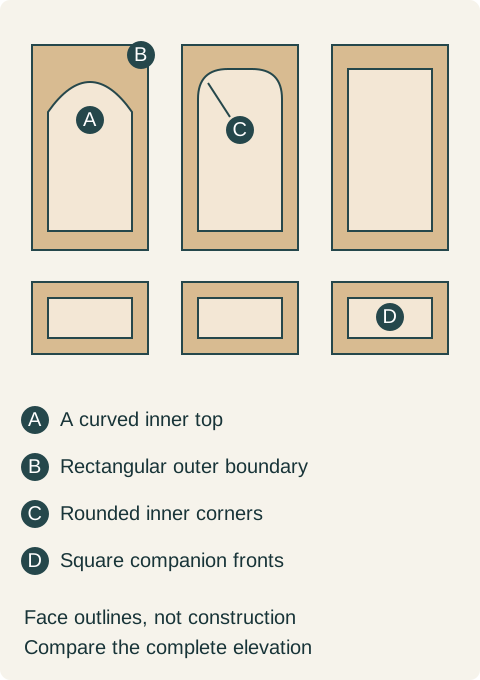
Trace the outside edge of the sample, then its inner frame line. A rectangular door can have an arched inner panel outline while retaining a rectangular outside boundary. That is different from a door whose outside top is curved, and different again from a cabinet front that bends around a corner in plan. The photographs may all be tagged arched or curved; they do not describe the same cabinet construction.
Conestoga's Waldorf example rounds the upper interior corners and pairs with its CRP-10 style. That is a different outline from a full arch across the panel top.
If the reference photograph shows a rounded opening but the chosen catalog door only softens its corners, the difference should be visible on the selection drawing. Do not ask the installer to turn one into the other after delivery. The location of the curve belongs to the door choice and, where relevant, to the cabinet opening. A visual shorthand is not enough to order the parts.
The drawers need their own answer
An appealing arch on a tall sample does not tell you what happens on a shallow drawer front. Ask for the offered companion fronts at their proposed sizes. Some selections intentionally combine a decorative door with a simpler drawer; that can be a coherent design rather than a missing detail. What matters is whether you have seen and accepted that relationship.
Cabinet Door Factory describes its Mission cathedral-style panel paired with square Adobe lower doors. This is a named family example, not a rule requiring arched uppers and square bases.
Use the available combinations to test the room. If the supplier cannot provide the proposed arch in a small front, choose a supported companion rather than drawing a reduced version that has not been offered. A door style may be available in one size or configuration without establishing that every decorative end, appliance panel or drawer follows it.
Teaching example Original face-outline concepts. A shows a curved inner top inside B, a rectangular outer door boundary. C rounds only the upper inside corners. D represents square companion fronts. These are not drawings of named products, joints, panel thicknesses or fabrication profiles.
Repeat the shape across the actual cabinet run
Place the candidate fronts on the kitchen elevation with the real changes in width. Repeated arches can become the main visual pattern. A single sample viewed close up may not reveal that rhythm, especially beside a window, hood and tall pantry. Leave the counter and wall finishes consistent while comparing, so the decision is about the door arrangement rather than an unrelated color change.
Look at the top of the inner panel as well as the outer cabinet line. Adjacent fronts can share a level outer top while their inner shapes rise to different positions or proportions. Ask how the offered family handles those differences. Do not invent a universal rule that every arch scales proportionally, or that every radius stays fixed as the door width changes. The actual supplied drawing resolves that question.
Include the tall cabinet before choosing. An upper-door arrangement that feels balanced above a counter may look unrelated when a large pantry face repeats the motif beside it. A square companion can be a deliberate transition. Alternatively, repeating the curved detail may be the feature you want. Both choices deserve a complete elevation, not an assurance that the catalog name guarantees a match.
A restrained curved detail can win over a full arch
Imagine a kitchen with a strongly patterned floor and a broad window already shaping the main wall. The owners like a cathedral-style sample, but the first elevation repeats its high inner curve across every upper front. With the actual narrow and wide cabinets shown, that pattern attracts more attention than they want. The wood color is still right; the repeated outline is the problem.
They compare a square family and an offered family with only rounded inner corners, keeping the same surrounding materials. They prefer the softened corners on the upper doors and the supplier's square companion on the base drawers and tall pantry. They choose that available combination after reviewing the actual front sizes. The order does not describe a generic arch and leave the supplier to guess which version the picture meant.
This decision preserves the curve they enjoy without copying the full cathedral outline. Another room might benefit from that stronger repetition. The example is a way to evaluate the composition, not a prediction about which style will retain resale value or stay fashionable. Choose the room you intend to use rather than paying for a claim about every future buyer.
The front shape does not identify its material
A curved inner outline can be made in different constructions. Establish the actual frame, panel and surface materials separately. Do not infer a solid-wood center or a particular joint from the visible arch. Equally, an arched panel outline does not mean the cabinet box itself has a curved top. Keep the decorative selection and the component specification connected without treating them as the same information.
Check the proposed knob or pull on the selected sample. Its mounting area should work with the actual profile and with the companion drawers. A handle position that looked right on the square alternative may visually crowd the curved detail. Use a removable template and the supplier's suitable mounting area; do not assume the favorite hardware can be drilled anywhere on the frame.
Before ordering, retain the exact door and companion names, front sizes, finish and selected hardware locations with the complete elevation. Include visible ends and any intentionally plain panels. If a later substitution changes the outline, review the group again. The worthwhile result is a kitchen whose upper doors, drawers and tall fronts belong together, with the curved detail placed where you actually wanted it.
Pure White
Cream White
Light Warm Gray
Gray
Navy
Black
Oak Tone
Dark Walnut Tone
Design study These finish studies are design references, not a list of currently orderable colors. Screens and lighting change the appearance; compare a physical sample before choosing.See all finish options →
Choose antiqued mirror for the reflected scene and concealed storage you want. Compare the full door group, its patterned surface and the view when it opens before replacing transparent glass.
The sample shows the door frame, a separate center panel, the face frame and the cabinet box. Each component has its own place in this Shaker construction.
Shaker construction: door frame, center panel, face frame and cabinet box. The cutaway helps locate these parts; confirm each material in the specifications for the selected cabinet.
01 / Door frame
The Shaker door has rails and stiles around a separate center panel. The frame and center panel are different components; confirm their materials in the specifications for the selected cabinet.
02 / Face frame
The face frame surrounds the opening at the front of the cabinet box and sits behind the doors. The face frame, door frame and cabinet box are separate parts.
03 / Cabinet box
The sample exposes the cabinet sides, interior surfaces and layered edges. The image does not establish the wood species or material specification of a selected cabinet.