Alder or cherry cabinets: similar grain does not make them substitutes
Compare alder and cherry as finished cabinet choices, including how you feel about dents and a changing wood color. A cherry-toned stain does not change alder into cherry.
A reddish alder sample can sit convincingly beside a new cherry sample. That visual resemblance does not make alder a substitute for cherry in an order, especially when the new kitchen must relate to existing cherry furniture. First decide whether the brief requires that species or simply the warm appearance shown. Then compare the finished proposals for handling marks and expected color development. A stain called cherry identifies neither the underlying wood nor its future appearance.
A stain name cannot promise long-term matching
If the project includes existing cherry furniture, evaluate the new cabinet choice as its own material. A close match on installation day is not a guarantee that a different species beside it will follow the same appearance over time. Decide whether a coordinated contrast is acceptable. If exact ongoing matching is essential, that is a demanding project condition to resolve with the actual materials, rather than a promise to infer from a stain called cherry or chestnut.
Examine the proposed fronts near the room’s fixed finishes. Flooring, counters and nearby furniture will remain part of the composition while the wood changes. It is possible to prefer the new sample but dislike the direction the room could take later. Ask to see relevant aged examples from the same supplier as context, without treating an example in another room as a timed forecast for yours. No photograph establishes the exact shade or schedule of change in a different home.
Canyon Creek’s Katana guide notes that alder and cherry can have similar grain, while strong sunlight may lighten alder and darken cherry. The direction of later color change can therefore differ even when initial samples look close.
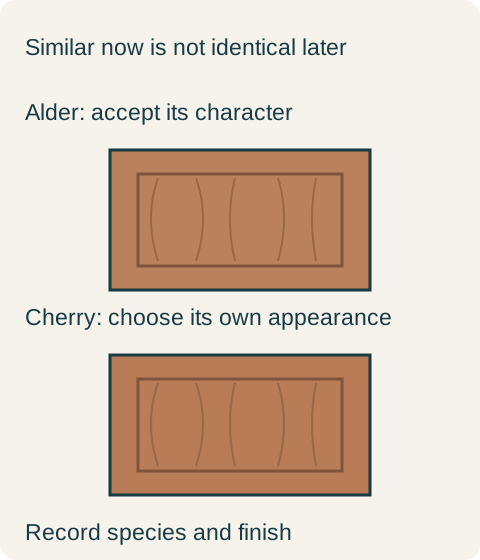
Teaching example Hypothetical side-by-side material choice. The colored panels identify two proposals, not measured aging, a species-identification chart or a promised future color. No hardness or time scale is implied.
Decide whether the new sample is the whole attraction
Look at what you like about each finished proposal. Is it the warm tone, the fine grain, the selected door profile or a combination? If the color is the only attraction, do not confuse that preference with a demand for a particular species. Conversely, if cherry itself is part of the brief, a visually similar stained alder front changes the purchase. Both choices can be reasonable, but they answer different wishes. Name the wood and the finishing treatment separately so the comparison remains understandable.
A casual kitchen chooses alder knowingly
Consider a hypothetical household choosing warm wood fronts for a frequently used family kitchen. It sees alder and cherry in the same door style and prefers the offered alder sample. The owners accept occasional handling marks as part of living with that material and are not trying to reproduce cherry’s future appearance. They select the alder option, keeping the cabinet interiors and hardware from the original plan. Their choice is an approved alder kitchen, not a substitution authorized merely because the two samples look similar today.
A hardwood name does not mean a dent-proof door
Omega describes its alder as fine-textured and comparatively soft among its hardwood offerings, making dents and marks easier to create. This is a meaningful handling consideration, even though alder belongs to the hardwood group.
That decision would be inappropriate for a buyer who strongly dislikes visible indentations but is being reassured only by the word hardwood. Such a buyer should compare another actual finished material or construction and its demonstrated behavior. Paying for cherry does not establish an indestructible alternative either. Separate the wood’s response to a bump from the finish’s resistance to scratches and the door’s overall construction. A hard clear coating does not turn every underlying wood into the same material.
Keep character selection separate from species
Regular alder and a deliberately knotty or rustic selection should not be combined into a single visual expectation. Compare the selection actually quoted. Someone choosing the fine-grained appearance of the displayed door has not automatically accepted a different selection with more pronounced knots. Likewise, a rustic preference does not establish a request for artificially distressed edges. Keep those appearance decisions distinct so the order does not acquire extra character that the purchaser never chose.
Use the same discipline for exposed companion parts. A cabinetmaker may propose a veneered side panel beside a solid-wood door frame. Judge the finished group and identify the component materials, rather than expecting every face to look like a cropped section of the door. A front-species change also does not prove that the shelves, drawers or hidden box changed. Compare those components separately if they are included in a quoted upgrade.
Price the actual alternative without inventing a hierarchy
There is no dependable universal price difference to apply to an unspecified alder and cherry order. Hold the cabinet arrangement, door style, finish scope and included services steady, then compare the real proposals. If a lower total also removes a drawer or changes an exposed end, the amount is not simply a species saving. The household in the example buys the alder appearance it prefers with the same required cabinet functions; the accepted sample and species remain together in its order record.
Pure White
Cream White
Light Warm Gray
Gray
Navy
Black
Oak Tone
Dark Walnut Tone
Design study These finish studies are design references, not a list of currently orderable colors. Screens and lighting change the appearance; compare a physical sample before choosing.See all finish options →
Compare the actual countertop products, heat-source routine and fabrication proposal. A fired porcelain slab and resin-bound quartz are different materials, but neither label replaces a complete kitchen specification.
The sample shows the door frame, a separate center panel, the face frame and the cabinet box. Each component has its own place in this Shaker construction.
Shaker construction: door frame, center panel, face frame and cabinet box. The cutaway helps locate these parts; confirm each material in the specifications for the selected cabinet.
01 / Door frame
The Shaker door has rails and stiles around a separate center panel. The frame and center panel are different components; confirm their materials in the specifications for the selected cabinet.
02 / Face frame
The face frame surrounds the opening at the front of the cabinet box and sits behind the doors. The face frame, door frame and cabinet box are separate parts.
03 / Cabinet box
The sample exposes the cabinet sides, interior surfaces and layered edges. The image does not establish the wood species or material specification of a selected cabinet.