

Design & industry
Wilsonart’s 2026 HPL launch: choose a palette across Harmony, Strata and Terrene
The whole release combines woodgrain, linear and textile-inspired HPL designs. Use that range to assign clear roles to cabinet and companion surfaces, while keeping the actual panel and countertop assemblies explicit.
Wilsonart’s HPL introduction offers a useful way to select a room palette without making every surface look like the same material. Its new design families can give cabinet fronts, a separate storage group and a companion surface different visual roles. Begin by deciding which surface should lead and which should recede. Then review the actual completed parts, because a coordinated visual collection does not by itself define a cabinet panel or countertop assembly.
Wilsonart’s announcement, published 2026-07-27, presents its 2026 HPL collection through Harmony woodgrains, Strata linear patterns and Terrene textile-inspired designs. The release groups them as a coordinated palette.
Reading note: Wilsonart2026 HPL collection announcement, published July27,2026.
The current collection page separately identifies existing designs moved into its In Stock category. That distinction does not confirm inventory at a project supplier or make those older designs new patterns.
Reading note: Wilsonart new HPL: Harmony, Strata and Terrene.
Choose the main field before the companion pattern
For a kitchen, identify the cabinet group that occupies the broadest view. Decide whether it should read as woodgrain, a quieter patterned field or another selected material. Use that decision to organize the rest of the sample review. Collecting several attractive chips without assigning them locations can leave every option competing for the same job.
The collection’s different visual families are a starting resource, not a mandatory recipe. A room may use a new woodgrain on the main group and retain an existing plain surface elsewhere. Another may place pattern on a secondary cabinet. The important decision is what each selected face contributes in its actual location, including the surfaces that are staying.
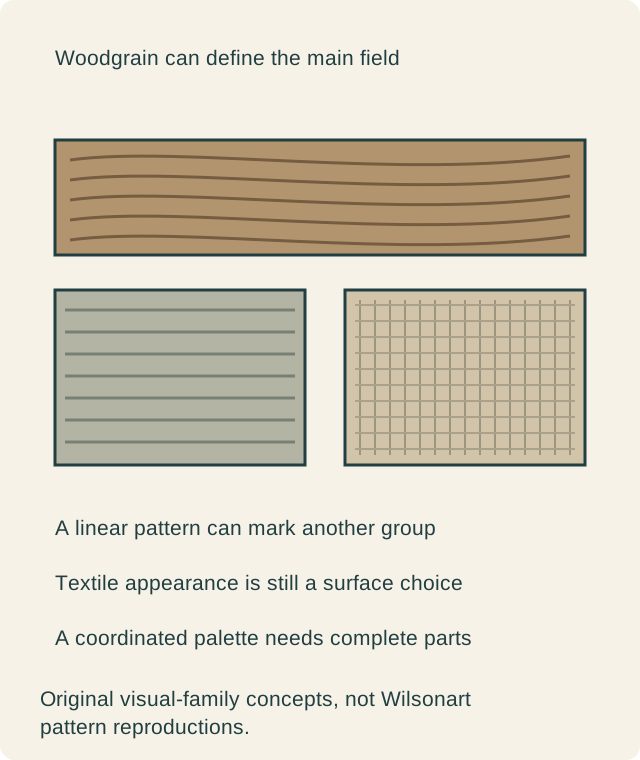
Woodgrain needs a room-sized reading
Review the proposed woodgrain on a representative surface and look at the intended cabinet elevation. A small sample can establish color interest while leaving the broader pattern unresolved. Decide how the offered design reads on tall fronts, stacked drawers and exposed ends, rather than expecting a favorable chip to describe the whole kitchen.
Keep the distinction between a woodgrain design and natural wood explicit. The buyer can prefer the offered HPL appearance on its own terms. There is no need to turn a species-inspired design name into a claim about the cabinet’s wood content. The final order should identify the actual surface product and the complete parts carrying it.
A linear companion should have a reason to be different
The linear family offers another type of visual field to investigate. Place a proposed selection beside the main front and ask what the room gains from the change. It might distinguish a separate storage group or provide a different backdrop for the main cabinet material. If it merely looks almost like the neighboring face without a clear purpose, a simpler combination may be easier to accept.
Use the proposed orientation and the actual component layout when comparing. A line pattern seen as a loose horizontal chip may read differently on a vertical door group. Have the fabricator explain the offered arrangement before the drawing assumes a particular continuity or direction. A coordinated color palette does not remove those manufacturing questions.
A textile-inspired design does not make an upholstered cabinet
Treat a woven-looking selection as the identified decorative surface being offered. Do not choose it expecting the behavior or feel of a fabric insert. The useful comparison is the actual sample in the intended room, together with its applicable finish and care information. An image of a weave is only part of that review.
This can be particularly helpful when a nearby room already contains real textiles. Decide whether the cabinet should echo that visual character or remain separate from it. Put representative samples together instead of relying on similar names. Coordination can include deliberate differences; the household should know which differences it is approving.
A hypothetical pantry group uses a companion and leaves the main kitchen quiet
Imagine a kitchen whose owners want a new woodgrain main cabinet field and a different treatment at a nearby pantry group. They begin with the woodgrain sample and examine its intended use across the main elevation. They then compare the offered linear and textile-inspired alternatives at the pantry location, alongside the room’s retained floor and furnishings.
In this hypothetical review, the textile-inspired alternative creates the distinction they want without adding another woodgrain field. They accept it for that group and omit the linear option. The provider identifies the complete fronts, edges and exposed panels carrying each selected surface. The room has a coordinated palette, with no assumption that all the parts have identical construction.
Another household might choose the linear companion instead, or use only the main woodgrain. The release is valuable because it supplies alternatives that can be compared as a related set. Its success does not depend on installing a representative from every family. The accepted material relationship and the complete offered parts are the result to buy.
Separate visual coordination from the fabrication package
Identify whether each quoted item is a loose facing sheet, a bonded panel or a finished component. The cabinet substrate, reverse and completed edges need their own definition. A design from the same collection does not establish that every provider fabricates it into the same door or offers all companion parts.
If the project also selects a countertop, review that complete assembly for its intended use. A pleasing relation to the cabinet surface does not make a loose laminate price equivalent to a fabricated top. Keep appearance choices connected to the actual scope and appropriate product information, rather than extending one attractive palette across unspecified constructions.
Keep new-design news separate from the current offer
The dated announcement establishes the introduction’s context. Current stock classifications and the provider’s ability to supply the chosen product are separate questions. Confirm the exact selected items and project supply arrangements in the quote, without converting a manufacturer’s general collection status into a local inventory promise.
Retain the accepted sample set with a drawing showing each surface’s location. If a pattern, finish or component changes, review the relationship it was meant to create. Wilsonart’s launch becomes useful to a cabinet buyer when a larger collection produces a smaller, clearly chosen palette that the actual finished order can deliver.
For an open kitchen and dining area, mark which surfaces are seen together from the same approach. A companion used on a distant storage wall has a different role from a face immediately beside the main front. The sample set should represent those relationships. This gives the collection’s range a concrete use: related choices can distinguish locations without forcing the same pattern through every cabinet in view.
Sources & further reading
- Wilsonart2026 HPL collection announcement, published July27,2026
- Wilsonart new HPL: Harmony, Strata and Terrene