Wide vs. Narrow Kitchen Drawer Bases: Usable Storage
Equal outside width can produce different internal space and access. Compare the largest item, the groups used together and what happens when another person needs a neighboring group.
Compare a wide drawer bank and narrower adjacent banks using actual usable dimensions and tasks. Their combined outside width can be the same while the clear space inside differs. A wide uninterrupted drawer can hold a group together; separate banks can give different groups independent fronts. Neither advantage settles the choice until the intended objects and people are included.
Draw the contents before deciding the number of fronts
List the largest rigid items and the groups normally taken out together. A long tray needs a continuous usable opening, while separate utensil groups may not. Record the way each item is stored, retrieved and returned. Do not confuse an attractive arrangement in an empty drawer with room to remove a piece from a stocked group.
Obtain clear internal width, depth, working height and the opening geometry for the selected alternatives. Outside cabinet width is only the shared planning boundary. Side construction, hardware and partitions affect the interior differently across products, so do not apply a universal deduction. Measure or use the exact product drawings for each alternative you are comparing.
Compare continuous width, not just added capacity
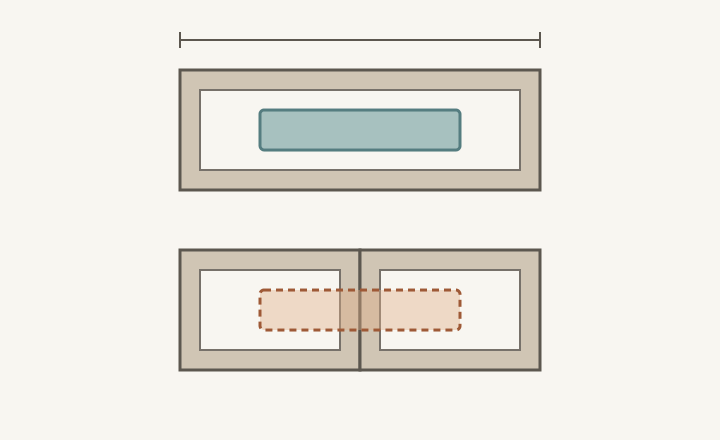
In a hypothetical comparison, both layouts occupy 36 inches outside. The wide drawer has 32 inches of clear internal width. The split layout uses adjacent 18-inch units, each with 14 inches clear, giving 28 inches in total: 4 inches less than the wide drawer. A tray 20 inches wide is within the 32-inch width but exceeds either 14-inch space by 6 inches. This checks width only; depth, height and removal still need testing. These are invented example dimensions, not standard cabinet deductions.
ABCD
Diagram The proportions follow the hypothetical width example. The lower dashed tray cannot borrow the space between independent drawers; the sketch does not establish depth, height, load or a complete installation.
A
The same overall outside span for both alternatives.
B
A continuous internal width for the wider drawer.
C
Separate left interior bounded by its own drawer construction.
D
Separate right interior, not an extension of the left opening.
Adding separate internal widths can describe part of a storage comparison, but it does not create an uninterrupted compartment. If the large item must move elsewhere in the split option, name that home and test it. Otherwise the narrow-bank proposal appears to solve the same inventory only because its awkward item has vanished from the drawing.
Compare task groups and the fronts they require
A wide drawer can keep a preparation group visible together and allow its organization to change within the available space. It also opens the shared front whenever any part of the group is needed. A person using that drawer may occupy a position another person needs at the same bank. Test the actual open front and standing places, not just the closed elevation.
Separate banks can allow one group to be retrieved without opening its neighbor. That does not guarantee people can use them simultaneously; their bodies, handles and routes still need room. If a task regularly needs items from both banks, count the extra opening and movement. Independent fronts are useful when they match independent tasks, not simply because there are more of them.
Check organization and loaded operation for the chosen system
Compare the actual organizers and intended contents rather than assuming a wide drawer must be a loose collection or a narrow drawer will organize itself. Dividers consume space and may constrain later changes. Confirm that the selected hardware, drawer construction and intended loading are compatible using their product instructions; width alone does not establish load capacity or operating behavior.
Include return after cleanup. A clear group home should remain obvious when some items are in use. If an item can only be returned after reorganizing everything around it, revise the assignment. Keep the largest-item check and the everyday-group check separate so neither is lost in an attractive overall capacity claim.
Save a comparison of the same inventory
Keep the outside span, actual usable dimensions, contents map and open-front task test for both options. Note any item relocated and any task that now crosses banks. The better arrangement is the one that stores and serves the intended inventory under the household’s routine, with its limits visible, rather than the one with the largest summed width or the most fronts.
Pure White
Cream White
Light Warm Gray
Gray
Navy
Black
Oak Tone
Dark Walnut Tone
Design study These finish studies are design references, not a list of currently orderable colors. Screens and lighting change the appearance; compare a physical sample before choosing.See all finish options →
Front proportions do not tell you the usable height inside. Group the actual objects, test their stored and removal positions, then compare the drawer combinations the selected cabinet system supports.
Less cabinet depth can help a constrained location, but check the complete projection and the inventory it displaces. A shallower box under an unchanged counter does not move the counter edge.
The sample shows the door frame, a separate center panel, the face frame and the cabinet box. Each component has its own place in this Shaker construction.
Shaker construction: door frame, center panel, face frame and cabinet box. The cutaway helps locate these parts; confirm each material in the specifications for the selected cabinet.
01 / Door frame
The Shaker door has rails and stiles around a separate center panel. The frame and center panel are different components; confirm their materials in the specifications for the selected cabinet.
02 / Face frame
The face frame surrounds the opening at the front of the cabinet box and sits behind the doors. The face frame, door frame and cabinet box are separate parts.
03 / Cabinet box
The sample exposes the cabinet sides, interior surfaces and layered edges. The image does not establish the wood species or material specification of a selected cabinet.