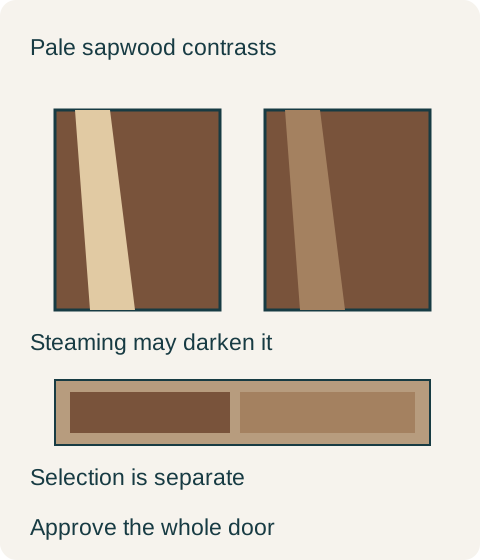
If a walnut cabinet quote says steamed, do not read that as all heartwood or uniform dark brown. Steaming describes a treatment; heartwood selection describes which material is included. A buyer seeking a consistent dark appearance must specify the desired finished range across the actual components, rather than relying on either word to settle the entire appearance.
Why steaming appears in walnut specifications
AHEC describes walnut sapwood as pale and its heartwood as brown, and explains that specialist producers may steam walnut to darken sapwood and reduce the contrast. It also notes that sapwood is admitted in walnut lumber grading. Those facts make treatment and material selection separate purchasing questions.
Darkening sapwood does not turn it into heartwood. Likewise, selecting heartwood is not a promise that all selected pieces share a single shade. The useful specification states whether sapwood is permitted, whether treatment is required or restricted, and what finished range is accepted. These choices can coexist; none should be silently inferred from a species label.
A cabinet can combine veneered panels with solid-wood framing or edge parts. A treatment statement attached to the lumber offer does not establish the treatment or selected range of the veneer. Map the material requirements to those components separately, then compare them together in the intended finish. A small dark veneer chip cannot represent every solid rail around it.
Teaching example Conceptual walnut color comparison. Colors are illustrative, not photographs, a grading chart, proof of treatment or an exact before-and-after prediction.
Choose the coordinated door assembly
Suppose a hypothetical buyer wants a calm brown door field with no conspicuous pale strips. Offer A identifies steamed walnut lumber but leaves color selection open and includes an independently sourced veneer panel. Offer B supplies a defined finished range for both the solid framing and veneer panels, with sapwood appearance and treatment recorded for each. Its complete door sample meets the buyer’s target. The buyer selects B and retains the range sample; A’s treatment label alone does not satisfy the requested coordinated appearance.
In that hypothetical decision, B is not selected because steaming is bad or because heartwood is automatically better. It is selected because the actual component group and finish demonstrate the agreed result. If another owner wants strong pale-to-dark contrast, a deliberately mixed range may be the appropriate choice instead. The aesthetic preference belongs in the order, not in an invented universal wood-quality ranking.
Compare the consequence of a selection requirement
A tighter appearance selection changes which pieces a fabricator may use. If an alternate removes that selection, it changes the delivered range even if the species and treatment stay the same. Compare that scope change openly; a lower offer with unrestricted appearance does not prove an equivalent selected cabinet costs less.
At receiving, use the approved completed range and the component record. Do not diagnose treatment history from a photograph or reject every lighter area as the wrong species. If the material identity is in doubt, investigate it separately. Treatment, wood identity and accepted appearance should agree, but they are not interchangeable forms of evidence.
Pure White
Cream White
Light Warm Gray
Gray
Navy
Black
Oak Tone
Dark Walnut Tone
Design study These finish studies are design references, not a list of currently orderable colors. Screens and lighting change the appearance; compare a physical sample before choosing.See all finish options →
A painted door, a wood-grain side and a plywood cabinet box can belong to the same cabinet. Here is how to read those parts, what the sample photos actually show, and which details to put on a quote.
The sample shows the door frame, a separate center panel, the face frame and the cabinet box. Each component has its own place in this Shaker construction.
Shaker construction: door frame, center panel, face frame and cabinet box. The cutaway helps locate these parts; confirm each material in the specifications for the selected cabinet.
01 / Door frame
The Shaker door has rails and stiles around a separate center panel. The frame and center panel are different components; confirm their materials in the specifications for the selected cabinet.
02 / Face frame
The face frame surrounds the opening at the front of the cabinet box and sits behind the doors. The face frame, door frame and cabinet box are separate parts.
03 / Cabinet box
The sample exposes the cabinet sides, interior surfaces and layered edges. The image does not establish the wood species or material specification of a selected cabinet.