When is a wide, shallow vanity drawer worth choosing?
A wide, shallow drawer is useful when low-profile items need a visible layout or an uninterrupted span; choose it only after checking the actual interior height and the room needed to use it.
Width and depth solve different storage problems. Spreading small objects across a broad drawer can make a collection easier to scan, while a deeper compartment may better accommodate upright packages. Neither benefit follows from the front's proportions alone. Before choosing the wider shallow format, identify what should lie in it and what would lose a suitable home if the cabinet provides less tall storage.
Start with the intended low-profile collection
Lay out the actual items in their intended stored condition. Include handles, closed cases and any dividers needed to keep the arrangement understandable. Decide whether the goal is to see the whole collection at once, keep a longer object intact or place related objects side by side. Each purpose gives the width a practical role instead of treating a broad drawer as automatically spacious.
Check whether the objects may be stored in the proposed orientation. Do not lay a container on its side merely to fit the available height when its product guidance or closure makes that unsuitable. If the collection contains many upright bottles, a wide floor may not compensate for the lack of height. Assign those bottles elsewhere before claiming that the shallow drawer meets the household's needs.
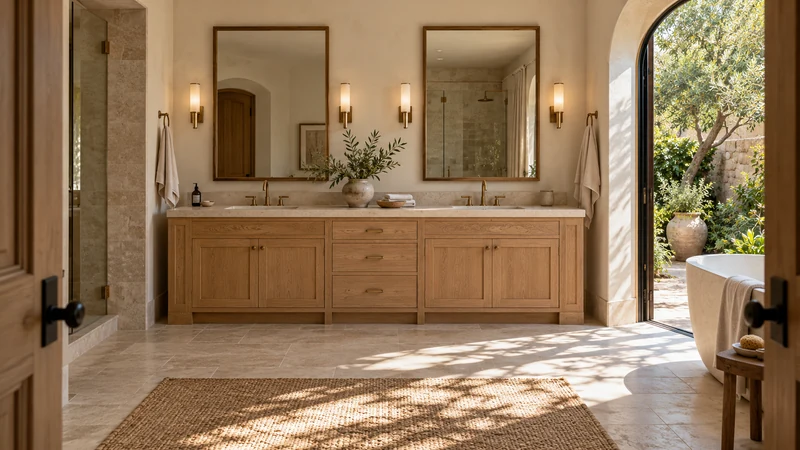
Design study The study pairs central drawers with door compartments below the basins. Compare the actual interior assignments; front proportions alone do not establish shallow storage.
Confirm the uninterrupted interior span
A wide front may cover an interior with dividers, a plumbing cutout or separate sections. Obtain the specific drawer drawing and distinguish the outside face from the usable floor. An item that needs a long continuous space must fit within an actual section, not across an obstruction. The cabinet's nominal width is not the length of that section.
Check usable height across the proposed arrangement, including any fittings or components above it. A low case can fit in one area while its raised hinge or handle conflicts elsewhere. Test the chosen organizers too: their bases and rims consume space, and dividing a wide floor into small cells may prevent the very continuous layout that motivated the selection.
Compare width with separate compartments
Use the same collection in a wide shallow option and in a realistic alternative, such as narrower drawers with different heights. A broad drawer may allow a long brush and nearby cases to remain visible together. Separate drawers may better distinguish users or keep frequently needed items accessible without opening a larger shared area. Compare the actual assignments rather than the number of visible drawer fronts.
Consider how the arrangement stays recognizable after use. An undivided wide floor can let small objects drift into an indistinct group. A modest division may help, but too many fitted cells can make ordinary packaging changes difficult. Choose boundaries around real groups and leave a clear home for each item that the user expects to find quickly.
Work through a height tradeoff
In a hypothetical household, the intended collection includes a long grooming brush, flat cases and a tall pump bottle. The wide shallow drawer accommodates the brush and cases in a visible arrangement, but the bottle cannot remain upright within its clear height. A narrower, taller alternative accepts the bottle yet divides the continuous space needed for the brush.
The household first checks whether the pump bottle has a suitable existing location where it is used. If it does, the wide shallow drawer can solve the remaining storage task well. If every item must stay in this cabinet and no other compartment accepts the bottle, the cabinet configuration needs revision. Fitting most of the collection is not a complete answer when an essential object has nowhere appropriate to go.
Test the drawer with people in the room
If a long object fits only diagonally, repeat the test with the rest of the collection in place. The diagonal may occupy space assigned to neighboring items, and retrieval may require moving them. Count that arrangement as successful only when the complete drawer still works during use.
Open the proposed drawer at the planned vanity position and reproduce the user's stance. Check access to both ends and whether the open drawer interferes with another person who needs the adjacent basin or storage. A broad shared drawer can be convenient for a sole user yet require coordination in a bathroom used simultaneously by others.
Keep the manufacturer's operating and loading limits with the comparison; width alone does not establish capacity or hardware performance. Choose the wide shallow format when its continuous, visible layout serves the collection and the remaining storage still works. A successful choice preserves that benefit during everyday retrieval and return, rather than simply creating an impressive drawer face.
Pure White
Cream White
Light Warm Gray
Gray
Navy
Black
Oak Tone
Dark Walnut Tone
Design study These finish studies are design references, not a list of currently orderable colors. Screens and lighting change the appearance; compare a physical sample before choosing.See all finish options →
Use a lower storage zone and an upper layer only when both remain accessible; judge the arrangement by the work required to retrieve and return the lower items.
It is useful when the intended objects remain easy to retrieve and the household accepts their visibility and upkeep; test those conditions before replacing enclosed storage with a shelf.
No. Confirm which fronts operate, what each opens onto and whether an actual drawer box is present before using the exterior design to estimate storage.
The sample shows the door frame, a separate center panel, the face frame and the cabinet box. Each component has its own place in this Shaker construction.
Shaker construction: door frame, center panel, face frame and cabinet box. The cutaway helps locate these parts; confirm each material in the specifications for the selected cabinet.
01 / Door frame
The Shaker door has rails and stiles around a separate center panel. The frame and center panel are different components; confirm their materials in the specifications for the selected cabinet.
02 / Face frame
The face frame surrounds the opening at the front of the cabinet box and sits behind the doors. The face frame, door frame and cabinet box are separate parts.
03 / Cabinet box
The sample exposes the cabinet sides, interior surfaces and layered edges. The image does not establish the wood species or material specification of a selected cabinet.