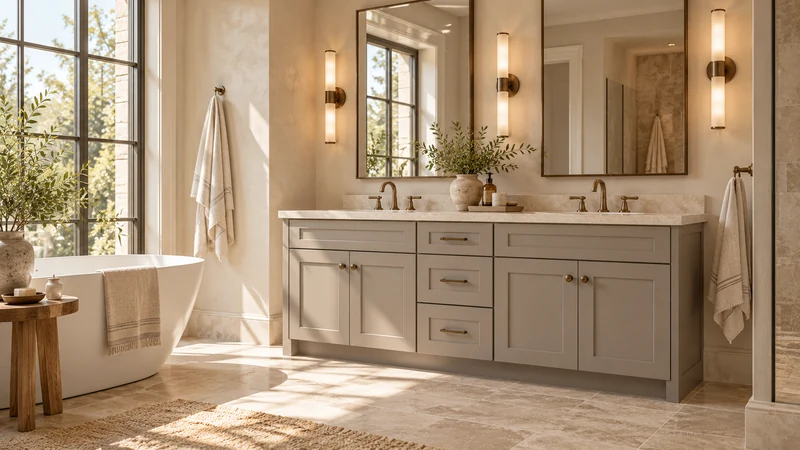
Does every drawer-shaped vanity front provide storage?
No. Confirm which fronts operate, what each opens onto and whether an actual drawer box is present before using the exterior design to estimate storage.
A vanity can have a balanced arrangement of horizontal fronts without providing a working drawer behind every one. That distinction matters when you expect a convenient home for small daily items near the basin. A handle, seam or drawer-like proportion describes the appearance; it does not establish the function. Read the front elevation together with the interior configuration before assigning your belongings to the cabinet.
Separate appearance from operation
Mark each visible front on the proposed elevation as a working drawer, hinged door, fixed panel or another specifically described component. Leave uncertain fronts marked unresolved. Do not infer movement from a pull or assume matching fronts have matching mechanisms. A showroom configuration or rendering may also differ from the model and options you intend to order.
For a concrete manufacturer example, PALET's vanity with a false drawer identifies that front as decorative. This supports a narrow point: a drawer-shaped front can be specified without providing drawer storage. It does not establish the configuration of another brand or of a cabinet selected for your project.
Design study The design study shows horizontal front divisions around the basins. A closed exterior cannot confirm which fronts contain working drawers.
Ask what is actually behind the front
A useful interior drawing should show whether there is a box, a shelf, an open bay or space occupied by the basin and associated components. Ask for the relevant view of the exact configuration. The absence of a drawer box is not necessarily a defect; it may be part of the intended assembly. The purchasing problem arises when the buyer counts that area as storage without confirmation.
Distinguish a fixed false front from a specified tip-out accessory or a true shallow drawer. Those functions are not interchangeable. A panel that can be removed for a particular service task also does not become a daily storage compartment. Only include an accessory in the plan when it is explicitly compatible with the cabinet and the selected basin installation.
Convert the elevation into a storage assignment
Place the household's priority items on a list, then assign them only to confirmed usable compartments. Small daily products that seemed destined for the front directly below the basin may need a side drawer or another accessible location. Do this before choosing organizers, since an attractive organizer cannot create a drawer box behind a fixed panel.
Review the operation as well as the count. A stack of actual drawers on the side may serve the routine well even when the central upper front is fixed. Conversely, a cabinet with many visible front divisions can still leave the user without a convenient shallow compartment. Judge whether the required storage exists where it will be used, rather than treating visual symmetry as a capacity diagram.
Work through an apparent match
Imagine a hypothetical replacement project in which the current vanity has a shallow working drawer beside the basin. The buyer selects a new elevation with similarly proportioned upper fronts and plans to move that drawer's contents into the front immediately under the new basin. The interior specification reveals that the chosen front is fixed and that the available side drawers have a different arrangement.
The buyer now tests the daily kit in a confirmed side drawer and checks its location during the grooming routine. If that works, the cabinet can remain a candidate with a revised storage plan. If the necessary shallow compartment is absent, the buyer chooses another configuration before ordering. The useful correction is to the functional assignment, not merely to the cabinet's visual resemblance to the old vanity.
Do not rely on a later conversion
Recheck the function map if the basin location or cabinet configuration changes before ordering. A drawing for an earlier arrangement is not evidence of the final interior. Carry the updated assignments into the selected configuration so an otherwise useful revision does not silently remove a needed compartment.
Changing a fixed panel into an opening is a separate design question involving the intended construction, available space and any compatible hardware. A basin or plumbing component may occupy the very area that appears unused from the front. Do not purchase a cabinet on the assumption that a generic kit, improvised hinge or cutout will produce the missing storage afterward.
Keep the confirmed front functions with the final cabinet drawing and order description. If a seller's wording or image remains ambiguous, resolve that exact front before relying on it. A fixed panel can be perfectly appropriate when the rest of the cabinet serves the household; it becomes a poor surprise only when the storage plan depends on a drawer that was never specified.
Pure White
Cream White
Light Warm Gray
Gray
Navy
Black
Oak Tone
Dark Walnut Tone
Design study These finish studies are design references, not a list of currently orderable colors. Screens and lighting change the appearance; compare a physical sample before choosing.See all finish options →
Compare the same toiletries, reserve items and access tasks in both interiors; choose the format that makes the important objects easiest to retrieve while accommodating the actual plumbing.
Use a lower storage zone and an upper layer only when both remain accessible; judge the arrangement by the work required to retrieve and return the lower items.
Choose a removable tray when lifting out a useful group improves the routine or cleaning access, and choose fixed divisions when the items are better retrieved individually from stable positions.
The sample shows the door frame, a separate center panel, the face frame and the cabinet box. Each component has its own place in this Shaker construction.
Shaker construction: door frame, center panel, face frame and cabinet box. The cutaway helps locate these parts; confirm each material in the specifications for the selected cabinet.
01 / Door frame
The Shaker door has rails and stiles around a separate center panel. The frame and center panel are different components; confirm their materials in the specifications for the selected cabinet.
02 / Face frame
The face frame surrounds the opening at the front of the cabinet box and sits behind the doors. The face frame, door frame and cabinet box are separate parts.
03 / Cabinet box
The sample exposes the cabinet sides, interior surfaces and layered edges. The image does not establish the wood species or material specification of a selected cabinet.