Should you choose a plumbing drawer or doors below the basin?
Compare the same toiletries, reserve items and access tasks in both interiors; choose the format that makes the important objects easiest to retrieve while accommodating the actual plumbing.
A drawer shaped around plumbing can bring small items forward, while a door compartment may accommodate objects that do not suit the drawer's divided floor. Neither description establishes the better purchase. The useful comparison begins with the household's collection and the proposed basin, drain and valves. A generous cabinet exterior or an attractive open-drawer photograph cannot show how that particular combination will work.
Give both options the same assignment
Separate the objects that must live below the basin from things that can reasonably go elsewhere. Include everyday products, occasional supplies and any larger container the household intends to keep there. Use their actual packaging, with lids and handles in the positions needed for storage. Do not make the drawer look better by removing its awkward objects while leaving them in the door-cabinet test.
Record which items must be reached quickly and which can tolerate additional handling. The comparison is not simply how much fits. A daily product hidden behind a large reserve container can be more troublesome than an occasional item stored in the same position. If an object has specific storage guidance, that guidance takes precedence over making either cabinet appear more efficient.
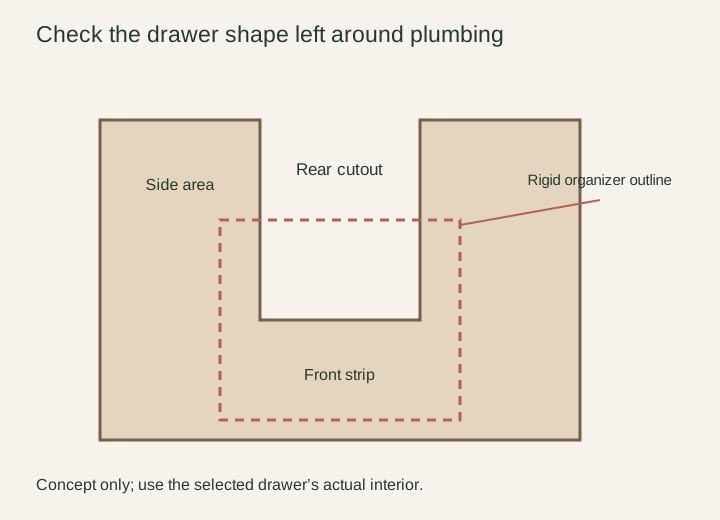
Diagram This conceptual cutout illustrates why the same inventory must be tested in each cabinet. Actual plumbing drawers vary; the diagram is not a product specification.
Test the drawer as a moving interior
Use the selected drawer's interior drawing, including the plumbing cutout, side compartments and usable height. Place the collection in those actual regions. A rectangular organizer cannot borrow empty area across a notch, and a tall package cannot occupy space reserved for the basin or drawer above. Check the drawer through its intended travel, with the specified plumbing arrangement represented.
Then retrieve the priority objects. Does pulling the drawer forward make them visible and easy to grasp, or do narrow sections leave a crowded row of bottles? Include the movement needed to return each item. A layout that works only when everything is packed in a precise order may be inconvenient for a shared bathroom. Use the cabinet manufacturer's operating and loading guidance for the chosen model.
Test the door compartment beyond its empty volume
Map the door opening, hinges, internal divisions and plumbing before arranging the same collection. Check whether the user can reach the back without removing the front row, and whether a larger container can pass through the opening. An interior may hold an object that cannot be inserted or retrieved conveniently in the finished room.
Try the actual door swing with the user's stance and nearby fixtures. A broad open bay can be useful, but its contents may require reaching or bending that a particular household would rather avoid. Do not assume an added pullout will solve this later: compatibility, clearances and the access route for that accessory must be established separately before including its benefit in the comparison.
Compare a worked household choice
In a hypothetical household, the required collection includes small daily containers and a rigid grooming caddy used occasionally. The plumbing drawer presents the daily containers clearly, but the caddy bridges its central notch and cannot sit properly. The door compartment accepts the caddy, yet the daily items become difficult to reach when arranged behind it. Both layouts have a real limitation.
The household finds a convenient existing location for the occasional caddy, then repeats the drawer test using the revised inventory. That change makes the drawer a reasonable choice. If the caddy must stay below the basin and cannot be divided, the door option may instead deserve priority, with daily items placed at the accessible front. The decision changes because the assignment changes, not because either cabinet type is inherently superior.
Include maintenance before choosing
Test the comparison with the intended user, not only the person preparing the drawing. Someone may prefer seeing items from above, while another may find the loaded drawer's opening action awkward. Record that observed difference without turning a cabinet format into a general promise of accessibility.
Ask how the selected assembly allows the shutoff valves and drain connections to be reached for the work anticipated by the installer. Distinguish moving stored objects from removing cabinet components. A removable drawer may help in a particular design, but do not assume removal is simple, sufficient or intended for routine household use without the product instructions.
Keep a comparison showing the same inventory, unresolved fit issues and the access tasks that actually improved. Choose only after the plumbing layout and cabinet configuration agree. When neither arrangement serves the required objects and access needs, reconsider the storage assignment or cabinet layout rather than accepting a difficult routine based on a drawer count or an empty-door photograph.
Pure White
Cream White
Light Warm Gray
Gray
Navy
Black
Oak Tone
Dark Walnut Tone
Design study These finish studies are design references, not a list of currently orderable colors. Screens and lighting change the appearance; compare a physical sample before choosing.See all finish options →
Choose a removable tray when lifting out a useful group improves the routine or cleaning access, and choose fixed divisions when the items are better retrieved individually from stable positions.
No. Confirm which fronts operate, what each opens onto and whether an actual drawer box is present before using the exterior design to estimate storage.
Choose an interior bin only if ordinary disposal, opening the bin, removing the liner and returning the container all work with the actual cabinet and plumbing.
The sample shows the door frame, a separate center panel, the face frame and the cabinet box. Each component has its own place in this Shaker construction.
Shaker construction: door frame, center panel, face frame and cabinet box. The cutaway helps locate these parts; confirm each material in the specifications for the selected cabinet.
01 / Door frame
The Shaker door has rails and stiles around a separate center panel. The frame and center panel are different components; confirm their materials in the specifications for the selected cabinet.
02 / Face frame
The face frame surrounds the opening at the front of the cabinet box and sits behind the doors. The face frame, door frame and cabinet box are separate parts.
03 / Cabinet box
The sample exposes the cabinet sides, interior surfaces and layered edges. The image does not establish the wood species or material specification of a selected cabinet.