Should a small bathroom waste bin go inside the vanity?
Choose an interior bin only if ordinary disposal, opening the bin, removing the liner and returning the container all work with the actual cabinet and plumbing.
Hiding a waste bin can make a bathroom look calmer, but its closed footprint tells only part of the story. The lid may need additional room, a pedal may be inaccessible behind a door and removing a filled liner can require a different path from inserting an empty bin. Compare the complete everyday task with the storage space you give up. An interior location is useful when it remains practical after the novelty of a hidden bin wears off.
Decide how the household will use it
Identify the ordinary bathroom waste the container is intended to receive and how often the household expects to access it. Evaluate access from the activities that generate that waste, rather than from a staged position directly in front of the cabinet. A door that must be opened before each small disposal adds a step; decide whether the household finds that acceptable.
Choose the actual bin type before allocating the compartment. An open container, a hinged lid and a pedal-operated bin have different operating movements. A pedal may work well on an open floor but poorly when a cabinet door and toe area block the foot's approach. Do not select the interior dimensions from the bin body while leaving the operating method undecided.
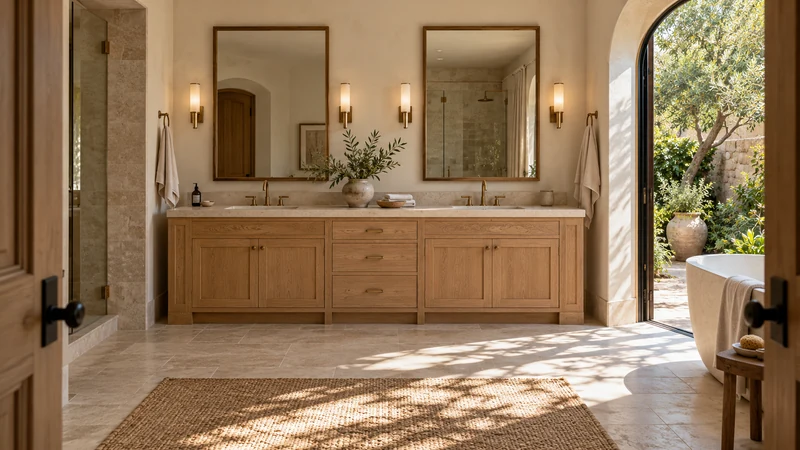
Design study Design study: closed cabinet fronts conceal the interior, where a bin would need operating and removal space as well as a place to stand.
Measure the operating space, not only the resting size
Include the bin's rim, handle, hinge and lid in the comparison with the selected cabinet interior. Check nearby basin components, pipes, shelves and door hardware. If the bin must slide or lift forward before it opens, include that movement and the place it occupies outside the cabinet. A solution that requires moving other stored items at every use is a different proposition from an accessible dedicated compartment.
In a hypothetical example, the available cabinet height is 18 inches and the closed bin is 14 inches tall. The selected lid requires 6 inches of additional height when fully opened, making the operating height 20 inches. It exceeds the available space by 2 inches, even though the closed bin fits. These are teaching dimensions, not a product specification or required clearance.
The decision could be a different suitable bin, a compartment with adequate operating space or an exterior location. Do not assume that leaving the lid partly open delivers the intended use. Test the selected product's complete operation in the proposed position, and keep the cabinet's existing access requirements intact.
Rehearse liner removal and replacement
The container's empty insertion path is not necessarily the same as the route needed for servicing it. Try the actual method for removing the liner or lifting the inner bucket, according to the bin's design. Include the handle in its raised position and the opening through which the container must pass. Check the room for a place to set the bin while changing the liner.
Use an appropriate clean mock load to understand the handling shape, rather than judging only an empty bag. A liner may spread above the rim or be awkward to gather when the basin is directly overhead. If the intended method requires removing the whole bin, confirm that it comes out without detaching plumbing or unrelated fixed cabinet parts. The service task should be an ordinary repeatable action.
Then fit the new liner and return the bin. A container that is easy to take out but difficult to reseat can gradually migrate to the bathroom floor. Check whether handles, liner edges or the lid prevent the cabinet from closing. The relevant comparison is the complete cycle, including the reset, not a successful initial placement.
Count the storage tradeoff and cleaning access
Mark the bin's complete operating area on the cabinet drawing and compare it with the items displaced. A hidden bin can consume a useful door compartment that would otherwise hold daily supplies. That exchange may be worthwhile, but count the space needed for movement as well as the bin itself. Do not claim the remaining gaps as convenient storage if using them would obstruct disposal or removal.
Review how the bin and surrounding interior can be reached for ordinary cleaning under their applicable care instructions. A removable container may simplify access, while a fixed organizer may add surfaces or corners that are harder to reach. Judge the actual selected arrangement. Concealment does not make the task disappear, and a liner does not establish that every surrounding surface remains accessible.
Test the cabinet choice before committing
Compare an interior and exterior location through the same sequence: approach, dispose, operate the lid if present, service the liner and restore the room. Include the intended user and the actual door opening. Keep any required plumbing access separate from the allocated bin area. Choose the location whose whole routine works, even if the answer is that the vanity's limited interior is more useful for another purpose.
Pure White
Cream White
Light Warm Gray
Gray
Navy
Black
Oak Tone
Dark Walnut Tone
Design study These finish studies are design references, not a list of currently orderable colors. Screens and lighting change the appearance; compare a physical sample before choosing.See all finish options →
Choose a defined storage location that meets the products' labels and household access requirements, then test the original containers and the complete removal-and-return task.
Choose a removable tray when lifting out a useful group improves the routine or cleaning access, and choose fixed divisions when the items are better retrieved individually from stable positions.
The sample shows the door frame, a separate center panel, the face frame and the cabinet box. Each component has its own place in this Shaker construction.
Shaker construction: door frame, center panel, face frame and cabinet box. The cutaway helps locate these parts; confirm each material in the specifications for the selected cabinet.
01 / Door frame
The Shaker door has rails and stiles around a separate center panel. The frame and center panel are different components; confirm their materials in the specifications for the selected cabinet.
02 / Face frame
The face frame surrounds the opening at the front of the cabinet box and sits behind the doors. The face frame, door frame and cabinet box are separate parts.
03 / Cabinet box
The sample exposes the cabinet sides, interior surfaces and layered edges. The image does not establish the wood species or material specification of a selected cabinet.