How can you tell whether tall toiletries will fit a vanity drawer?
Measure the product in its normal stored configuration and test its path into the closed drawer, using actual interior dimensions rather than the drawer-front height.
A bottle that looks shorter than a drawer front may still be too tall for the usable interior. The drawer bottom, the structure above and the chosen organizer all affect the space available. The bottle itself may also be taller after a pump or dispensing attachment is fitted. Start with the complete product as the household intends to store it, then compare both its resting position and the movement needed to put it away.
Measure the complete item, not its container alone
Include the cap, pump, spray head or other attachment that will normally remain on the product. If the packaging drawing gives a body dimension, do not assume it includes the entire assembly. Check the actual item where possible. Also record its footprint and any handle or projection that affects neighboring objects, so a height solution does not create a crowding problem across the drawer.
Distinguish a shipping configuration from the state used in the bathroom. The ability to remove an attachment for transport does not mean removing it every day is an acceptable storage routine. Decide what the household intends to keep assembled. Any change in orientation or container should follow the product's own instructions; do not assume every bottle may be stored on its side simply because it fits that way.
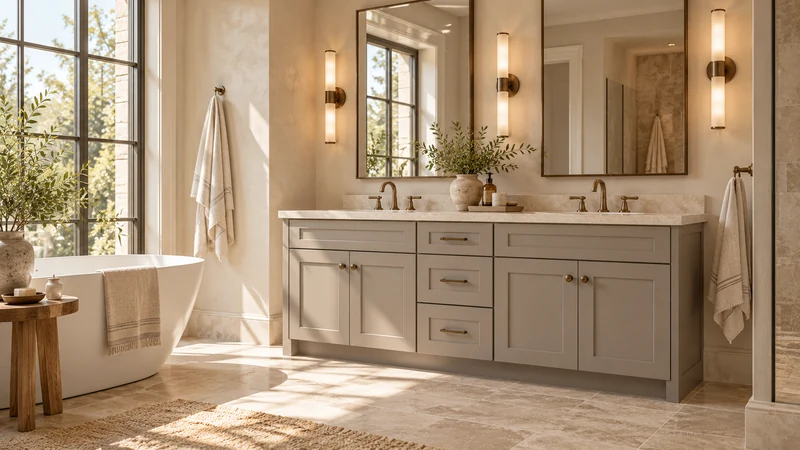
Design study Design study: drawer fronts show the furniture composition, while tall-item fit requires the actual interior and the complete bottle assembly.
Find the usable height along the whole route
Request the actual drawer interior dimensions for the selected cabinet configuration. Identify where height is measured and what sits above the drawer. A basin, rail or other fixed component can affect a specific area even when the front looks tall. Include the thickness and shape of any organizer placed on the drawer bottom, using the selected organizer's real dimensions.
Then follow the item into storage. Check whether it can pass the opening, sit in its assigned position and remain clear as the drawer closes. The narrowest point on that route may differ from the space above its final resting place. If the assessment relies on tilting the bottle, test the real motion and confirm that the product is suitable for it rather than treating tilting as a universal fix.
Work through a height comparison
In a hypothetical example, a drawer provides 8 inches of clear usable height at the proposed bottle position. The product is 7 inches tall with its transport cap but 9 inches tall with the pump the household intends to leave attached. It fits by the capped measurement but exceeds the available height by 1 inch in the intended stored state. These are teaching dimensions, not a cabinet specification.
The purchasing decision should use the assembled configuration. Compare a suitable taller compartment, another appropriate storage location or a product format the household actually wants to use. Do not count the bottle as fitting while quietly assuming the user will remove and reinstall the pump after every use. A storage arrangement that depends on a disliked extra step is unlikely to deliver the convenience expected from the new vanity.
The same review should include getting the item back out. A bottle may stand inside a deep compartment but be awkward to grasp when crowded by neighboring products. Leave the intended retrieval method visible in the plan. The goal is not just a successful photograph with the drawer open; it is repeated access with the actual stored group.
Compare drawer and door storage honestly
If the preferred drawer cannot accommodate the tall item, compare a door compartment with an appropriately reviewed shelf arrangement. Check the opening and access route there as carefully as for the drawer. A door-front cabinet is not automatically tall storage, particularly when the basin and plumbing occupy the relevant zone. Use the actual interior configuration to decide where the product can live.
Separate the needs of the tall daily item from those of short accessories. Moving every product to a deeper compartment may waste the easy visibility of a shallow drawer. A mixed arrangement can be more useful: tall items in a suitable location and smaller items where they are easy to find. The choice should follow the real inventory rather than a preference for every bottle sharing a category.
Confirm fit again when the format changes
Keep a short record of the tallest assembled items and the locations that accommodate them. Recheck when a pump, package size or organizer changes; the cabinet can remain identical while the stored assembly changes enough to matter. Before buying the vanity, confirm resting height, entry movement, closing clearance and retrieval for the selected interior. That is stronger evidence of fit than a comparison between bottle height and drawer-front height alone.
Pure White
Cream White
Light Warm Gray
Gray
Navy
Black
Oak Tone
Dark Walnut Tone
Design study These finish studies are design references, not a list of currently orderable colors. Screens and lighting change the appearance; compare a physical sample before choosing.See all finish options →
Give daily products the space needed for convenient use, then place replenishment stock in a suitable reserve location with a clear route back to the bathroom.
Plan a place for the complete, ready-to-store tool and its accessories, while following the appliance instructions for use, cooling and care before it enters the cabinet.
The sample shows the door frame, a separate center panel, the face frame and the cabinet box. Each component has its own place in this Shaker construction.
Shaker construction: door frame, center panel, face frame and cabinet box. The cutaway helps locate these parts; confirm each material in the specifications for the selected cabinet.
01 / Door frame
The Shaker door has rails and stiles around a separate center panel. The frame and center panel are different components; confirm their materials in the specifications for the selected cabinet.
02 / Face frame
The face frame surrounds the opening at the front of the cabinet box and sits behind the doors. The face frame, door frame and cabinet box are separate parts.
03 / Cabinet box
The sample exposes the cabinet sides, interior surfaces and layered edges. The image does not establish the wood species or material specification of a selected cabinet.