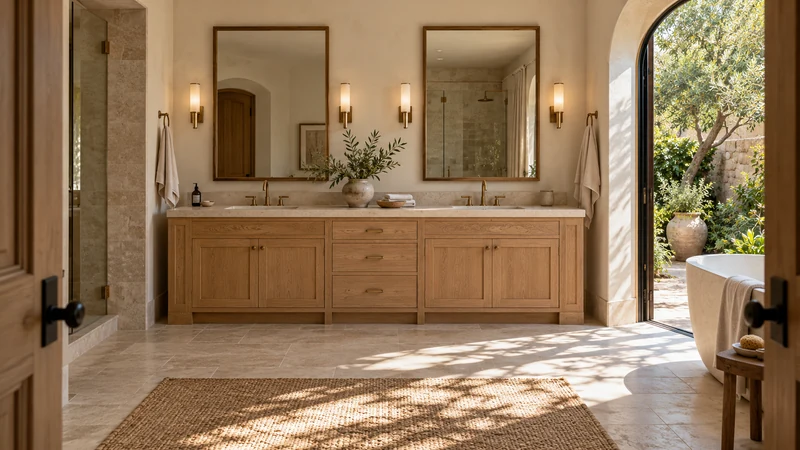
A tidy drawer can still be poorly assigned. If finishing a routine requires reopening the same drawer, moving another kit or leaving the cabinet to fetch a small item, the arrangement may look organized without saving effort. Begin with a specific routine and follow it all the way through. Choose drawer locations around the actions, then use containers or dividers only where they help those actions remain easy to repeat.
Observe a complete routine, including the reset
Choose an ordinary morning or evening sequence and lay out the products and equipment it actually uses. Record the order of retrieval, where items are placed during use and when they are ready to return to storage under their applicable care instructions. Do not stop the observation at the moment everything comes out of the drawer. Putting it away is often the step that reveals a poor allocation.
Distinguish items used together from items that merely look alike. A small mirror and a grooming brush may belong to the same preparation sequence even though their shapes differ. Conversely, bottles with similar packaging can belong to different activities. Grouping entirely by appearance may make the interior attractive while forcing the user to search several areas to complete a simple task.
Keep occasional supplies out of this first test. The purpose is to learn the everyday path, not to fit the entire household inventory into the most convenient drawer. Once that path is understood, assign less frequently used items to the remaining appropriate areas. Storage priorities become easier to explain when they follow actual repeated use.
Design study Design study: the central drawer stack offers separate possible retrieval locations; the right assignment depends on the complete daily routine.
Assign a retrieval position and a temporary landing
Check each proposed drawer from the position where the task happens. Can the user open it without moving away from the useful mirror or blocking the place where the kit will sit? Include the drawer's open position, not just its closed front. A convenient closed location can become awkward when the extended drawer occupies the user's standing space.
Plan where retrieved items wait while the task is underway. A drawer is a storage location, but it does not automatically provide a suitable work surface. If the kit needs to open on the counter, reserve that landing space in the test. A routine that depends on balancing items on the basin edge has not been resolved merely because everything fits neatly when stored.
The arrangement can combine a daily kit with separate items that need another location. Keep product-specific storage and care requirements in view. Do not force every object into a single drawer for the sake of completing a set. The aim is a clear sequence with appropriate places, not an absolute rule that the whole routine must live together.
Test a worked allocation before buying organizers
Imagine a hypothetical routine that uses a grooming pouch, a comb and a small mirror. The pouch fits the upper drawer, but the mirror is placed below it in the same compartment. Every morning, the user removes the pouch, lifts the mirror and then sets both on the counter. Every reset requires restoring the same stack. The drawer fits the inventory, yet its arrangement adds handling to the repeated sequence.
Compare a side-by-side layout in a wider usable drawer, a separate nearby position for the mirror or a removable kit that keeps the necessary items together without burying them. Try the complete sequence with the actual objects. The best choice is the one that makes retrieval and return straightforward while respecting the available cabinet shape; a more elaborate divider is not automatically an improvement.
Repeat the test with the drawer closing and the counter returned to its normal state. If an item has no natural return position, it is likely to become a permanent counter resident. Change the allocation before buying a fitted organizer. This trial can reveal that a shallow, easily scanned compartment is more valuable for the routine than unused depth elsewhere.
Keep the arrangement understandable as habits change
Give each daily item a stable location and leave enough flexibility for the routine to evolve. A new container shape or a different preparation sequence can make a once-useful compartment awkward. Revisit the affected area rather than rebuilding the entire vanity arrangement whenever something changes. The record can be as simple as a drawer sketch showing the task group and its landing place.
Judge the result by what happens after an ordinary use: the user can find the needed items, complete the task and return them without displacing unrelated supplies. That is a more useful measure than whether every drawer is equally full. A successful allocation supports a repeatable daily sequence and gives the household a clear reason for where things belong.
Pure White
Cream White
Light Warm Gray
Gray
Navy
Black
Oak Tone
Dark Walnut Tone
Design study These finish studies are design references, not a list of currently orderable colors. Screens and lighting change the appearance; compare a physical sample before choosing.See all finish options →
Give daily products the space needed for convenient use, then place replenishment stock in a suitable reserve location with a clear route back to the bathroom.
Measure the product in its normal stored configuration and test its path into the closed drawer, using actual interior dimensions rather than the drawer-front height.
Plan a place for the complete, ready-to-store tool and its accessories, while following the appliance instructions for use, cooling and care before it enters the cabinet.
The sample shows the door frame, a separate center panel, the face frame and the cabinet box. Each component has its own place in this Shaker construction.
Shaker construction: door frame, center panel, face frame and cabinet box. The cutaway helps locate these parts; confirm each material in the specifications for the selected cabinet.
01 / Door frame
The Shaker door has rails and stiles around a separate center panel. The frame and center panel are different components; confirm their materials in the specifications for the selected cabinet.
02 / Face frame
The face frame surrounds the opening at the front of the cabinet box and sits behind the doors. The face frame, door frame and cabinet box are separate parts.
03 / Cabinet box
The sample exposes the cabinet sides, interior surfaces and layered edges. The image does not establish the wood species or material specification of a selected cabinet.