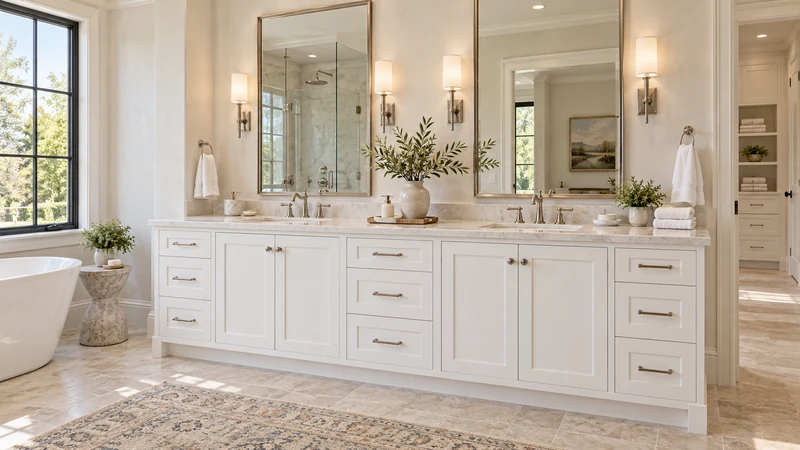
Where should bulk bathroom supplies live when the vanity is small?
Give daily products the space needed for convenient use, then place replenishment stock in a suitable reserve location with a clear route back to the bathroom.
A large package can fit inside a vanity and still make the cabinet less useful. If unopened reserves occupy the easiest drawer, the products used every morning may end up on the counter. Start by separating daily use from replenishment. The cabinet's job is not automatically to hold every package associated with the bathroom; it should support the routine while the household can find and replace supplies without unnecessary searching.
Separate active products from reserve stock
Identify what is currently in use, what is a replacement for it and what is merely being kept because it arrived in a multipack. Record the actual products rather than treating all similar bottles as interchangeable. A reserve is useful only if the household recognizes it as the appropriate replacement when needed. Keep the relevant identity, instructions and storage requirements with the products.
Do not make the most convenient drawer the default home for unopened stock. First establish what space the daily routine needs. Then consider a nearby cabinet, linen storage or another suitable household location for the remainder, subject to the product's own storage requirements and the household's access needs. The closest possible location is not always the most useful allocation of limited space.
Design study Design study: the doorway toward linen storage suggests a separate location to evaluate for reserves, subject to the products and actual household route.
Measure the package and the replenishment unit
Decide whether the reserve will stay in its outer package or be stored as individually identified units. Compare both forms with the actual shelf or drawer. Include the package's opening and the ability to remove a replacement without unloading unrelated contents. A carton that fits tightly may become awkward once it is opened or partly empty.
If removing outer packaging is appropriate, retain the information needed to identify and use the products. Do not turn the exercise into transferring unknown contents into unlabeled containers. The storage plan should make the reserve easier to recognize, not make similar-looking items harder to distinguish. A clear package-facing arrangement may be more useful than a visually uniform row of anonymous bottles.
Compare the cost in useful cabinet space
Imagine a hypothetical small vanity whose upper drawer can hold the household's daily grooming kit. A newly purchased multipack also fits there, so the kit moves to the counter. The reserve now has an excellent location but the repeated routine has become less convenient. This is a storage tradeoff, even though the household has not run out of total interior volume.
The buyer tests a different arrangement: active products remain in the vanity, while the recognized replacements occupy a suitable reserve shelf elsewhere. The test includes carrying a replacement to the bathroom and returning the remaining stock to an orderly position. If that route is easy to repeat, the reserve shelf can serve the occasional task without sacrificing the daily drawer.
If the alternative location is difficult to reach, mixed with unrelated items or routinely forgotten, the plan needs revision. Perhaps a smaller immediate reserve belongs nearby and the rest stays in another clearly identified location. Choose the arrangement from the actual household behavior rather than imposing a rule that all bulk products must be far away or all must remain under the basin.
Make replenishment easy to notice and complete
Choose a simple point in the routine for checking the reserve, such as when the active product is replaced. The household should be able to see what remains without opening every container. Keep current reserves distinguishable from empty packaging or products no longer used. A cabinet that appears full can hide the fact that the needed replacement is absent.
Assign a recognizable place for each reserve group and tell the people who replenish it where it belongs. When a new pack arrives, check that it fits the planned space before forcing other categories aside. If bulk purchases repeatedly exceed the available suitable storage, reconsider the package choice or reserve allocation. Adding a larger vanity is not the only possible response to an inventory habit.
Judge the arrangement by the refill task
Try a complete replenishment: locate the correct product, remove it, bring it to the point of use and leave the remaining stock easy to understand. Confirm that the product's storage instructions and household access requirements are still met. If the process works, the reserve does not need to occupy the most convenient daily compartment.
Keep a brief note of where active products and reserves belong, especially when they are in different rooms. Revisit the arrangement when package sizes or household routines change. The useful outcome is a vanity that supports daily use and a reserve system that actually supplies it, rather than a cabinet filled with future replacements while today's items have nowhere to go.
Pure White
Cream White
Light Warm Gray
Gray
Navy
Black
Oak Tone
Dark Walnut Tone
Design study These finish studies are design references, not a list of currently orderable colors. Screens and lighting change the appearance; compare a physical sample before choosing.See all finish options →
Measure the product in its normal stored configuration and test its path into the closed drawer, using actual interior dimensions rather than the drawer-front height.
Plan a place for the complete, ready-to-store tool and its accessories, while following the appliance instructions for use, cooling and care before it enters the cabinet.
The sample shows the door frame, a separate center panel, the face frame and the cabinet box. Each component has its own place in this Shaker construction.
Shaker construction: door frame, center panel, face frame and cabinet box. The cutaway helps locate these parts; confirm each material in the specifications for the selected cabinet.
01 / Door frame
The Shaker door has rails and stiles around a separate center panel. The frame and center panel are different components; confirm their materials in the specifications for the selected cabinet.
02 / Face frame
The face frame surrounds the opening at the front of the cabinet box and sits behind the doors. The face frame, door frame and cabinet box are separate parts.
03 / Cabinet box
The sample exposes the cabinet sides, interior surfaces and layered edges. The image does not establish the wood species or material specification of a selected cabinet.