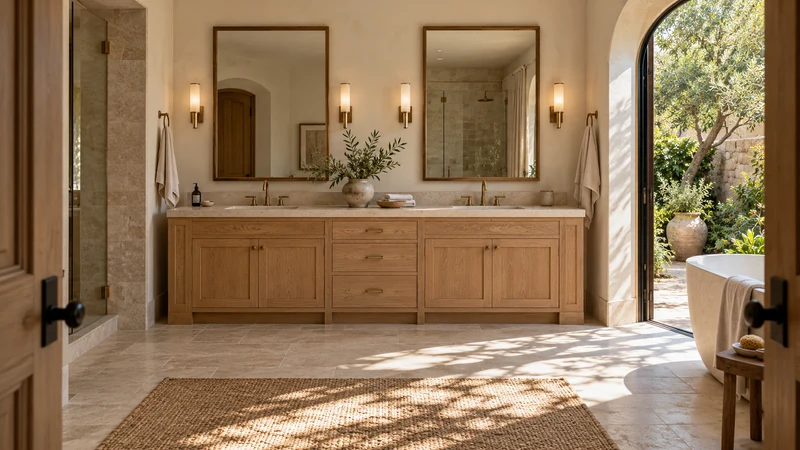
Set up a vacation-home vanity for arrival, departure and the time between
A bathroom used in visits needs a different storage routine from one used every day. Keep the arrival kit, local supplies and departure check easy to distinguish.
A vacation-home vanity should work when you arrive after time away, not only during a normal morning. It is easy to accumulate partly used bottles, duplicate supplies and items nobody remembers leaving behind. Organize the cabinet around what stays at the property, what travels with the user and what gets checked before departure. This is a storage plan for intermittent use, not a substitute for the property’s care or closing procedures.
Make the first-use items easy to find
Place the small set needed on arrival where it is visible without unloading the cabinet. Choose that set from the household’s actual routine rather than stocking every possible product. A clearly assigned drawer or removable tray can make it obvious what is present and what is missing. Avoid burying this set behind bulk packages that are rarely opened during a short stay.
Run through arriving with a travel bag. Decide whether personal items remain in that bag or use a temporary cabinet area. Do not fill every usable drawer with permanent supplies and then expect the counter to absorb everything visitors bring. The arrival arrangement should leave the basin usable and give damp items an appropriate place to dry before they are put away.
Separate the property’s supplies from traveling belongings
Assign a permanent home to shared items that stay at the property and a flexible area to things that leave with the user. The distinction helps when several family members use the home at different times. It also prevents a person from treating an unfamiliar personal bottle as a shared replacement simply because it was left in the vanity.
For example, place the property’s unopened replacement supplies in a labeled grouping, while a removable personal tray is emptied at departure. The grouping is useful only if people can see what belongs in it. A deep mixed pile can hide an empty package and trigger unnecessary shopping. Keep labels and the storage arrangement simple enough that someone returning months later can understand them.
Design study A central drawer can be considered for an arrival grouping, subject to its real interior. This design image does not establish capacity or suitability for a seasonally vacant property.
Buy and store according to real visits
Choose reserve quantities from actual use, the length of a typical visit and how supplies can be replenished. Do not fill a large vanity just because the space is available. Keep packaging directions and relevant product information with the supplies, and remove items that should not remain in the room under their own storage instructions. Cabinet organization does not extend a product’s useful life.
Reserve storage should be easy to inspect without disturbing the arrival set. If the vanity interior is divided by plumbing, use the available sections deliberately rather than pushing packages into unseen corners. Keep access to the cabinet and any required service points available. A shelf full of supplies should not conceal the area someone needs to inspect.
Include an inspection that a real person can finish
Before leaving, remove traveling belongings, check for forgotten items and return the shared set to its assigned place. Look at the cabinet interior and visible connections for changes that need attention through the property’s normal maintenance process. Do not seal damp towels or wet organizers inside simply to make the room look tidy. Follow the selected cabinet’s care instructions.
Keep a short restocking note where the next user can find it, without storing private travel details in a shared list. The useful cabinet choice offers accessible daily storage and inspectable reserve areas; it does not require a complicated sorting system to remain usable. When comparing vanities, test both arrival and departure. A cabinet that works only after a long reorganization is a poor fit for occasional visits.
Pure White
Cream White
Light Warm Gray
Gray
Navy
Black
Oak Tone
Dark Walnut Tone
Design study These finish studies are design references, not a list of currently orderable colors. Screens and lighting change the appearance; compare a physical sample before choosing.See all finish options →
A garage shell measurement is not a cabinet-order dimension. Follow the wall buildup, floor plan and bathroom entry through to the finished vanity location.
The sample shows the door frame, a separate center panel, the face frame and the cabinet box. Each component has its own place in this Shaker construction.
Shaker construction: door frame, center panel, face frame and cabinet box. The cutaway helps locate these parts; confirm each material in the specifications for the selected cabinet.
01 / Door frame
The Shaker door has rails and stiles around a separate center panel. The frame and center panel are different components; confirm their materials in the specifications for the selected cabinet.
02 / Face frame
The face frame surrounds the opening at the front of the cabinet box and sits behind the doors. The face frame, door frame and cabinet box are separate parts.
03 / Cabinet box
The sample exposes the cabinet sides, interior surfaces and layered edges. The image does not establish the wood species or material specification of a selected cabinet.