

Construction & materials
Tru-Form cabinet veneer: wood species and controlled grain
A buyer can require the named wood species and still investigate an engineered grain format. Compare the actual finished faces, their panel construction and their place in the cabinet group without treating consistency as permanent identity.
A cabinet buyer who wants the actual named wood species and a controlled grain appearance does not have to treat those preferences as the same requirement. State both, then investigate the product formats that can meet them. Tru-Form is a manufacturer example worth reviewing in that discussion. The purchase still depends on actual finished faces and a complete panel proposal, rather than assuming that an engineered description either removes the wood species or guarantees a permanently identical kitchen.
FormWood describes Tru-Form as engineered from flitches of the actual species represented, with controlled comb grain and a stainable surface, offered as sheets and panels. The published description does not disclose every manufacturing step.
Reading note: FormWood: Tru-Form controlled-grain actual-species veneer.
Write the species requirement before the appearance shorthand
If actual walnut or another specified species is essential, say so plainly. A wood-like pattern name and a verified species description answer different questions. At the same time, explain the desired appearance: straighter grain, a quieter field, or a particular amount of natural variation. Do not expect a species word alone to communicate all of that.
This gives the provider a real brief. It can investigate the documented format and compare it with other proposals without quietly substituting a lookalike material. A buyer whose priority is only the appearance may choose differently. The point is to preserve the actual requirement before evaluating which sample looks most appealing.
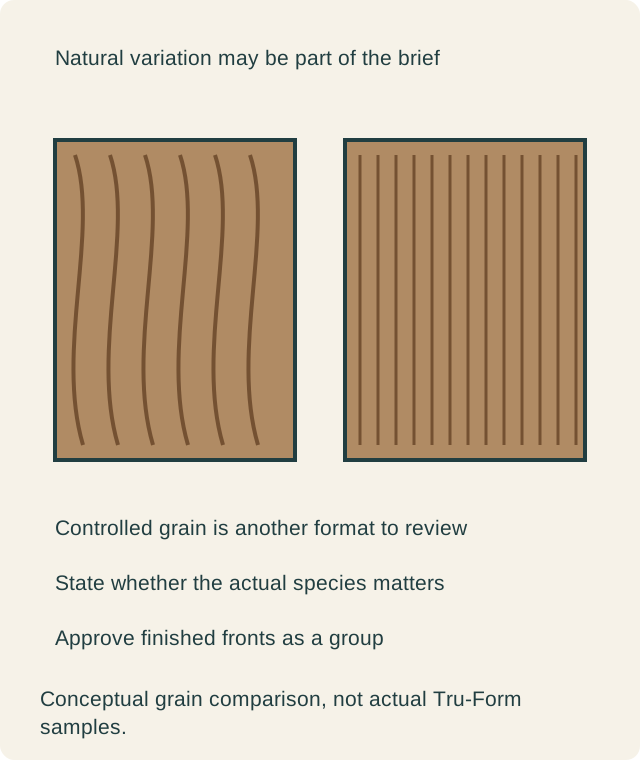
A controlled format should be compared with representative natural faces
Ask for the provider’s available way to show both proposals fairly. One exceptionally quiet natural sample and one unusually varied sample are not a useful description of the full choice. The household should see enough of the offered appearance to understand what it is selecting and which variation remains part of the order.
Compare at the intended cabinet scale. A straight-grain face on a tall front can read differently from the same general direction across stacked drawers. Put representative finished examples beside the planned elevation. The decision is about the pattern the room will contain, rather than whether a loose sheet looks impressively uniform on a table.
Stainability is a reason to make a finished sample
If the design needs a stain, have the selected veneer finished through the proposed process before approving color. A stainable description does not demonstrate the appearance of the buyer’s intended stain and topcoat. Do not use an unfinished veneer sample as though it already represents the delivered door.
Keep the wood selection and finish record connected. If a different face product is proposed later, review the completed alternative again. Similar raw colors do not settle the final result. The provider should show the surface it actually intends to supply, while the household approves the visible tone and grain together.
Controlled grain is separate from continuity across fronts
Decide whether each front should simply have a related appearance or whether the pattern is intended to continue across neighboring doors and drawers. These are different requests. A controlled grain format does not automatically establish a custom front-to-front sequence.
Mark any important group on the elevation. The provider can then explain what arrangement is available and how the fronts will be identified. If the design only needs a consistent direction and coordinated tone, say that instead of asking for an undefined perfect match. Clear expectations help preserve the reason for choosing the format without adding an unconfirmed commission.
A hypothetical cabinet group keeps the species requirement
Imagine owners who require actual walnut but prefer a restrained, straight-grain field on a dining-side cabinet group. The natural-face proposal they review contains more sweeping grain than they want. They do not authorize a different raw species merely to obtain the appearance. Instead, the provider investigates the documented actual-species controlled-grain option and prepares an appropriate finished proposal.
In this hypothetical case, the owners like the representative finished group and its coordinated edges. They select that package with the veneer product and species clearly recorded. They also state that neighboring fronts need a related appearance rather than an uninterrupted custom sequence. The choice resolves both the material requirement and the visual brief without describing the finished cabinet as solid walnut.
Another household may prefer the livelier natural faces and keep that proposal. A buyer without a raw-species requirement may also have different engineered options. The outcome here is not a universal material ranking. It is a particular product format considered because the project wanted both a named species and a more controlled grain arrangement.
The supplied sheet or panel is not automatically a completed door
Ask what the provider is actually quoting: face material, a panel or a finished cabinet component. The core, reverse, edge treatment and hardware preparation still need definition. A controlled face does not resolve those parts simply by making the broad grain field easier to describe.
Do not infer the complete bonding process from a general product label. Have the fabricator identify the offered construction and applicable preparation. The buyer need not design the adhesive procedure, but should know who is responsible for the completed panel and whether the approved sample represents it. An attractive veneer sheet is only one stage in the purchase.
Keep exposed ends and later additions in the review
Place the proposed door beside the actual exposed-end and trim treatments. Decide which surfaces carry the same veneer format and which coordinate through another intentional treatment. The order should make those distinctions visible, especially where a cabinet turns toward the dining area or a walkway.
For future additions, retain the exact product, species, finish and front arrangement. A consistent initial appearance is not a promise that a later batch will match an aged installation without comparison. Ask what the provider can realistically supply for replacement, and compare the proposed new part with the room as it exists at that time.
Approve the documented result without inventing the hidden process
The manufacturer’s published format gives enough information to investigate the option, but it does not invite guesses about every internal production step. If a construction detail matters to the project, obtain an answer for the actual offered product. Do not turn a marketing description of consistency into an unsupported explanation of how the material is made.
The cabinet decision is ready when the species requirement, finished grain appearance and complete component proposal agree. The household has seen the selected effect as a group, knows what parts carry it and has a clear record for service. Tru-Form then serves as a concrete material option, with its published scope and the project’s actual offer kept distinct.
Sources & further reading
- FormWood: Tru-Form controlled-grain actual-species veneer