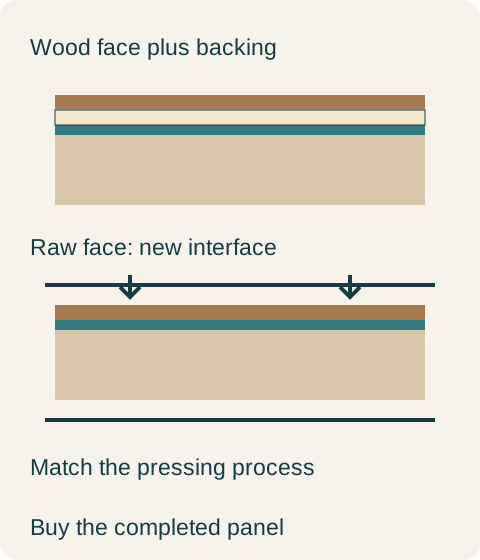
A raw-veneer alternate should not be approved solely because its species and grain resemble the original paper-backed face. Removing the backing changes the material presented to the adhesive and can invalidate the specified bonding process. For cabinet side panels or fronts, compare the finished panel package rather than treating the alternate as a simple sheet-price substitution.
The backing belongs to the adhesive specification
Better Bond Titan DX instructions expressly exclude raw, unbacked veneer while describing suitable paper-backed veneer applications on rigid porous substrates. That is a limitation of the named product. It does not mean that every contact adhesive is suitable for every backed veneer or every existing cabinet surface.
A different process example is Titebond Cold Press for Veneer, which is formulated for cold-press lamination onto porous materials and to minimize adhesive bleed-through. Its documentation also says it is specifically for veneering, not other assembly applications. Product purpose and manufacturing method must travel together.
The visual face is only part of the delivered construction. In a paper-backed sheet, the backing lies between the wood face and the field-applied adhesive. A raw sheet presents the wood itself at that interface. The rest of the panel still needs its specified core and compatible reverse construction. Changing the face product does not justify deleting the reverse layer or reusing a process merely because both sheets are real wood.
Teaching example Conceptual veneer sections and manufacturing sequence, not to scale. No layer thickness, pressing pressure or adhesive recipe is specified.
A distinctive grain can require a different fabrication package
Suppose a hypothetical cabinet order originally specifies a paper-backed face on a suitable new MDF substrate using its documented bonding process. The buyer prefers a particular grain offered only as raw veneer in this example. The selected alternate includes that veneer plus a professional pressed-panel fabrication package with its appropriate adhesive, specified reverse construction and completed finishing trial. The buyer accepts the revised full package, and the original paper-backed bonding process is removed from the work order.
In the hypothetical comparison, an offer for raw veneer alone is not an equivalent alternative to the finished panels. It omits preparation, pressing and the completion work needed to achieve the chosen result. Conversely, if the raw grain is not worth the changed scope to the buyer, retaining the approved paper-backed panel is a completed design choice. The comparison should expose that tradeoff before either material is purchased.
Retained cabinet surfaces create another condition
A new porous core and a previously coated cabinet face are different bonding surfaces. Titan DX, for example, excludes non-virgin substrates and says coatings can prevent bonding. Therefore the new-panel example cannot be transferred unchanged to refacing an old finished box. The selected system must address the actual receiving surface; the grain choice does not establish adhesion there.
At review, retain the veneer construction, identified adhesive/process and completed panel sample as a linked specification. Check that a later substitution preserves the approved package or explicitly revises it. This keeps the attractive face from arriving with an unapproved manufacturing assumption hidden beneath it, while leaving application ratios and equipment settings with the professional fabricator.
Pure White
Cream White
Light Warm Gray
Gray
Navy
Black
Oak Tone
Dark Walnut Tone
Design study These finish studies are design references, not a list of currently orderable colors. Screens and lighting change the appearance; compare a physical sample before choosing.See all finish options →
The hidden back of a veneered panel is part of its construction. Specify it with the face, core and bonding method before assuming a decorative panel will remain flat.
The sample shows the door frame, a separate center panel, the face frame and the cabinet box. Each component has its own place in this Shaker construction.
Shaker construction: door frame, center panel, face frame and cabinet box. The cutaway helps locate these parts; confirm each material in the specifications for the selected cabinet.
01 / Door frame
The Shaker door has rails and stiles around a separate center panel. The frame and center panel are different components; confirm their materials in the specifications for the selected cabinet.
02 / Face frame
The face frame surrounds the opening at the front of the cabinet box and sits behind the doors. The face frame, door frame and cabinet box are separate parts.
03 / Cabinet box
The sample exposes the cabinet sides, interior surfaces and layered edges. The image does not establish the wood species or material specification of a selected cabinet.