

Construction & materials
Translucent wood veneer cabinets: choosing panels and backers
A glowing wood accent is a different panel proposal from ordinary veneer over an opaque cabinet core. Compare the actual veneer, backer and completed face, then decide whether the illuminated wood figure earns a place beside the unlit cabinetry.
A translucent wood accent should be bought as an identified light-transmitting panel assembly, not as ordinary cabinet veneer with a light added behind it. The attraction may be real wood figure revealed by transmission, but the supporting material and finished face are part of that effect. Begin with a fixed accent panel proposal beside the cabinetry, then decide whether the actual illuminated appearance is worth choosing over an ordinary opaque wood surface.
Jacaranda describes TransTec as thin sliced wood bonded to clear or translucent backers so light can pass through. This establishes a facing format; it does not establish a completed cabinet door or make any conventional veneered board translucent.
Reading note: Jacaranda: product guide,TransTec.
The backer is part of the material choice
The TransTec product page distinguishes backers with different flexibility and translucence. Its acrylic-backed version also has an acrylic-treated face, and the manufacturer calls for application-specific specification. These are different offered constructions, not interchangeable backing labels.
Reading note: Jacaranda: TransTec backer options and specification scope.
Ask which complete version is proposed and what additional support it receives. A flexible facing sample cannot by itself establish a rigid cabinet panel. The maker should identify the finished assembly without asking the buyer to infer its construction from how easily a loose sheet bends.
If an alternative backer is proposed, compare the resulting sample with the same intended lighting. Do not accept the substitution merely because it carries the same wood species. The buyer is choosing the appearance and handling of the complete panel, not a veneer name detached from everything behind it.
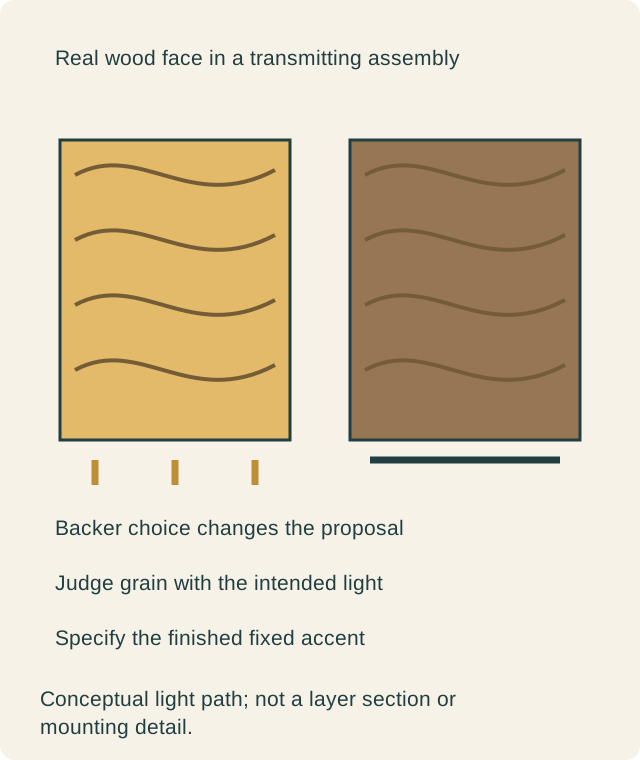
Transmitted wood figure is its own appearance
An opaque wood sample can establish that a species and cut are appealing without demonstrating the transmitted result. Request a representative sample of the actual facing and backing under the proposed light. Look at the broad field and the features that become prominent, rather than choosing from a small attractive patch alone.
Decide whether the household wants the grain to remain a quiet reference or become the main decorative pattern. A figure that is subtle beside ordinary cabinet lighting may become more important in the illuminated proposal. That can be the reason to buy it, but it should be a preference the owners see rather than a surprise attributed vaguely to natural variation.
Keep the ordinary cabinet proposal separate
A surrounding veneered cabinet can remain opaque while the accent uses a different construction. There is no need to pretend every front is identical. Show the junction and decide whether the contrast is deliberate: perhaps the accent is a framed light feature, while the rest of the cabinet reads as ordinary wood furniture.
If the intention is a visually continuous wood field, compare the actual illuminated and unlit neighbors together. Sharing a species does not approve that relationship. The project may need a different placement or a clearly separate accent instead of an unsupported promise that the glowing panel will match an ordinary door in every state.
A face treatment belongs in the appearance and use decision
Ask to see the completed exposed face, including its intended protective treatment. A veneer sample without the quoted finish should not be the only approval reference. If the proposed version has a different face treatment, compare the actual touch and reflection instead of assuming all real wood feels alike.
Keep the relevant care information with that version. Do not transfer an oiling or refinishing routine from nearby solid wood to a treated translucent panel simply because both show wood grain. The provider should identify what applies to the delivered assembly and where the owner should direct a future surface question.
A fixed accent can be the clearer brief
Begin by deciding whether the panel is fixed or operates. A fixed illuminated feature avoids treating the facing material’s flexibility as proof of door suitability. If the project requires a moving front, the provider must separately resolve the complete door, hardware and lighting arrangement for that application.
For the fixed proposal, show the visible perimeter and how the panel meets the cabinet. Do not leave mounting or support implied by a rendering. The buyer does not need to design those details, but it needs the completed perimeter shown and the responsible fabricator identified before the cabinet opening is finalized.
A hypothetical serving cabinet selects a separate feature
Imagine owners who want a real-wood glow near a dining cabinet. They initially ask for an illuminated area that looks like an extension of the ordinary wood doors. A representative sample shows a transmitted figure they enjoy, but its relationship to the surrounding opaque fronts is more distinct than they expected.
In this hypothetical decision, they keep the material and make it a clearly separate fixed accent above the serving cabinet. The surrounding doors retain their ordinary veneer construction. They prefer the deliberate contrast to a failed attempt at making two different assemblies read as an identical continuous field.
Another household may find the illuminated figure too active and choose the ordinary opaque panel instead. That outcome is useful too. The comparison has tested the special material rather than assuming that real wood plus backlighting must improve the cabinet.
Review the feature in its normal room states
See the selected assembly with its light off and with the intended room lighting present. The accent remains part of the room when it is not glowing. Decide whether the household likes the quiet state as well as the evening feature; this is an appearance approval, not a measurement of useful task light.
Do not remove other lighting from the plan merely because the panel looks bright in a photograph. Reading labels or serving food is a separate requirement. Treat the wood glow as a chosen decorative effect unless the lighting proposal establishes another role.
Retain a complete material and panel record
Keep the wood selection, veneer version, backer, exposed-face treatment and representative lit sample with the panel proposal. The lighting and cabinet providers should identify the actual assembly and service access, including the components that remain reachable after installation.
The decision is ready when the wood figure, its supporting construction and its relationship to the ordinary cabinets are all intentional. A named translucent veneer is a useful starting point. The finished accent, viewed in the room’s real conditions, is the product the household actually needs to choose.
Sources & further reading
- Jacaranda: product guide,TransTec
- Jacaranda: TransTec backer options and specification scope