

Buying cabinets
Touchless or manual kitchen faucet: choose the control you want to live with
Buy sensor control for a repeated water task you prefer doing that way, after checking ordinary handle use and the complete sink-cabinet equipment. A mechanical faucet can be the better complete purchase.
Choose the water task, not the novelty
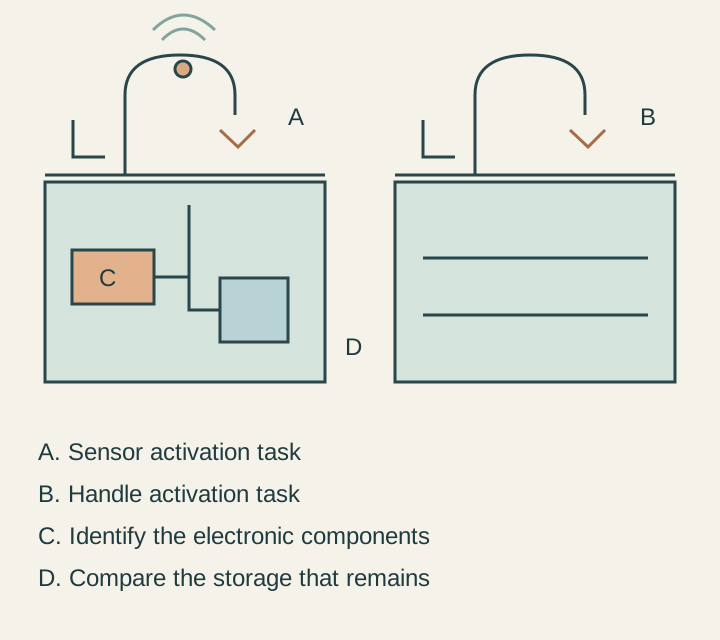
Choose a touchless faucet when the actual activation method makes a recurring sink task more convenient and the household accepts its controls, power and cabinet arrangement. Choose a mechanical faucet when its ordinary handle remains easier to understand or when the additional electronic system buys little useful change. Compare complete candidates at the real sink, including the spray functions each actually provides.
Name the task that motivates the sensor. Perhaps the cook wants to start and stop water while holding a bowl, or dislikes repeatedly returning to a particular handle. Identify what the hands are doing and where the vessel is. Hands busy is not a complete specification; the sensor location still has to serve that movement.
A sensor does not decide temperature or spray preference
Rehearse a normal sequence on the actual candidate under its instructions: select the desired conditions, start water, change what needs changing and stop. Find out which actions belong to the sensor and which remain at the handle or other control. Do not assume that touchless means the user never touches anything.
Compare the same sequence on the mechanical candidate. If the perceived inconvenience comes from a badly placed old handle, another mechanical faucet could solve it without electronics. If the hands-busy task repeatedly favors the sensor candidate, that is a specific benefit worth recording.
Keep the ordinary stream and movable spray checks separate. A pleasing activation method cannot compensate for a spout position that misses the useful basin area or a spray head the user dislikes holding. The complete faucet must work when the head is parked as well as when it is being moved.
Identify the power arrangement before filling the cabinet
Moen’s MotionSense FAQ identifies control-box-specific battery and AC arrangements. Confirm the generation and supplied components rather than treating an electronic faucet as the same equipment behind every similar-looking spout.
Reading note: Moen — MotionSense installation and power FAQ.
For the actual candidate, list the control equipment, power components and access its installation requires. Show them alongside the sink, drain, disposer and retained filtration. Reserve the manufacturer’s required arrangement before declaring that every unused-looking corner can hold an organizer.
If a power provision needs to be added or changed, have the responsible installer define that scope before buying. A nearby socket does not establish compatibility, available use or the accepted connection. This guide supplies no electrical installation procedure.
Ask what the selected model’s instructions say about operating behavior when power is unavailable. A familiar handle is not evidence of a particular backup function. Different equipment documents may describe different generations, so preserve the exact identity used for the accepted answer.
Check sensing in the actual working scene
Position the ordinary bowl, pot and the person at the sink. Follow the activation movement without inventing a gesture from another product. Then repeat the return to normal washing. The important observation is whether the desired action occurs when the household expects it.
Include other normal activity near the sensor. Ask how the documented controls handle cleaning or temporarily disabling the sensing function where provided. Do not test by forcing water or exposing equipment; a suitable controlled demonstration and the operating instructions can answer the purchase question.
Have other regular users try it. One person may learn the sequence readily while another prefers an immediate mechanical action. That difference can legitimately decide a shared faucet. Neither enthusiasm for automation nor dislike of it establishes how these particular candidates work.
The cabinet must remain useful after installation
Plan ordinary storage around the complete system and its moving spray hose where applicable. A container placed safely away during a demonstration may return to a position that obstructs the installed assembly. Recheck with the usual cleaning supplies present.
Identify the access needed for prescribed battery replacement or other owner care. What moves temporarily, and where does it go? An electronic box that can only be reached after dismantling a fixed organizer has a different daily ownership consequence from one with an accepted route.
Also compare the deck and nearby window controls, backsplash and accessories. The sensor should not distract from the faucet’s physical envelope or mounting arrangement. If the retained top needs work for either choice, include the confirmed solution rather than assuming the electronic option changes only the spout.
Keep the accepted control behavior attached to the order
Before accepting an alternate faucet, compare the actions the household approved, not only the finish and spout outline. A changed sensor position or control arrangement may require the bowl task to be tried again. A substitution can also change what the sink-base drawing must accommodate, even if the mounting location looks similar.
Identify the candidate's documented way to sustain and stop the flow for a longer ordinary task, such as filling the accepted vessel. The useful sequence may differ from a brief rinse. If the user has to repeat an unwanted gesture to complete that recurring job, record it as part of the comparison rather than calling every sensor action a convenience.
Keep any questions about unavailable power specific to the offered generation. The buying record needs an answer supported by that model's instructions, including the action the owner accepts; the presence of a familiar handle does not supply that answer. An alternative is acceptable only after its controls, equipment and storage consequences remain workable.
Compare finished purchases and an accepted fallback
Price the faucet, required components, power work where applicable, installation and any changed sink-base interior. Retain common work on both sides. Do not invent a hygiene improvement or an amount of saved water to justify the price difference.
Imagine a hypothetical household that wants sensor activation while rinsing a large mixing bowl. The actual sensor candidate performs that accepted task, and its ordinary handle and spray also pass. The cabinet drawing shows its equipment without losing the only useful cleaning-supply position, and the owner accepts the documented care routine.
The household buys that complete electronic installation. Another household might discover that an alternate mechanical handle solves its original reach complaint while preserving a simpler preferred routine. Both outcomes follow the actual task. Keep the model, operating sequence, power decision and cabinet layout together so the final choice remains understandable after installation.
Sources & further reading
- Moen — MotionSense installation and power FAQ