Pull-down, pull-out or a separate side spray: choose the whole kitchen faucet arrangement
Compare the spray head in your hand, the normal fixed stream, the sink-deck layout and the cabinet below. The tallest arch or longest-looking hose does not decide which arrangement is easier to use.
Choose the spray arrangement by how the household uses and returns it, not by spout height alone. A pull-down head, a pull-out wand and a separate side spray can each serve a useful kitchen, but they put the movable component and its resting place in different positions. Compare complete candidates with the actual sink, utensils and mounting layout before choosing a finish.
Try the part that will be in your hand
Start with a cool, empty pot or mixing bowl that represents everyday cleanup. In a suitable showroom demonstration, grasp the candidate spray component, move it toward the working area and return it as intended. Observe the hand position, access to its controls and whether the user understands when it is properly seated. Do not assume the movement is comfortable because the hose reaches the far side of an empty sink.
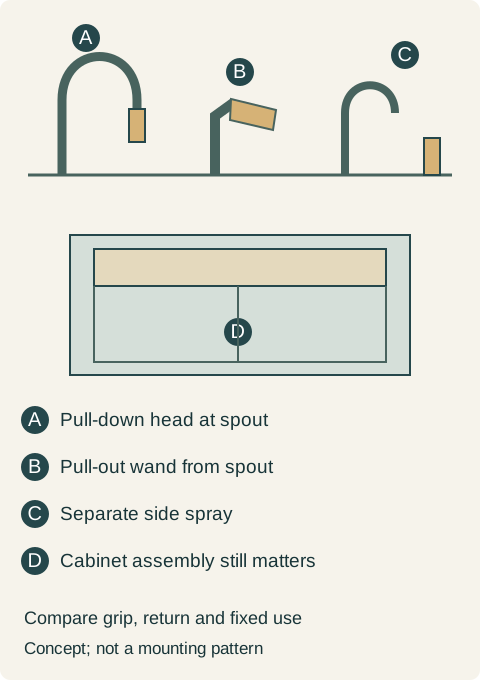
KOHLER’s cited faucet guide distinguishes pull-down and pull-out forms, with a larger section of the pull-out spout coming away. Both integrate the spray function rather than requiring a separate side spray. This is a form distinction, not current stock information.
The larger wand may suit one user’s grip, while another prefers the smaller head at the end of an arch. Compare the actual products. A format name does not establish operating effort, hose length, docking method or reliability, and it is not evidence that every model in that family feels the same.
With a separate side spray, the main spout remains in place while the user picks up another component from the deck. Include that transition and the return to its holder. It may preserve the main faucet silhouette the owner wants, but the holder is another physical object beside the basin, not a free spray function without a mounting position.
Most faucet use still begins at its resting position
Look at the ordinary stream before pulling out anything. Where does the outlet sit over the basin, and can the usual bowl or pot be placed comfortably beneath it? Include the rim, rear ledge and actual handle. A tall arch creates a visual opening, but height alone does not say where the water is directed or whether the vessel fits the working area.
Then compare the spray task. The movable head may help reach a different part of the bowl, but it should not be used to excuse an inconvenient normal outlet position. Decide which tasks actually need movement and which should remain simple with the head parked.
A side spray and a main faucet are also a matched operating arrangement. Follow the selected product’s controls; do not assume all combinations provide simultaneous independent water use. The question here is how the household switches between ordinary flow and spraying, not how many outlets can be made to run at once.
Teaching example Conceptual fixture forms: A has a detachable head at an arched spout; B removes a larger wand from the spout; C keeps a separate side spray beside the main faucet. D represents the cabinet volume that still needs to accommodate the selected assembly. Gold shapes identify movable spray components, not universal hose paths or installation dimensions.
Keep the deck layout complete
Moen’s mounting guide shows faucet arrangements for different sink-hole configurations and directs buyers to the selected model’s specifications for escutcheon use. A pull-down or pull-out name alone does not determine the required mounting pattern.
Identify the actual holes, spacing, usable mounting surface and underside access with the installer. In a retained top, a proposed side-spray holder might need a location that is not available. Conversely, replacing a separate spray with an integrated one can leave an existing hole that still needs an accepted treatment. Do not assume a decorative base plate hides any pattern regardless of size or position.
Include a soap dispenser, drinking-water faucet or other retained deck component in the same view. These are separate choices competing for the working surface and the user’s reach. An integrated spray may reduce the number of visible components in a particular proposal, but it does not automatically provide room for every other accessory.
Check the selected faucet against the actual window control, backsplash and cabinet above where relevant. Avoid rules such as all pull-out models are low or all arched models clear a large vessel. Compare the actual envelope, including operating handles, rather than turning a style category into a dimension.
The cabinet review follows the chosen assembly
Show the equipment under the sink together with the faucet’s required arrangement. Moving hoses, weights or other components belong to the selected system; different models can arrange them differently. Preserve their intended operation with the normal storage present, not only with the cabinet emptied for an installation photograph.
This review does not by itself choose the spray format. A kitchen can have plenty of free space below and still have a spray head the user dislikes holding. Equally, a pleasant showroom grip is not enough if the complete installation conflicts with the retained organizer. Resolve both before approving the finished cabinet interior.
For service, identify the actual faucet and spray assembly rather than treating similar-looking heads as interchangeable. The buyer need not plan a repair procedure, but should retain the product identity and an accessible installation. A separate spray does not promise independent compatibility with any future main faucet.
A larger wand earns its place in one kitchen
In a hypothetical retained-sink project, the owner likes the look of an arched pull-down faucet. During a hands-on comparison, however, the larger wand on a particular pull-out candidate feels easier to grasp and direct around the household’s mixing bowl. Its ordinary outlet position also works over the existing basin. The choice is based on those actual candidates, not a ranking of everyone’s hands.
A separate-spray proposal would require another deck position that the owner does not want to add. The pull-out candidate has a supported mounting arrangement for the retained surface, and the installer confirms that its complete below-sink assembly can coexist with the accepted storage. The owner tests returning the wand as well as extending it.
The final selection is that pull-out model, with the agreed mounting pieces and the retained deck components identified. The owner accepts its appearance instead of buying the preferred arch and hoping the grip will become convenient later. No new hole or imaginary storage space is left out of the comparison.
Compare the completed purchase
Price the chosen faucet, required mounting pieces, permitted accessories and installation work together. Added spray functions or an unusual silhouette do not establish better value for a household that will not use them. Conversely, a comfortable everyday grip can matter more than a small difference between fixture-only quotes.
Approve the ordinary stream position, movable spray task, return motion, deck arrangement and cabinet operation as one package. Finish samples come after those functions work. The useful result is a faucet the household can use normally with its actual sink and storage, rather than a spray head that reaches a distant point only when everything around it has been removed.
Pure White
Cream White
Light Warm Gray
Gray
Navy
Black
Oak Tone
Dark Walnut Tone
Design study These finish studies are design references, not a list of currently orderable colors. Screens and lighting change the appearance; compare a physical sample before choosing.See all finish options →
The basin, disposal, filter and their access requirements share the same cabinet. Resolve that complete arrangement first, then assign storage to the remaining usable regions.
The sample shows the door frame, a separate center panel, the face frame and the cabinet box. Each component has its own place in this Shaker construction.
Shaker construction: door frame, center panel, face frame and cabinet box. The cutaway helps locate these parts; confirm each material in the specifications for the selected cabinet.
01 / Door frame
The Shaker door has rails and stiles around a separate center panel. The frame and center panel are different components; confirm their materials in the specifications for the selected cabinet.
02 / Face frame
The face frame surrounds the opening at the front of the cabinet box and sits behind the doors. The face frame, door frame and cabinet box are separate parts.
03 / Cabinet box
The sample exposes the cabinet sides, interior surfaces and layered edges. The image does not establish the wood species or material specification of a selected cabinet.