A tilting vanity mirror or a fixed mirror that extends lower?
A shared seated and standing position can call for either a larger fixed reflective area or an adjustable angle. Compare the actual views and the adjustment task before choosing the mirror and its neighboring cabinets.
A mirror that tilts can change the reflected view without moving its wall attachment to a new height. A fixed mirror with a suitable lower edge can provide a useful view without anyone adjusting it. For a position used both seated and standing, compare those approaches with the actual users before adding a special mirror system to the bathroom order.
The question is not whether an adjustable product sounds more accommodating. It is whether the fixed alternative already works, and whether the people using the adjustable alternative can obtain their view through a practical control sequence. Include the basin or preparation surface, lighting and supply locations in that comparison. A mirror cannot correct an unsuitable approach to the cabinet below.
HEWI's US mirror overview presents tilting mirrors and a fixed mirror extending toward the washbasin as alternative approaches for standing and seated users. It does not determine the correct arrangement for a particular household.
A tilting mirror changes angle, not the cabinet opening
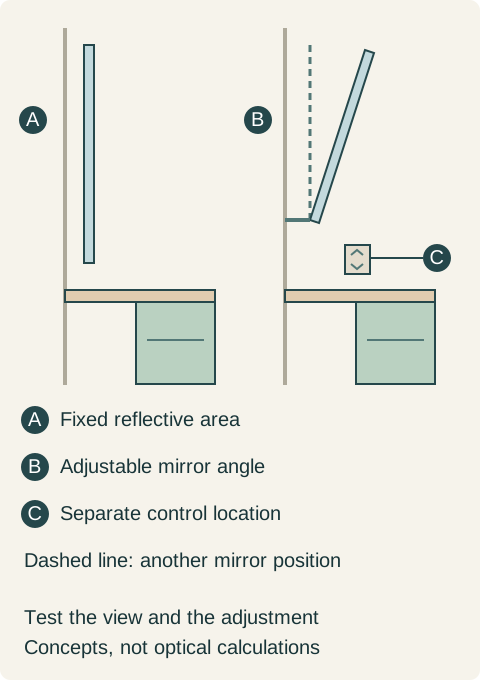
HEWI's motorized model 801.01.500 is a wall-mounted mirror controlled by a separate wireless wall switch. The mechanism adjusts its inclination. This is a named product example, not a usaKT supply claim.
Think of that movement separately from raising the whole mirror or opening a medicine-cabinet door. The upper and lower edges change their relationship to the wall as the mirror tilts, so the available reflected view changes too. The mounting arrangement and permitted travel still belong to the selected system. Do not improvise a tilting mechanism for an ordinary mirrored cabinet front.
The mirror itself supplies no cabinet storage. If a proposed package replaces a medicine cabinet with a tilting mirror, show which toiletries lose their former home. Do the same for a fixed plain-mirror proposal. Compare those complete combinations, rather than giving one mirror credit for storage that belongs to a different product in the rendering.
Teaching example Simplified side views: A is a fixed mirror extending lower; B changes mirror angle, with the dashed line showing another position; C is a separate control. The control is represented face-on; counter lines establish context only. The diagram does not trace reflected rays, prescribe an angle or verify mounting and accessibility requirements.
Give the fixed mirror a fair trial
A fixed mirror deserves consideration when both users can see the required area from their usual positions. Its advantage is simple: the next person does not have to change the mirror setting. Begin with the reflective area that fits the wall, not an arbitrary alignment with the top of a neighboring tall cabinet.
Use a safely supported real mirror for the viewing trial. A paper outline can show whether its lower edge competes with the faucet or trim, but it cannot demonstrate reflection. Keep the actual seated position and standing task represented. Leaning to make a small sample work is not the same as a useful view during the normal routine.
Review the lower edge with the faucet, counter and intended mounting arrangement. Extending the mirror downward is a design option to investigate, not permission to put glass wherever it fits on an elevation. The chosen mirror must still be suitable for the location and be installed according to its requirements.
Adjustment must be part of ordinary use
With the tilting option, test the sequence from the previous user's setting. Can the next person reach and operate the control, stop at a useful view and complete the task? Testing only a mirror that someone else has already positioned hides the main difference between the alternatives.
The HEWI operating instructions show a hold-to-adjust control for tilting up or down. A useful demonstration should therefore include operating that control, not only seeing the mirror after adjustment.
Place the proposed control in relation to the real cabinet fronts and supply locations. A wall switch can be independent of the mirror yet still be blocked by an open door or inconvenient from the intended seat. Keep its location in the selected package. Wireless control does not mean the motorized mirror has no power or installation requirements; those remain a separate professional review for the exact product and project.
Also inspect the complete movement beside the faucet and adjacent cabinets. Successful reflection at one setting does not prove that every allowed setting clears the surrounding assembly. Follow the selected instructions, and keep any applicable project accessibility requirements with the responsible design team. A household trial informs selection; it does not certify compliance.
The restricted wall favors an adjustable mirror
In a hypothetical renovation, a shared preparation position is used seated by one adult and standing by another. Its surface and underside have already been selected for those tasks. Daily supplies fit in an adjacent cabinet that remains in both mirror proposals. A wall feature limits the available mirror arrangement above the counter.
The fixed-mirror proposal is tested at the feasible positions. In this assumed trial, its available reflective area does not give the seated user the required view without an awkward change of position. Extending it lower would conflict with the reviewed fixture arrangement. Neither result is inferred from eye height alone; both are observations assumed for this example.
An appropriately installed adjustable mirror is then tried with each user starting from the other's setting. Both can obtain the required view, and the proposed control position can be used without opening the supply cabinet or standing to reach it. The equipment's movement, mounting and services are reviewed separately for the selected package.
They choose the adjustable mirror with that control location and retain the already suitable supply cabinet. They accept adjusting the view between users because it solves a demonstrated limitation of the fixed alternative. The decision does not change the surface height or turn the mirror into storage; those parts of the preparation station remain explicitly accounted for.
Keep the simpler option when it works
If both views had worked with the fixed mirror, the added adjustment system would need another reason to justify its place in this purchase. A preference for its appearance may be valid, but it should be stated as a preference rather than a necessary response to seated use.
Approve a complete arrangement: useful reflection, manageable adjustment if needed, reachable supplies and a reviewed installation. Keep the real trial distinct from the manufacturer's feature description. That makes the decision about the people using this bathroom, rather than assuming that every shared vanity requires a moving mirror.
Pure White
Cream White
Light Warm Gray
Gray
Navy
Black
Oak Tone
Dark Walnut Tone
Design study These finish studies are design references, not a list of currently orderable colors. Screens and lighting change the appearance; compare a physical sample before choosing.See all finish options →
Define whether the seated task needs a preparation surface or the basin itself, then test the actual user and seating with the full underside, mirror, storage and route included.
Prepare a coordinated brief covering the person's tasks, their actual equipment, the bathroom approach and the complete basin assembly. Send those relationships for product and professional review before choosing a cabinet from its floating appearance.
The sample shows the door frame, a separate center panel, the face frame and the cabinet box. Each component has its own place in this Shaker construction.
Shaker construction: door frame, center panel, face frame and cabinet box. The cutaway helps locate these parts; confirm each material in the specifications for the selected cabinet.
01 / Door frame
The Shaker door has rails and stiles around a separate center panel. The frame and center panel are different components; confirm their materials in the specifications for the selected cabinet.
02 / Face frame
The face frame surrounds the opening at the front of the cabinet box and sits behind the doors. The face frame, door frame and cabinet box are separate parts.
03 / Cabinet box
The sample exposes the cabinet sides, interior surfaces and layered edges. The image does not establish the wood species or material specification of a selected cabinet.