

Buying cabinets
Standard-depth or counter-depth refrigerator: compare food capacity and the whole room
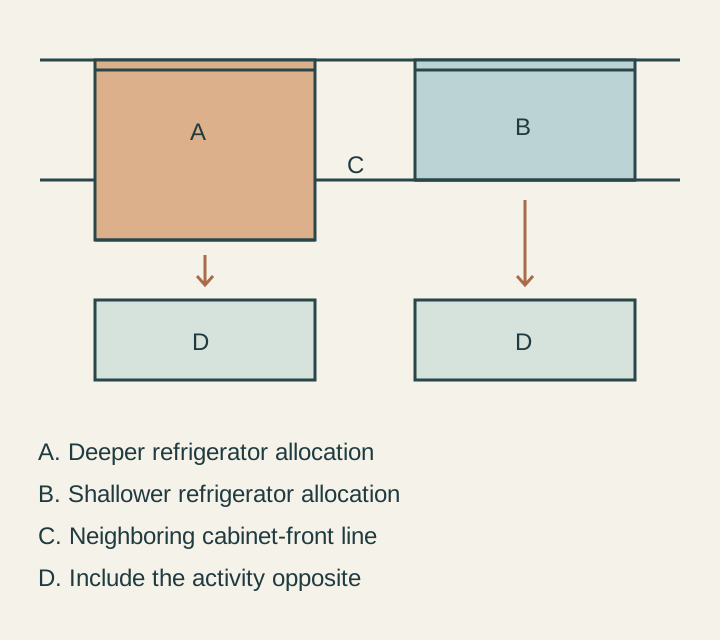
Choose less projection when the actual food load still works and the room gains something useful. Keep a deeper candidate when its storage benefit is worth the accepted passage and cabinet relationship.
Choose the tradeoff between food storage and room space
Choose a counter-depth candidate when its accepted grocery load and operating arrangement work and its reduced projection improves a real room task or the appearance you value. Choose a standard-depth candidate when its particular storage is more useful and the resulting projection remains acceptable. Compare actual models; neither label promises a capacity, price or finished alignment.
Start by naming the problem. Is the existing refrigerator blocking a route, visually dominating a cabinet run, or failing to hold the food? These problems need different evidence. A shallower-looking replacement can improve the room while leaving the food problem untouched, and a larger interior can be worthwhile if the passage already works.
Depth is separate from installation type
Bosch’s comparison guide lists depth categories separately from installation type. Choosing counter depth does not itself establish that a refrigerator is a built-in appliance.
Reading note: Bosch — Refrigerator Comparison Guide, depth and installation columns.
Keep the intended appliance’s instructions with the cabinet proposal. A surround cannot convert a freestanding product into a furniture-front installation. Likewise, a visible freestanding refrigerator can be deliberately coordinated rather than treated as an unfinished compromise.
Establish the actual installed outline from a common wall reference, including the required rear arrangement, doors and handles. Name which front is supposed to align with the cabinets. A label is not enough to promise a flat elevation, and pushing a machine beyond its supported position is not an appearance solution.
Test the grocery group before replacing volume
Use an ordinary shopping load plus the awkward containers that matter: a covered dish that cannot tilt, a wide platter, tall bottles or a bulk package actually retained. Assign them to shelves, bins and freezer areas in both candidates. Total advertised volume cannot show their arrangement.
Check access to the back and the sequence of removing items. A shallower shelf may reduce one retrieval difficulty but require a different number of rows; a deeper shelf may accommodate the group while placing frequent items behind others. Test the actual interior rather than declaring shallow or deep universally more organized.
Do not make an unacceptable food load fit by silently assuming more frequent grocery trips. Changing shopping frequency can be a valid household decision, but it must be accepted. The same applies to replacing containers or keeping an overflow appliance elsewhere. Those are real consequences and possible added purchases.
Compare both the closed and working room
Mark the closed appliance front in the room plan, then its required door and drawer opening positions. Add the person reaching inside and the ordinary activity opposite. A shallower closed profile does not by itself prove simultaneous passage when a door is open.
If the opposing island is the cause of the conflict, compare an actual change to that island with the shallower appliance. Reducing island storage or seating is another purchase decision with inventory to reassign. The refrigerator should not receive credit for fixing a room arrangement that is separately being rebuilt.
A standard-depth candidate can be acceptable when its projection enters an area with no conflicting task. Conversely, even a modest visible projection can matter at a busy doorway. Judge the verified location and household route rather than an isolated depth difference.
A wider or taller alternative also spends cabinet space
If a preferred shallower candidate changes overall width or height, draw that complete alternative. It may affect the pantry next door or the cabinet above. Do not assume the plan can preserve every cabinet while accepting a differently shaped refrigerator.
Give the affected cabinet contents a home. A refrigerator that holds the groceries but removes the only suitable tray cabinet has shifted storage demand rather than eliminating it. Test the tray group in its replacement location with the rest of the inventory present.
Include end panels, upper-cabinet depth and side views in the appearance review. Extending a decorative panel to conceal a deeper machine may change adjacent access and does not create a supported built-in arrangement. Buy the accepted visible relationship with its real construction.
Price the whole accepted food-storage system
Compare the actual appliance, required parts, delivery, connections and different cabinet or counter work. If an option depends on another refrigerator elsewhere, include its space, installation and intended retrieval routine. Do not compare one complete room against a second proposal whose overflow storage is left out.
Avoid assuming a universal price hierarchy or predicting energy and repair costs from depth alone. Use documented information for the selected products if those factors matter. The present decision can be explained without an invented operating-cost payback.
Imagine a hypothetical family choosing a shallower refrigerator to improve the route between kitchen and dining room. Its ordinary groceries fit, but the large covered serving dish does not. They first consider a different acceptable container, then test another candidate rather than buying a second refrigerator for one object.
The final shallower candidate accommodates their accepted group and preserves the neighboring pantry. Its open-door trial also leaves an understood route. They choose it at the complete quoted price. Another household may prefer the deeper candidate when its food load genuinely benefits and passage remains acceptable. Approve grocery arrangement, installed outline and cabinet consequences together; a smooth front should not hide an unresolved storage system.
Sources & further reading
- Bosch — Refrigerator Comparison Guide, depth and installation columns