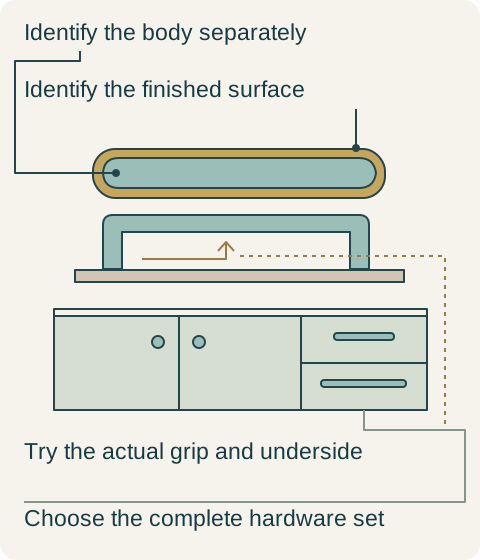
Choose cabinet hardware as a finished working object, not by a metal ranking alone. Solid brass can be a deliberate material preference, but a brass-colored pull is not necessarily made from brass, and a zinc-alloy pull is not automatically an inferior choice. The useful comparison identifies the body, the surface treatment and the shape your hand uses. A higher quote should buy something you can name and want, rather than simply a more impressive material label.
Read the body and finish as separate specifications
Top Knobs lists the Griggs pull in Honey Bronze with Zinc Alloy in a separate Base Material column. That is a specific catalog example of a decorative metal name describing the finish rather than the underlying alloy. No price or performance ranking is drawn from that entry.
Schaub describes its NOHO hardware as solid brass, while its finish choices include Polished Nickel and Matte Black. The body can therefore be brass without looking brass-colored. This example establishes product identity, not a universal advantage over another manufacturer’s hardware.
For each candidate, write the model, base material and finish in separate fields. If the listing says only metal or brass finish, the body remains unidentified. Do not fill that gap from the photograph. Equally, solid brass does not mean bare, untreated brass: the selected finish still determines which surface is exposed to hands and cleaning. An owner who wants a particular appearance over time needs the finish information as well as the metal name.
Teaching example Conceptual comparison of finished pulls: a cutaway separates body from surface; the lower front shows the selected family across knobs and pulls. Colors indicate parts only, not real metal finishes or measured coating thicknesses.
The hand touches a shape, not a material category
Set comparable samples on a demonstration front and open it normally. On a bar pull, notice the space behind the grip, where fingers meet the posts and whether the underside has an uncomfortable edge. On a knob, notice how much of the shape can be held and whether the neck feels cramped. Test the actual sizes proposed for the kitchen. An attractive large display piece says little about the smaller member being ordered for narrow drawers.
Separate what you observe from what you infer. A heavier loose sample may feel substantial, but weight also changes with the amount and arrangement of material. It does not identify the alloy or establish the strength of the mounting assembly. A thick, short handle and a longer, slimmer one are not a controlled material comparison. Record the useful observation, such as a comfortable rounded underside, instead of turning heft into a durability score.
Look at the underside and the bases as well as the face. Is the visible finish satisfactory around the parts touched by fingers? Does the actual sample sit properly on the proposed flat mounting area? Are joints or transitions visually acceptable? A sample can reveal an objectionable edge or an appearance problem. It cannot establish a service-life claim by being held briefly, and a nice-looking front view does not settle the attachment to the cabinet.
A premium can be for a design you prefer
Compare complete hardware groups, including the knobs and pull sizes assigned to the room. A preferred brass design may justify its quotation because its rounded grip, base detail and available companions create the result you want. That is a reasonable purchase even without claiming that brass always lasts longer. Conversely, paying for that material alone does not help if the desired small knob or suitable drawer pull is absent from the proposed set.
Keep the comparison fair when a quote changes. Replacing a simple zinc-alloy bar with an ornate brass pull changes several things at once. The difference is not a clean price for the alloy. Compare the actual finished sets, their quantities and the proposed fastening work. If you value only the warmer color, first determine whether the original family already offers a satisfactory finish. If you value the particular brass object, say so; it is a different reason to spend.
The chosen zinc-alloy set earns its place on the drawer
In a hypothetical kitchen, the owners initially request solid brass because they associate its weight with quality. Their sample comparison includes an identified brass design and an identified zinc-alloy alternative, both in finishes they accept. The brass sample has a pronounced shoulder where their fingers approach the stem. The zinc-alloy pull has a smoother transition and feels more comfortable on the demonstration drawer. These are observations about those samples, not rules about the metals.
The zinc-alloy family also contains the smaller knobs and longer drawer pulls the design needs. The complete quotation is lower in this hypothetical comparison, with the required pieces and fastening scope included. The owners select that family throughout the cabinets. They keep its specified finish and care instructions and do not expect exposed-brass behavior from it. The decision gives priority to the grip and coordinated set they actually preferred; it does not claim a universal price order or equal tested longevity.
Keep the surface decision with the material decision
Before ordering, consider how the selected finish is meant to be maintained. Do not assume that a product containing brass should be polished with a brass cleaner: that would ignore any surface treatment on it. Use the identified product’s care guidance. If a changeable, uncoated appearance is part of the attraction, establish that it is the actual option being ordered rather than an expectation attached to the word brass.
Retain the complete identity of the accepted pieces. A later substitute with the same color description may change the alloy, the grip or the finish treatment. Review the changed attributes together before accepting it. Material transparency is useful because it makes that discussion precise. The purchase is successful when the hardware feels right, forms the intended set and carries the surface expectations the household actually chose.
Pure White
Cream White
Light Warm Gray
Gray
Navy
Black
Oak Tone
Dark Walnut Tone
Design study These finish studies are design references, not a list of currently orderable colors. Screens and lighting change the appearance; compare a physical sample before choosing.See all finish options →
A matching finish does not make the refrigerator handle the same purchase as a drawer pull. Coordinate the complete handle, custom panel and appliance before releasing the hardware order.
Compare the actual countertop products, heat-source routine and fabrication proposal. A fired porcelain slab and resin-bound quartz are different materials, but neither label replaces a complete kitchen specification.
The sample shows the door frame, a separate center panel, the face frame and the cabinet box. Each component has its own place in this Shaker construction.
Shaker construction: door frame, center panel, face frame and cabinet box. The cutaway helps locate these parts; confirm each material in the specifications for the selected cabinet.
01 / Door frame
The Shaker door has rails and stiles around a separate center panel. The frame and center panel are different components; confirm their materials in the specifications for the selected cabinet.
02 / Face frame
The face frame surrounds the opening at the front of the cabinet box and sits behind the doors. The face frame, door frame and cabinet box are separate parts.
03 / Cabinet box
The sample exposes the cabinet sides, interior surfaces and layered edges. The image does not establish the wood species or material specification of a selected cabinet.