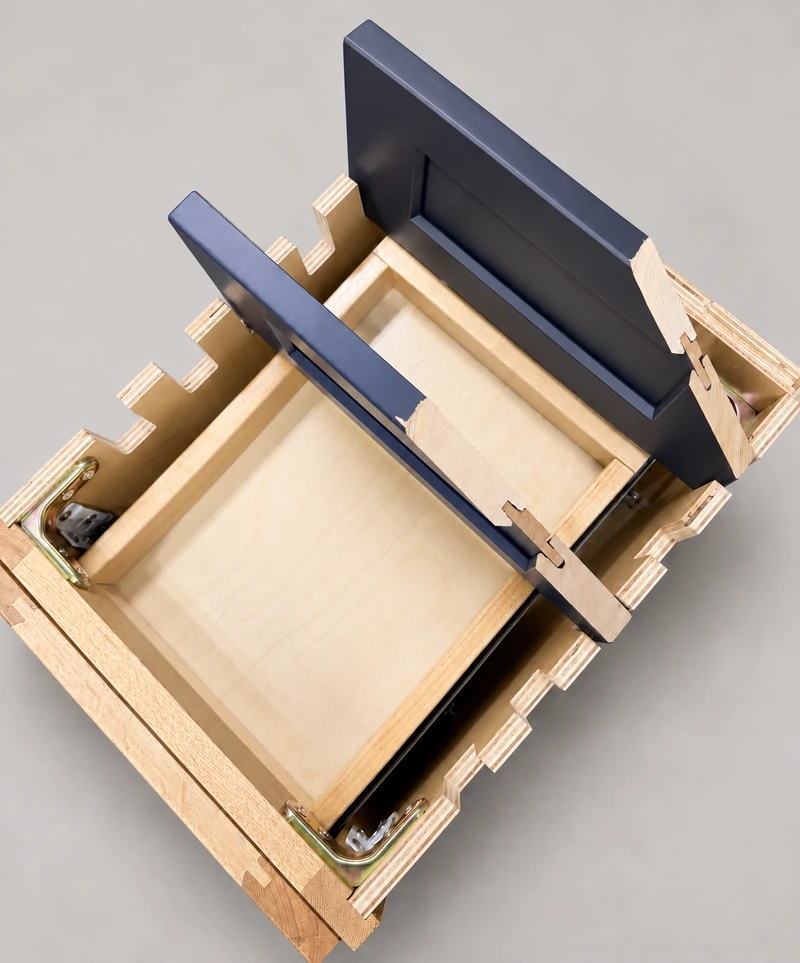
For a drawer that will carry heavy contents, examine how the bottom is supported and obtain load information for the complete drawer. A strong-looking corner joint describes the connection between side pieces; a runner label describes particular hardware. Neither alone establishes what the bottom panel and assembled drawer can carry in the selected size.
Physical sample Use the exposed parts to distinguish the bottom from the sides and hardware. This display does not establish a load rating, panel thickness or the complete support arrangement of an ordered drawer.
Follow the contents down to the supporting parts
Open an approved display drawer and identify the bottom, the side pieces, the rear and the connection to the runners. Ask for a section or underside view if the support is hidden. The point is to understand which components belong to the quoted assembly, not to infer their strength from color or surface appearance. Do not remove a display drawer without permission and the correct procedure.
Check whether the bottom is retained by grooves or another specified arrangement, whether additional support is present, and whether the description changes with drawer width or depth. Obtain the bottom’s material and specified thickness separately from the side material. “Wood drawer” or “dovetail drawer” leaves these questions unanswered.
Keep the drawer box and runner preparation connected
Conestoga’s drawer-box information distinguishes box construction from hardware preparation, including compatible undermount notches and clips. It illustrates why a box and its hardware must be specified together; it does not establish the capacity of a usaKT.com drawer.
Ask which runner system and attachment details apply to the actual drawer size. If a seller supplies a hardware rating, clarify what it covers, whether the drawer’s own weight is included and whether the assembled cabinet has a separate limitation. Do not transfer a rating from a similar-looking runner or add the stated capacities of separate parts together.
Describe the load as well as its total weight
A pile of cookware spread across the bottom and a compact heavy object resting on small feet are different loading descriptions. Tell the supplier what will be carried and how it contacts the bottom. A total weight alone omits that information. Ask whether the proposed use falls within the product’s stated conditions rather than seeking a general assurance that it is heavy duty.
Include permanent inserts, dividers or trays that move with the drawer. Their weight and contact points are part of the proposed assembly. An insert marketed for organizing contents does not automatically reinforce a bottom. Any structural reinforcement or changed attachment should be reviewed as a product modification, not improvised after purchase.
A hypothetical weight calculation that asks the right question
Suppose an empty drawer weighs 8 lb and the proposed contents weigh 22 lb. The combined moving weight is 30 lb. This hypothetical arithmetic is not a capacity recommendation. It identifies a question for the supplier: does the quoted rating concern contents alone, or the complete moving assembly, and does it apply to this exact drawer?
In that example, even a clear answer about the runner would leave the bottom construction and loading conditions to be confirmed. A compact appliance could also need a different support assessment from loose utensils of the same total weight. Use a contents list and a photo of the contact area to make the question concrete.
Approve the assembly, then watch for changes
Save the box dimensions, bottom specification, support description, runner identification and the supplier’s applicable load statement with the order. Record any limitations on concentrated loads or added accessories. If information is unavailable, choose a documented alternative or keep the heavy-use decision unresolved rather than testing the limits of a display drawer.
When the drawer arrives, compare its identifiable construction with the approved description before loading it. If the bottom separates, bows unexpectedly or rubs another component, remove contents as appropriate and arrange an assessment instead of continuing to add weight. Photos should show the whole drawer, the bottom edge and the hardware identification. Those observations make a service request much more useful than a report that the drawer feels weak.
Pure White
Cream White
Light Warm Gray
Gray
Navy
Black
Oak Tone
Dark Walnut Tone
Design study These finish studies are design references, not a list of currently orderable colors. Screens and lighting change the appearance; compare a physical sample before choosing.See all finish options →
A painted door, a wood-grain side and a plywood cabinet box can belong to the same cabinet. Here is how to read those parts, what the sample photos actually show, and which details to put on a quote.
Read the rear-panel construction and mounting information separately so an attractive interior back does not stand in for the cabinet’s installation requirements.
The sample shows the door frame, a separate center panel, the face frame and the cabinet box. Each component has its own place in this Shaker construction.
Shaker construction: door frame, center panel, face frame and cabinet box. The cutaway helps locate these parts; confirm each material in the specifications for the selected cabinet.
01 / Door frame
The Shaker door has rails and stiles around a separate center panel. The frame and center panel are different components; confirm their materials in the specifications for the selected cabinet.
02 / Face frame
The face frame surrounds the opening at the front of the cabinet box and sits behind the doors. The face frame, door frame and cabinet box are separate parts.
03 / Cabinet box
The sample exposes the cabinet sides, interior surfaces and layered edges. The image does not establish the wood species or material specification of a selected cabinet.