Separate drinking-water faucet or an integrated filter tap: what changes in the kitchen?
An integrated outlet can reduce visible fixtures; a separate beverage faucet can preserve the main faucet you already like. Compare controls, bottle placement, complete filtration equipment and the actual sink-deck arrangement.
Choose a separate beverage faucet when retaining the main faucet and giving drinking-water use its own control is worth another mounting position. Choose an integrated filter tap when its ordinary kitchen use and drinking-water controls both work for the household and reducing visible fixtures matters. Either choice must include the actual water system. A different faucet silhouette does not establish filtration performance or remove the equipment below the sink.
Separate the outlet decision from the water-treatment decision
Begin with the system the project has actually selected and its supported requirements. This comparison does not determine whether a household needs filtration or which treatment is appropriate for its water. It addresses where the accepted system dispenses and how that outlet fits the kitchen.
Kraus’s cited Bolden filter faucet uses independent supply lines for regular and filtered water. Its description identifies the undercounter filtration system as separately supplied. Combining the functions in the faucet does not mean the faucet body contains the complete treatment system.
Keep the faucet, filtration equipment and included components distinct in the quote. A listing called a filter faucet may describe the dispensing fixture; a bundle may include more. Do not compare the price of a faucet alone with a complete system and conclude that integration is cheaper.
Delta’s cited Clarifi bundle includes an under-sink filtration system and a separate beverage faucet. Its beverage-faucet description specifies cold-water use and excludes instant-hot tanks. That named example should not be treated as a universal hot-and-cold beverage outlet.
Verify the complete proposed pairing rather than assuming a compatible-looking connector settles it. Keep any required components with the system selected for the project. A cabinet layout is not permission to alter a water-treatment arrangement or omit a prescribed part.
Decide which controls the family wants to use
With a separate outlet, the household approaches a beverage faucet for that task and leaves the main faucet’s controls as they are. Test the actual handle and the position of the bottle or pitcher. Another visible fixture may be an acceptable trade for a distinct control, especially when the existing main faucet is already comfortable.
With an integrated candidate, demonstrate how the particular model selects ordinary and filtered water. Do not infer its sequence from a similar faucet or assume every combined model uses the same lever action. The user should be able to choose the intended function, stop it and return to normal kitchen use without uncertainty.
Assess the normal washing and spray tasks too. A combined faucet that is convenient for filling a glass but awkward for the household’s large mixing bowl is not an improvement to the whole sink. Conversely, a main faucet that works well need not be replaced merely to make the drinking outlet less visible.
No arrangement automatically creates another person’s working space. Two separate faucets can still share the same crowded basin and approach. Place the people and ordinary dishes in the comparison before assuming that independent controls mean independent simultaneous tasks.
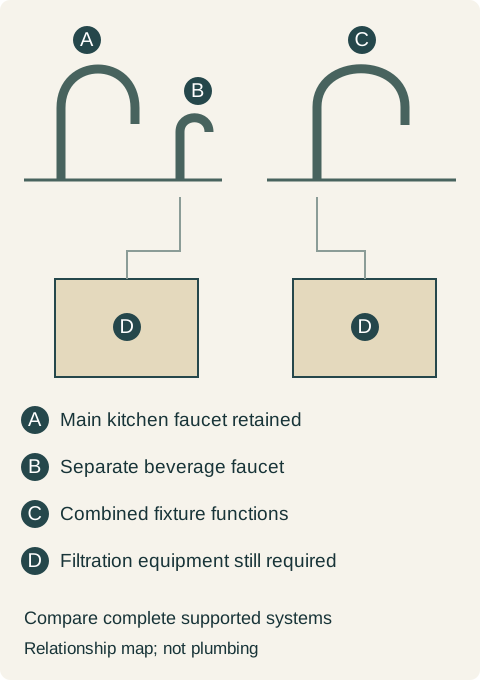
Teaching example Conceptual allocation. At left, A is the main kitchen faucet and B a separate beverage faucet. At right, C combines the regular and filtered-water functions in one fixture. D represents filtration equipment that still belongs in the complete purchase. Lines show functional relationships only, not plumbing routes, shared equipment between alternatives or approved connections.
Give the actual container a place
Use the everyday water bottle, carafe or pitcher, including its opening and handle. Check the outlet position, approach and where the container rests while filling. A small glass shown under an empty display faucet may omit the tall bottle that will be filled every morning.
For a separate faucet, the proposed hole should place its outlet where that task works with the basin. Do not locate it solely where the deck happens to look empty. Include the main spout’s movement and any soap dispenser or retained accessory, then assess the combined arrangement.
For an integrated fixture, the dispensing location shares the selected faucet’s geometry. Confirm the actual outlet used for filtered water and the permitted operating state. A pull-down washing head does not by itself establish that every function is intended to operate in every extended position.
A cleaner-looking deck can still contain a full equipment package
Draw the installed filtration components beneath the sink, together with their specified access, the bowl, drain and other selected equipment. Integration above the counter should not be credited with removing that equipment below. Likewise, a separate beverage faucet does not require a second full sink base by definition; the selected assembly determines its actual space.
Keep the cartridge-change or other prescribed service task possible with the agreed storage in place. Those movements belong to the particular system. Identify what must be moved temporarily and where it can go, rather than marking every space between equipment as usable permanent storage.
If the countertop is retained, establish the actual mounting options with the responsible professional. A new beverage-faucet hole may be feasible, undesirable or unsuitable in that project. Do not assume drilling is trivial, and do not assume replacing the main faucet avoids every alteration. Price the confirmed solution.
Keeping a liked main faucet can settle the choice
Consider a hypothetical household whose main faucet works well with its washing routine. The owners want a drinking-water outlet connected to an accepted under-sink system. They compare a combined replacement with a separate beverage fixture while keeping the same container and dispensing task in the trial.
The integrated candidate reduces visible pieces, but the owners prefer the grip and ordinary controls of their existing main faucet. The separate proposal has a mounting position approved for the actual top, places the bottle usefully over the basin and keeps the two fixtures clear in their intended states. The below-sink arrangement accommodates the supported system with its service access preserved.
The household keeps the main faucet and adds the separate beverage outlet. It accepts another visible fixture and the confirmed top work. The complete quote includes the dispensing faucet, system components, compatible connection scope and installation, rather than leaving the filtration equipment absent from an attractive deck rendering.
In a kitchen where the extra mounting position is unacceptable, a suitable integrated candidate can be the better choice after both operating functions pass the same review. It earns that result through the actual assembly and controls, not a claim that one visible fixture is inherently simpler to maintain.
Keep the accepted system identifiable
Retain the exact faucet and filtration-system identities, included components, applicable care information and the accepted cabinet arrangement. Follow the selected system’s maintenance instructions; this guide supplies no universal replacement interval. Recheck the affected fit and compatibility if either product changes.
The completed purchase should make ordinary washing, drinking-water dispensing and maintenance understandable without sacrificing the storage promised in the cabinet plan. Decide how much the household values a separate control or a less crowded deck, then buy the supported arrangement that delivers that preference in the real kitchen.
Pure White
Cream White
Light Warm Gray
Gray
Navy
Black
Oak Tone
Dark Walnut Tone
Design study These finish studies are design references, not a list of currently orderable colors. Screens and lighting change the appearance; compare a physical sample before choosing.See all finish options →
The basin, disposal, filter and their access requirements share the same cabinet. Resolve that complete arrangement first, then assign storage to the remaining usable regions.
The sample shows the door frame, a separate center panel, the face frame and the cabinet box. Each component has its own place in this Shaker construction.
Shaker construction: door frame, center panel, face frame and cabinet box. The cutaway helps locate these parts; confirm each material in the specifications for the selected cabinet.
01 / Door frame
The Shaker door has rails and stiles around a separate center panel. The frame and center panel are different components; confirm their materials in the specifications for the selected cabinet.
02 / Face frame
The face frame surrounds the opening at the front of the cabinet box and sits behind the doors. The face frame, door frame and cabinet box are separate parts.
03 / Cabinet box
The sample exposes the cabinet sides, interior surfaces and layered edges. The image does not establish the wood species or material specification of a selected cabinet.