

Buying cabinets
Reverse osmosis or a carbon filter: choose the treatment goal before the sink cabinet
Compare actual systems with verified claims for the intended water task, then include dispensing, connections, maintenance and remaining cabinet storage in the purchase.
Buy the system that addresses the identified goal
Choose an actual RO candidate when its verified claims match the household's established treatment goal and its dispensing, installation and ownership arrangements are acceptable. Choose an actual carbon-filter candidate when its verified claims meet that goal and the complete arrangement better suits the kitchen. Do not treat RO as an automatic upgrade or carbon as an automatic substitute.
The decision begins before choosing the sink-base organizer. Name what the household wants treated and where it needs that water. A wish for better water is too broad to verify against a product. The selected system should answer the identified concern, not a general impression created by the number of stages or the size of its equipment.
Check the complete product's claim
EPA advises identifying treatment goals and verifying model-specific certified reduction claims. Its guide distinguishes filtration from RO, which produces treated and reject-water streams; systems can combine technologies.
Reading note: US EPA WaterSense — Guide to Selecting Water Treatment Systems.
Keep the actual candidate's model identity, performance data and relevant certification together. Establish that the documented claim answers the selected goal under the stated conditions. A familiar certification mark alone does not tell the buyer which specific claim applies to that product.
If the water information or intended goal is unresolved, resolve it with the appropriate water supplier, testing information or qualified treatment professional before making the treatment choice. A cabinet designer cannot establish a water-treatment need from a photograph of the sink. This step gives the cabinet project a defined equipment brief instead of an assumed technology preference.
Compare systems rather than isolated filter media
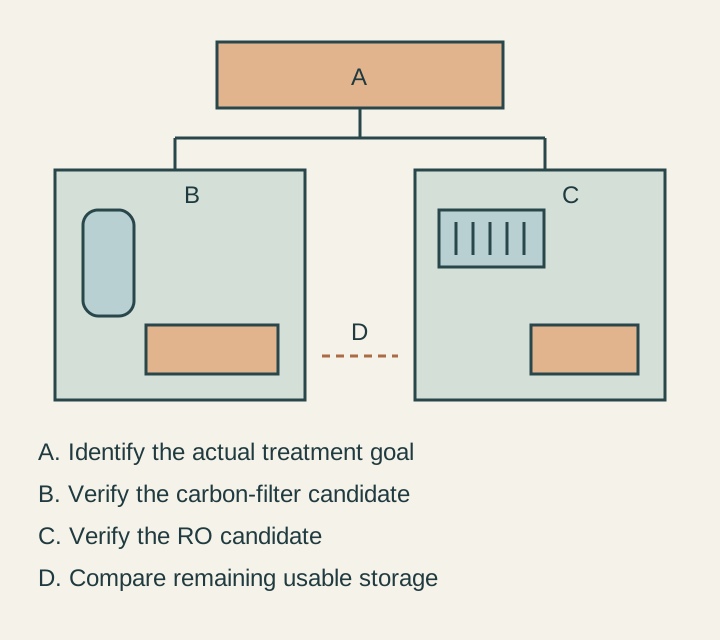
Ask exactly what is included in each proposal: treatment assembly, dispensing arrangement, consumables and any other required components. A carbon cartridge sold on its own is not the same purchase as a supported complete system. Nor does an RO label describe every component behind the door.
Do not reject a candidate merely because its component list includes more than one treatment technology. Compare the complete documented product against the goal, then compare its physical and ownership consequences. Counting filter stages is not a substitute for identifying the claimed result.
Keep separate water functions separate in the quote. If the household also wants instant-hot water or another dispenser, confirm the exact supported pairing rather than assuming that a successful filtration choice establishes compatibility with every outlet.
Follow the real water containers
List the containers filled during an ordinary day and at the busiest recurring time: glasses, retained bottles, a pitcher or a cooking vessel where relevant. Test the selected outlet's physical arrangement with those containers, including lids, handles and the intended standing position.
For water delivery behavior, use the candidate's actual specifications and an appropriate demonstration. A container fitting under the outlet does not establish that the owner accepts the filling routine. Keep any unverified delivery preference visible instead of inventing a category-wide speed or capacity claim.
If the household relies on water at another kitchen location, decide how it gets there. Carrying a filled pitcher can be acceptable. Adding another outlet or system is a different scope that belongs in the room and price comparison, not an invisible benefit of the initial purchase.
Draw the equipment and connections before storage
Use the selected product's actual component list and installation instructions. Identify any tank, power equipment or other component present on that candidate rather than assigning the same package to all RO or carbon products.
For the RO proposal, have the installer define the treatment and reject-water connection arrangement the actual system requires. For the carbon proposal, confirm its own supply and dispensing arrangement. This article does not give connection instructions or authorize changing a system to avoid a cabinet conflict.
Add the sink underside, drain, disposer if retained and other equipment in the same section. The installation must fit as one arrangement. A drawing that shows each component separately can conceal a conflict when the whole set is placed inside the real sink base.
Reserve the actions that keep the system usable
Read the chosen instructions for replacing consumables and carrying out other prescribed care. Show the necessary movement and access in the cabinet drawing, not only the installed shapes. A cartridge that fits while closed may need space that a fixed organizer would occupy during replacement.
Identify what stored objects move temporarily and where they wait. Test the sequence with the usual cleaning supplies represented. A removable bin may be an acceptable compromise; repeatedly dismantling a fixed storage assembly is a different burden to evaluate.
Have the intended owner or service provider review that routine before ordering interiors. Follow the product's actual care requirements rather than assigning a universal replacement interval. If a proposed system is physically inaccessible to the person expected to maintain it, revise the layout or the candidate.
Compare the whole purchase and ongoing supplies
Obtain complete current quotes for equipment, required components, installation and affected countertop or cabinet work. A faucet-only price is not the price of the treatment installation. Keep work common to both alternatives on both sides.
Then identify the permitted replacement products and the purchasing and care arrangement the household is willing to maintain. Use the actual proposed products and documented requirements; do not invent universal running costs, service life or savings. A lower initial price can still accompany an ownership routine the buyer dislikes.
After equipment and maintenance space are reserved, assign the remaining cabinet regions to specific supplies. Confirm their retrieval with the system in place. The complete treatment choice and the usable cleaning-supply storage should be approved together.
A goal changes the preferred system
Imagine a hypothetical household that initially asks for RO because it assumes the larger equipment package must be better. After its treatment goal is identified, the buyer compares exact certified claims rather than the technology names.
A carbon-filter candidate meets that established goal and its actual dispensing trial suits the retained bottle. The installed arrangement preserves a useful removable supply bin and allows the specified consumable change. The compared RO proposal is documented too, but its additional project scope provides no further benefit the household has chosen to buy.
The owner selects the complete carbon installation. Another household whose established goal instead requires the verified capability of its chosen RO candidate may accept that system and its cabinet consequences. Neither conclusion transfers automatically to a different water supply or product. Keep the identified goal, exact claim, container trial and cabinet section together so the final purchase remains traceable to the kitchen's real needs.
Sources & further reading
- US EPA WaterSense — Guide to Selecting Water Treatment Systems