

Buying cabinets
Instant hot-water dispenser or electric kettle: which complete kitchen arrangement?
Trade a repeated counter routine for a permanent water system only after checking the quantities used, sink approach and cabinet space that the tank and maintenance actually require.
Choose where the household will handle hot water
Buy an instant hot-water system when frequent small draws at an accepted dispensing point justify permanent equipment beneath the counter and the complete installed cost. Keep an electric kettle when its fill, heat and pour routine works well and preserving the sink cabinet or avoiding another fixture is more valuable. Compare the kitchen that remains after the choice, including the space needed to use and maintain the equipment.
Start by separating needs. Water for individual drinks, a large cooking task and a temperature-specific preparation are different demands. Record what people actually fill, where they carry it and what conditions the preparation requires. Do not assume that a product called instant replaces every kettle task, or that a kettle with a larger-looking body automatically serves every gathering conveniently.
Price a system, not only a faucet
InSinkErator presents separate faucets, tanks and optional water-system components as well as complete systems. The component list matters when comparing a permanent dispensing installation with a kettle.
Reading note: InSinkErator — Instant Hot Water Dispensers, system components.
Ask the supplier to identify everything included in the actual proposal and any required items supplied separately. A fixture price does not represent the tank, installation and complete supported arrangement. If you also want treatment or chilled water, keep that additional purpose identified rather than allowing it to disappear into a general hot-water label.
Select the exact system before the cabinet arrangement is released. The faucet and heating equipment must be a supported combination. A conveniently located existing beverage outlet does not establish that it is suitable for a hot-water tank. If you keep a separate drinking-water system, show both assemblies and their access together.
Follow the quantities and the containers
Observe an ordinary period of use and the busiest recurring occasion. Are people repeatedly filling individual cups, preparing a pot, or filling a vessel for cooking? Look at the candidate’s documented temperature choices, draw capacity and recovery behavior for that actual task. Use model information rather than a universal expectation attached to the word instant.
For a kettle, check the supported fill range, pouring action and the way the intended person returns it to its base. Consider where the lid opens and how it reaches the water source. For a fixed outlet, use a cool, empty version of the everyday cup or vessel to test its position at the sink. The dispenser should not be selected around a small showroom cup if the household mostly fills a handled pot.
If the household wants different temperatures, determine how the actual candidates provide them and what operating sequence is required. Do not infer that any hot-water tap provides an arbitrary requested temperature, or that every electric kettle offers temperature selection. Buy the controls and capabilities documented for the offered equipment.
The sink cabinet gives up more than a tank outline
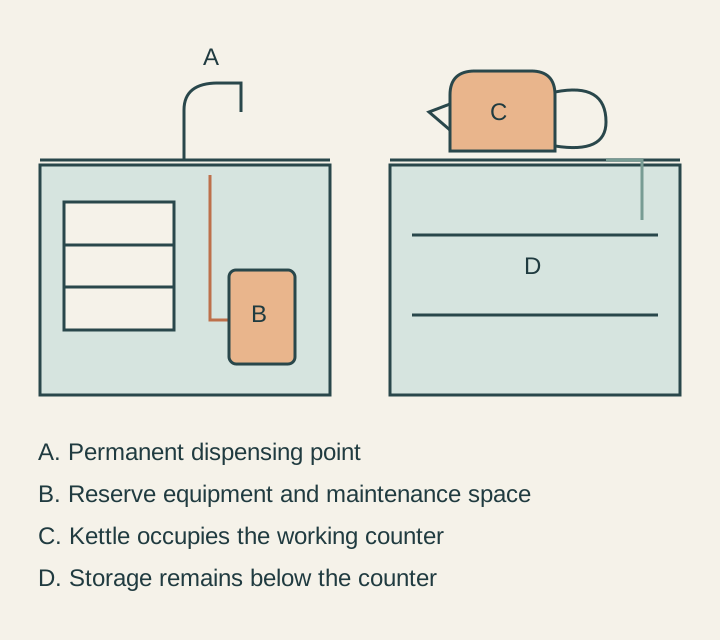
Place the specified heating equipment within the sink-base section alongside the bowl, drain, disposer and retained filtration where applicable. Include the actual mounting arrangement and service requirements. Only then assign cleaning supplies or organizers to the remaining interior. A tank that fits in an empty rectangle may conflict with the working drawer or leave no way to reach a connection.
Ask how the prescribed maintenance is performed in the finished cabinet. Which items must be removed, and where do they wait? Does a permanent shelf or pullout block the task? The owner needs an understandable access arrangement, not a claim that equipment is hidden and therefore takes no storage.
For an existing counter, have the responsible professional establish whether the proposed dispensing position can be provided. Include its full relationship with the main faucet, window operation and retained accessories. A visually empty spot on the sink deck does not establish a suitable mounting hole or convenient approach.
The kettle also has a real footprint
Give the kettle a supported operating position, with the lid, handle, cord and required surroundings considered under its instructions. Do not count its cabinet parking space as the place it can necessarily operate. A kettle kept in an appliance garage may still need to be moved into a suitable open working position.
Measure the counter segment that remains useful for preparation with the kettle in ordinary use. A portable appliance is not automatically a small interruption when it occupies the only clear landing area. Conversely, if it lives in a beverage zone already sized for that routine, removing it may free a surface the household has no important reason to reclaim.
Compare cleanup and return as well as dispensing. Who refills the kettle, empties it as instructed and puts it away? Who keeps the fixed system’s maintenance information and handles its required care? Purchase convenience only when the associated household work is acceptable; neither format removes responsibility merely by changing where it happens.
A household keeps the kettle and the sink drawer
Imagine a hypothetical kitchen replacement whose owners frequently make tea but are satisfied with their kettle’s observed operation. They initially add a dispenser to clear the counter. The actual sink-base drawing shows that the accepted tank and access would replace the pullout holding the household’s cleaning supplies.
They trial a separate beverage-counter position for the existing kettle. It leaves the main preparation segment clear and provides a convenient fill-and-return routine. The displaced sink supplies, however, have no equally useful home in the proposed cabinet plan. The owners keep the kettle and drawer, accepting its presence at the beverage station.
A household with repeated cup-filling at the sink and an accepted below-counter equipment area could reasonably choose the fixed system instead. Compare the complete installed prices and accepted daily use, without inventing an energy-saving amount or treating a manufacturer example as a USA KITCHENS & TOPS inventory offer. The final order should preserve the chosen operating place, exact system identity and storage the kitchen still needs.
Sources & further reading
- InSinkErator — Instant Hot Water Dispensers, system components