

Buying cabinets
Refrigerator screen or plain front: choose the kitchen task before the display
Test a real shared task from the planned standing position, accept the account and connection work it needs, and compare complete refrigerators before changing the cabinet wall around a screen.
A useful screen needs a task and a suitable position
Choose a refrigerator with a screen when the exact offered display performs a household task people actually want to do at the refrigerator, in a position they accept, and the complete appliance still fits their food and cabinet plan. Choose a plain front when another accepted method handles the task better or the screen adds little beyond its initial appeal.
Start with a task such as checking a shared household item or consulting a supported piece of information. Identify who will do it, when and for how long. Do not buy a large display on the assumption that family members will invent enough use for it after installation.
Demonstrate the wanted function on the actual version
Ask the seller to demonstrate the exact task on the proposed model and software arrangement. A promotional image of a calendar, recipe or video does not show that the owner's preferred service or content works on that particular refrigerator.
Write down what equipment, compatible devices, connection and accounts the demonstrated function needs. If a requested service cannot be demonstrated or its current requirements are unclear, do not make it the decisive reason for the purchase. Compare the refrigerator on the capabilities actually established.
Samsung's Family Hub setup guide makes Wi-Fi and account sign-in optional during initial setup, while noting that certain device-synchronizing features require the same Samsung account. Optional setup is not evidence that every wanted screen task works without those conditions.
Reading note: Samsung USA — How to set up the Samsung Family Hub refrigerator.
The owner should accept the requirements of the specific chosen task rather than treating a familiar app name as universal compatibility. Do not promise that a current service, interface or feature will remain unchanged for the refrigerator's entire ownership.
Give the screen user a real place in the room
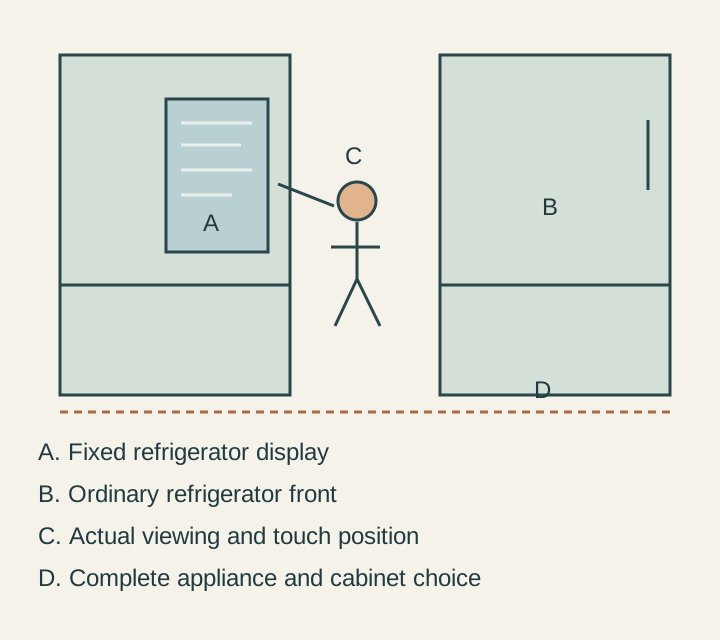
Mark the display on the actual appliance elevation. Test reading and touching from the standing position available in the proposed kitchen, with the real users. A large image in a rendering says little about small text, reflections or reaching the controls the person needs.
Use the household's ordinary room lighting in a representative trial where possible. Observe whether someone steps back, shifts sideways or leans across the refrigerator front to finish the task. Those movements belong in the layout; they should not be erased to make the aisle look clear.
Include another person retrieving food or passing to the pantry. A screen user remains a person standing at the refrigerator. The appliance may combine two functions on its front without providing two independent working positions.
Decide whether the refrigerator is where information belongs
Compare the same task with the household's existing phone, a retained display or another accepted method. Keep the comparison concrete: can the relevant people find and use the information where the kitchen actually needs it?
A fixed screen can be attractive for a genuinely shared task if people accept its location. A portable device may be preferable when the information needs to follow the cook to a different counter or room. Neither arrangement wins merely because one is built into a large appliance.
If a separate device remains in the proposal, give its supported use and storage a real place without sacrificing the only useful preparation surface. Do not claim the refrigerator screen frees counter space unless the item being removed actually occupied that space and no replacement takes its place.
Agree who maintains the shared arrangement
Identify who sets up accounts, keeps the wanted information useful and handles the product's prescribed updates or owner care. If the task requires shared access, confirm how the selected system permits it before treating one person's successful demonstration as a family solution.
Consider what the owner is comfortable showing on a screen visible from the kitchen or adjoining room. This is a household display preference, not a claim that the product exposes private information. Confirm the settings and account arrangement appropriate to the actual use rather than guessing what all visitors will see.
Keep essential household information accessible through an accepted alternative when the chosen screen task is unavailable. That alternative need not defeat the screen purchase; it reveals whether the premium feature remains an accepted convenience rather than the only way the household can complete a necessary action.
Evaluate the refrigerator behind the display
Use the same ordinary and post-shopping food collection in both candidates. Fit produce, tall containers, covered leftovers and frozen packages in a single accepted arrangement. Do not let a successful screen demonstration replace the cold-storage trial.
Compare doors, drawers, shelves and any drink functions independently. If the screen model changes the freezer shape or food arrangement as well, decide whether that whole combination is desirable. It is inaccurate to attribute the entire purchase difference to the display alone.
Inspect the front the owner actually wants, including handles and visible screen behavior in the accepted mode. A refrigerator with a screen is not automatically compatible with furniture panels or a different surround. Buy the actual supported installation.
Complete the cabinet wall and the quote
Have the responsible installer confirm each candidate's enclosure, required spaces, door movement, connections and service provisions. The display's apparent location does not authorize tightening the surrounding cabinets or changing the appliance's installation arrangement.
Show the side panels, overhead cabinet, neighboring pantry and food-access position in both proposals. If a candidate changes any storage, reassign the contents before approving the order. A screen that wins a task does not answer where the displaced serving pieces will go.
Compare the complete refrigerator, supported accessories, installation and cabinet work. Separately identify any accepted service costs established for the chosen task. Avoid assumed savings, future resale value or an unverified universal support lifetime as justification.
A household chooses a plain front
Imagine a hypothetical family considering a refrigerator screen for cooking information. The exact demonstrated function works, but the cook needs to consult it while working at the opposite preparation counter. Using the fixed display means repeatedly returning through the route another person uses for food.
The family's retained portable method serves the same accepted information task from an assigned position without consuming the required preparation area. A plain-front refrigerator also passes the same food-storage trial and its complete cabinet surround is accepted.
They choose that plain-front package. Another household with a shared task comfortably performed at the refrigerator may prefer the screen. Keep the demonstrated function, accepted standing position, connection requirements and full cabinet plan together; those facts make the display purchase a kitchen decision rather than a promise of unspecified future usefulness.
Sources & further reading
- Samsung USA — How to set up the Samsung Family Hub refrigerator