

Buying cabinets
Door-in-Door refrigerator or ordinary door: buy around the food you actually retrieve
Assign a real group of bottles and condiments to the extra access compartment, then compare the closing sequence, main storage and complete cabinet surround with an ordinary-door refrigerator.
Buy an extra access compartment only when its assigned contents justify it
Choose a refrigerator with an additional door compartment when the household repeatedly retrieves a stable group of foods that fits that compartment, and accepts the rest of the refrigerator and its operating sequence. Choose an ordinary-door arrangement when the useful contents change too much, the wanted containers do not fit, or the whole refrigerator works better without the feature.
Start with the food rather than the front panel. Milk, a dressing bottle and a daily condiment can form a meaningful access group. A general desire for easier access is harder to test because almost every refrigerated item could qualify. The buyer needs a specific job that the compartment will perform often enough to matter.
Establish what the added door actually opens
LG describes Door-in-Door refrigerators as having an additional door compartment for frequently accessed items. That architecture alone does not establish the useful shape or contents of a particular candidate.
Reading note: LG USA — Door-in-Door refrigerator architecture FAQ.
Have the seller demonstrate the exact model's front access and main-door access. Watch which handle, button or latch opens each part, what stays closed, and what is reachable from the main interior. A see-through panel, external drink dispenser and nested food compartment are different features; do not assume one confirms the others.
Repeat the demonstration yourself with the intended user. A household should accept the actual distinction between opening the compartment and opening the refrigerator, including the supported closing sequence. Do not use an unverified energy-saving or freshness claim to turn an awkward task into a necessary purchase.
Assign a real food group before comparing volume
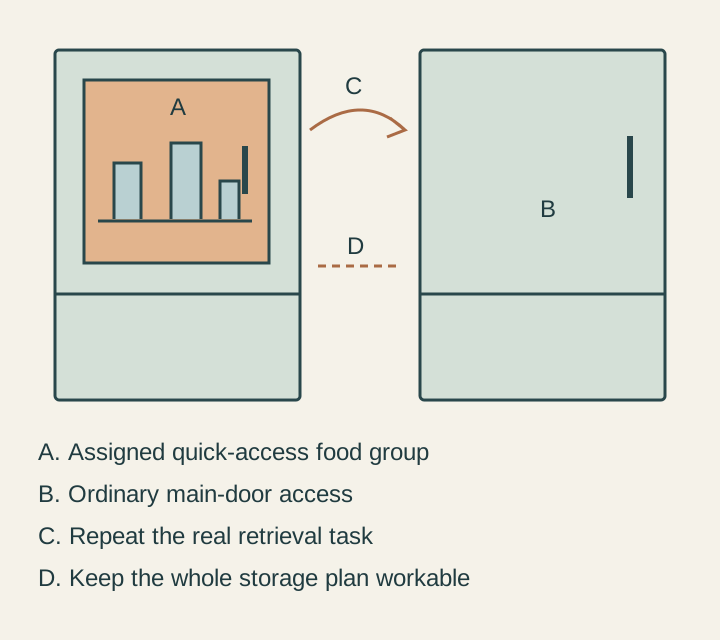
Bring the dimensions of the containers normally kept there, including lids and handles. Test the upright arrangement and the space needed to grasp and return each item. An object that fits only after removing another daily item has a different retrieval task from the one shown in an empty display.
Include the item when it is newly purchased, not just a nearly empty substitute. A replacement bottle may have a different shape even when its contents are familiar. Decide whether the family will keep buying a limited container format or wants the freedom to change brands and package sizes.
Keep the group small enough to describe honestly. Do not count every door-bin item as a beneficiary if most remain behind the main door. Conversely, do not reject the compartment solely because a rarely used oversized jar stays elsewhere. The purchase can be worthwhile for a specific accepted task.
Test return and closure, not just the first grab
Follow the container to the counter where it is used and back into its place. Include a hand occupied by another ordinary object where that reflects the real routine. Determine whether the user can comfortably identify and operate the intended access without improvising a different grip.
Check the prescribed way to close the compartment and main door. Let every regular user try it. If someone repeatedly opens the whole door anyway, that person's task has not gained the same benefit as a showroom demonstration centered on the extra access.
Ask how the selected product signals an incompletely closed part and inspect the relevant instructions. Do not assume every model reports every opening in the same way. The family should understand the equipment it buys, rather than planning around an alert that belongs to another version.
Compare the main refrigerator with the same grocery load
Lay out ordinary groceries and the fuller load following the usual shopping trip. Allocate produce, covered leftovers, tall containers and freezer packages in both candidates. The nested compartment does not remove the need to examine shelf adjustment, main door bins and freezer organization.
A convenient front group can still accompany an unsuitable main interior. Identify any item that loses a workable place and show its new position. Do not claim a category-wide storage penalty or advantage: compare the actual offered layouts and use the same collection in both.
Separate the quick-access task from an external water or ice task. Someone fetching a condiment may still stand where another person fills a glass. A different access opening does not create another independent refrigerator station in the floor plan.
Order cabinets around the complete selected appliance
Show both access modes in the room with the user standing in position. A smaller compartment opening may suit a brief retrieval while the main door still needs its complete useful movement for groceries, shelves or cleaning. Do not shrink the cabinet opening or aisle based only on the small front access.
Read the exact installation information with the responsible installer. Confirm the enclosure, required spaces, door operation, connections and supported service access. Similar advertised refrigerator widths do not authorize the same panels, overhead cabinet or side-wall position.
Compare full purchase scopes. Include the chosen refrigerator, required installation work and changes to adjacent cabinetry. Give displaced kitchen items a real cabinet destination if the selected surround changes storage. The extra food compartment is a feature of the refrigerator purchase, not a reason to leave the cabinet order unresolved.
A front-access group fails the family trial
Imagine a hypothetical household that frequently retrieves milk and salad dressing. It prefers the nested-door candidate in the elevation and initially expects both items to use the front compartment. The retained milk container fits, but the ordinary dressing bottle cannot be retrieved in the intended upright arrangement without moving the milk.
The household could change its containers or accept the extra movement. Instead, it compares an ordinary-door refrigerator that accommodates both items in its checked door bins and accepts the main-door opening in the room. The main shelves and freezer also fit its regular grocery collection.
The family buys the ordinary-door arrangement and the matching complete cabinet surround. Another household with a stable, well-fitting front group may choose the extra compartment after the same trial. Keep the accepted containers, access sequence, full food allocation and selected appliance identity together. That record explains what the feature earns in this kitchen without relying on a broad convenience promise.
Sources & further reading
- LG USA — Door-in-Door refrigerator architecture FAQ