

Buying cabinets
Front vs. rear range controls: use and cabinet layout
Try reading and changing the actual controls with ordinary cookware present, then compare front projection, the wall behind the range and the complete installed kitchen.
Choose the controls the regular users can read and operate
Buy a front-control candidate when its actual reading and adjustment routine works better for the people cooking, and the household accepts its front projection and complete wall-and-cabinet arrangement. Buy a rear-console candidate when that specific position is comfortable and understandable, and the whole appliance fits the desired kitchen.
Start with a repeated meal, not a preference for a bare wall or a familiar row of knobs. Identify which cooking and oven controls the users change, when they look at the display and where they stand. A large visible control panel is useful only if it provides the information and movement they actually want.
Locate every control on the exact candidate
Whirlpool describes rear-backguard and front-control arrangements in its range comparison. Those control locations do not replace the selected model's installation information.
Reading note: Whirlpool — Slide-in and freestanding ranges, control configuration.
Find the surface-cooking controls, oven settings, timer and any other function the household expects to use. Do not assume they all occupy the same location. A front row of burner knobs can coexist with an oven interface elsewhere.
Keep the exact appliance identity attached to the demonstration. Control location, heating technology and installation arrangement are separate things to confirm. A front-controlled product should not inherit a countertop detail or cabinet opening from another model simply because both look similar in a front photograph.
Rehearse adjustment with the actual cookware arrangement
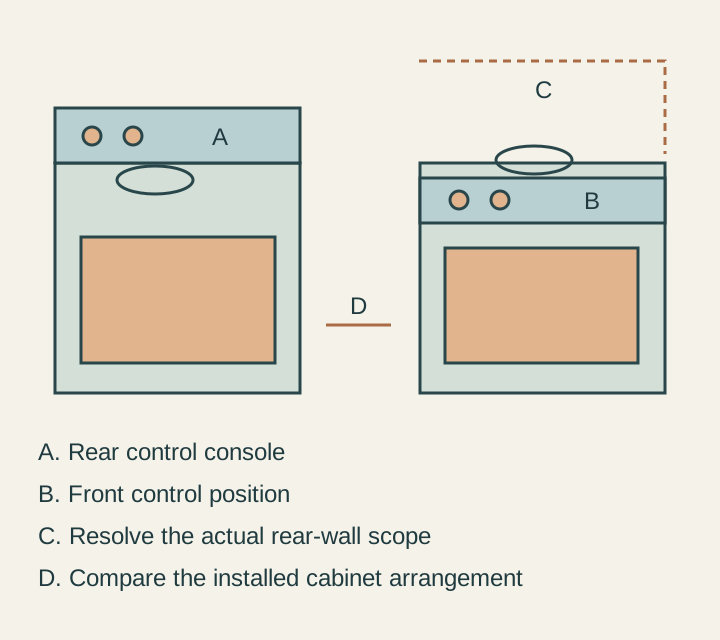
Place the ordinary cold, empty pots and pans in their intended positions. Include the handles and lids that remain during cooking. Ask the regular user to identify a control, select the intended function and follow the documented adjustment sequence in an appropriate inactive demonstration.
Then change the arrangement to the fuller meal that occurs regularly. A knob or label that was easy to see with a small pan may be less clear behind another vessel. Likewise, a front interface that looked convenient from above may be difficult to read from the user's real standing position.
This exercise compares reach, visibility and understanding; it does not establish a universal safety advantage or cooking performance. For actual operation, use the product's intended demonstration and instructions. Do not make someone perform an awkward operating action merely to defend a preferred appliance.
Reading the display is a separate task
List the information the cook wants during a meal. The surface setting, oven status and timer may matter at different times. Check what the actual display shows, where the person can see it and which selection is needed to view the wanted information.
Include the usual room lighting and the angle below the hood or upper cabinets where applicable. A clear promotional photograph does not show reflections or the user's sightline. If another household member also cooks, repeat the same trial rather than using the taller person's result for everyone.
If reading from the nearby preparation area is important, test that position too. The better interface may be the one that communicates clearly there, even when both can be operated while standing directly at the range. Keep that preference separate from a claim that a higher or lower panel is always easier.
Account for the front of the working kitchen
Show the actual control face, knobs, handle and oven door in the proposed installation. A control surface may project differently from the body. Compare that complete outline with the aisle and nearby cabinet fronts rather than aligning only the range's large rectangle.
Open the neighboring drawer or door used during cooking and include the person using it. Determine whether its handle or path competes with the range's front arrangement. A workable closed elevation is not proof that the cookware drawer remains comfortable during the meal.
Ask about the selected model's documented control-lock behavior if that function matters to the household. Do not equate a hidden or more distant control with a particular protective feature. Evaluate the offered equipment rather than assuming a location alone resolves the concern.
Complete the wall behind the appliance
For a proposal without a rear console, draw the actual wall and countertop meeting behind the selected range. Determine which finished area becomes visible and what work the exact appliance installation requires. Removing the console in a rendering does not finish the wall.
For a rear-console proposal, inspect how that actual part meets the planned backsplash and adjacent cabinets. A console can be an accepted visible element; it should not automatically be dismissed as an inferior appearance. The household is buying the result it wants to see and use.
Have the responsible installer and finish professionals define the real scope. Keep the range, hood and surrounding surfaces coordinated under their instructions. This article gives no universal clearance, wall-material specification or assumption that every front-control range is interchangeable with a retained appliance.
Compare the complete range, not the control location alone
Try the same cookware and oven containers in both candidates. If one also changes cooking layout, oven functions or the lower compartment, evaluate those differences independently. The whole price difference cannot automatically be assigned to moving the controls.
Compare prescribed cleaning with the actual panel and surrounding surfaces. Identify what is accessible in the normal permitted state, without assuming that removable-looking knobs or trim may be removed. The care routine belongs to the exact product.
Price appliance, installation, required components, actual wall or counter work and affected cabinets together. Keep the control preference attached to that finished proposal. A favorable appliance tag does not include unspecified repairs behind it.
A rear console remains the better choice
Imagine a hypothetical household that initially wants an uninterrupted backsplash and therefore favors a front-control range. The complete cold-pan trial works, but the oven interface is difficult for a regular user to read from the ordinary standing position.
A rear-console candidate gives that person the wanted information and adjustment sequence. It also accommodates the same cookware and oven containers, and the household likes its actual appearance within the checked cabinet and backsplash arrangement.
They select that complete rear-console proposal. Another household may prefer the front position after the same test and accept its wall-finishing scope. Keep the model, cookware trial, display sightline and coordinated cabinet details together. The selected control location earns its place by working during a real meal, not by standing alone as a style category.
Sources & further reading
- Whirlpool — Slide-in and freestanding ranges, control configuration