When a cabinet quote offers PUR edging instead of EVA, compare the adhesive product and the process used to apply it. The change can affect bonding and resistance, but a label does not show whether the shop can process that adhesive correctly. The useful purchase is a finished edge qualified for the intended panel and edgeband, with the fabrication scope included.
PUR has a reaction after the initial set
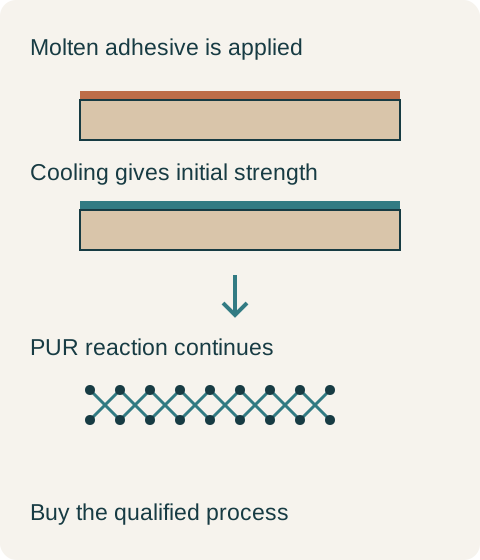
Jowat explains reactive PUR in stages: the molten adhesive first cools and physically hardens, providing initial strength. Moisture in the substrate and air then participates in chemical crosslinking. The manufacturer links that reaction to resistance against water, moisture, heat and chemicals. Initial handling strength therefore should not be treated as proof that the later reaction is complete.
REHAU’s RAUBOND guide distinguishes EVA products from its reactive PUR products. The PUR entries call for specialized processing equipment and moisture-protected sealed containers; the product page also makes the equipment requirement explicit. An ordinary EVA routine is not automatically an approved PUR routine, even when both materials arrive as hot-melt products.
Keep the adhesive name, edgeband reverse treatment and panel construction together in the proposed process. REHAU identifies suitable primers or pretreatment for particular edge materials and notes that substrate condition, environment and equipment affect adhesion. A good-looking glue line on a loose sample does not establish the same result on every proposed material combination.
Diagram Conceptual reactive-PUR sequence: physical cooling and chemical crosslinking are distinct stages. This is not a timing chart, laboratory result or whole-cabinet performance claim.
Choose the shop that can supply the specified process
In a hypothetical cabinet order, the buyer has specified a reactive PUR edge package for selected parts. A proposed substitution would run the adhesive through an EVA-only setup without approved PUR capability. A second fabrication proposal includes compatible PUR equipment, protected adhesive handling and a completed component trial accepted for the intended use. The buyer selects that complete proposal and rejects the unsupported process substitution. The decision does not require declaring every EVA-bonded cabinet inferior; it preserves the process actually requested for this order.
For an order whose established EVA package already meets its requirements, a change should have a defined purpose. Compare the promised performance scope and finished component evidence against the additional production work. A generic claim of premium glue is not enough to explain a price difference, and it does not establish a universal service-life multiplier.
The quotation needs the fabrication scope
Identify which components receive the specified adhesive, including exposed and concealed edges that are part of the requirement. Distinguish factory-finished edges from later site cuts. A quote for loose panels plus an adhesive product is not equivalent to delivered, prepared and accepted cabinet components.
Record the current product instructions and the fabricator’s accepted process with the order. Cure and storage conditions belong to the selected adhesive, so do not borrow a fixed waiting time from another PUR product. Any moisture-resistance claim should retain its tested scope; the edge adhesive alone does not establish the behavior of openings, joints and other materials in the whole cabinet.
Pure White
Cream White
Light Warm Gray
Gray
Navy
Black
Oak Tone
Dark Walnut Tone
Design study These finish studies are design references, not a list of currently orderable colors. Screens and lighting change the appearance; compare a physical sample before choosing.See all finish options →
A nearly invisible edge line describes a specific bonding and finishing result. It does not mean the cabinet is made from one solid piece or that the complete assembly is waterproof.
Thin banding covers a panel edge; solid lipping adds a separately specified wood member. Compare the finished outline, profile and assembly before treating thicker edging as an upgrade.
The sample shows the door frame, a separate center panel, the face frame and the cabinet box. Each component has its own place in this Shaker construction.
Shaker construction: door frame, center panel, face frame and cabinet box. The cutaway helps locate these parts; confirm each material in the specifications for the selected cabinet.
01 / Door frame
The Shaker door has rails and stiles around a separate center panel. The frame and center panel are different components; confirm their materials in the specifications for the selected cabinet.
02 / Face frame
The face frame surrounds the opening at the front of the cabinet box and sits behind the doors. The face frame, door frame and cabinet box are separate parts.
03 / Cabinet box
The sample exposes the cabinet sides, interior surfaces and layered edges. The image does not establish the wood species or material specification of a selected cabinet.