

Bath & laundry planning
Dressing wardrobe: long hanging bays or double hanging?
Keep an uninterrupted hanging bay for garments that need their full drop. Use double hanging where the actual short garments fit above and below without touching another rail, clothing or stored objects. In a dressing area serving the primary bath, this choice should follow what people wear and put away, rather than a drawing that fills every vertical opening with another rod.
Keep an uninterrupted hanging bay for garments that need their full drop. Use double hanging where the actual short garments fit above and below without touching another rail, clothing or stored objects. In a dressing area serving the primary bath, this choice should follow what people wear and put away, rather than a drawing that fills every vertical opening with another rod.
Sort the clothes before choosing the cabinet
Separate long dresses, coats and other full-length pieces from shirts, jackets and trousers stored folded over hangers. Use their normal hangers and covers. Measure the occupied shape from the point where the hanger rests on the rod to the lowest part of the garment; shoulder-to-hem measurements alone miss the hanger's contribution.
Do this with representative bulky and long pieces, not only the easiest shirt. Identify clothing kept elsewhere by choice, such as seasonal coats. The proposed wardrobe does not need to contain every item the owner possesses, but it should have a named home for everything assigned to this room.
CabParts lists double-hang, long-hang and medium-hang closet configurations. Those are different storage arrangements; their names do not establish the right dimensions for a particular wardrobe.
Reading note: CabParts: closet hanging configurations.
Check the complete hanging section
Show the actual finished rail positions, shelf undersides, cabinet base and any lower drawers. A clear opening on a front elevation is not necessarily usable garment drop after hardware and shelves are installed. Draw the hanger and clothing inside the finished section and check where hems end.
For double hanging, examine the upper and lower levels separately. The upper garments should not settle onto the lower rod or clothing. The lower garments should not pile onto a shelf or the base. Increasing one level's space can reduce the other's, so review both after an adjustment instead of approving each independently on different drawings.
Keep reach separate from garment length
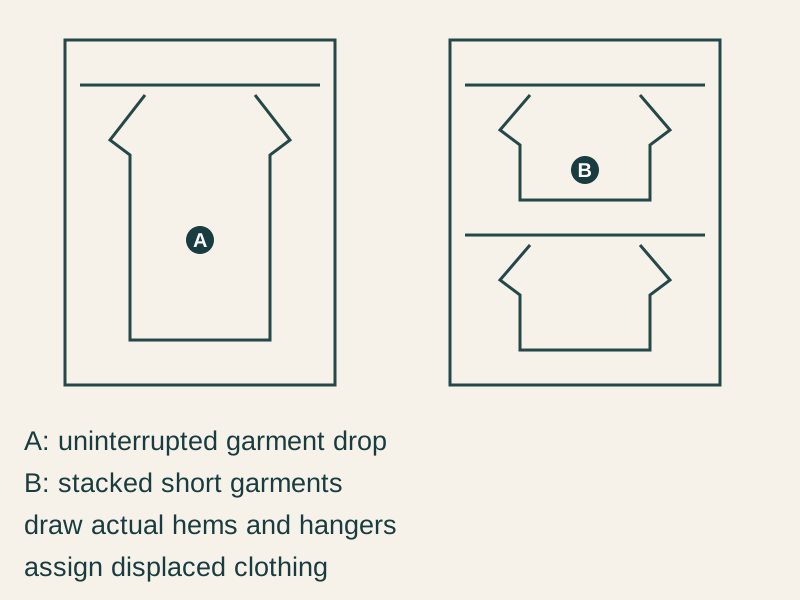
- A
- A: uninterrupted garment drop
- B
- B: stacked short garments
A long hanging compartment does not require its rod to be placed as high as possible. Locate the rod for the intended clothing and user within the supported cabinet design. Similarly, an upper double-hang rail may fit the clothes but be inconvenient for the person who uses it every day.
Try removing and returning clothing on the chosen hanger, including the motion needed to lift the hook over the rod. A reach aid or moving mechanism would introduce another purchase with its own movement and support requirements. Do not count that accessory as already included in an ordinary fixed-rail proposal.
Compare capacity using the same clothing
Place the same intended garments in both layouts, with the spacing people actually need to identify and remove them. Doubling rods does not double usable capacity when long clothes lose their only suitable location. Nor should a mostly empty long bay be preserved merely because it looks orderly if a small long-hanging section elsewhere already handles those pieces.
Include the clothing displaced by drawers or shelves. A proposal may offer useful folded storage while reducing hanging space, but those gains should be evaluated together. A separate rack in the bedroom belongs in the comparison if it becomes necessary to make the new wardrobe work.
Follow a household's actual mix
Imagine an owner whose work wardrobe consists mainly of short shirts and jackets, but whose long dresses are worn regularly. The proposed wall contains a long bay; changing all of it to double hanging would leave those dresses without a suitable place. This is a hypothetical planning case.
The owner first reserves the long space needed by those dresses, using their real hangers and garment drop. The remaining section is then tested for double hanging. This mixed layout provides useful short-clothing capacity without turning the long garments into a problem to be solved after installation.
If those long pieces were instead intentionally stored in another suitable closet, more double hanging might be sensible. The deciding fact is where the actual clothing will go, not whether one diagram displays more rods.
Test the dressing routine beside the bath
Walk through choosing clothes, laying out an outfit and returning an unworn item. Keep bathroom doors, the changing position and any hamper in their ordinary locations. A good hanging section still needs a workable place for the person holding a garment outside the cabinet.
Separate wet towels and recently used bath items from this dry-clothing plan. Assign those objects their own appropriate locations rather than quietly borrowing the empty bottom of a hanging bay. Otherwise a garment arrangement that fit at purchase may become obstructed during everyday use.
Put the useful section on the order
Record finished rail positions, shelf and drawer relationships, hangers used for the trial and the clothing assigned to each section. If later adjustment is important, confirm the actual system's adjustment method and parts rather than assuming every rod can move freely.
Choose long hanging where uninterrupted garment drop earns the space. Choose double hanging where both levels fit the assigned clothes and users. A mixed wardrobe is often a more accurate purchase than applying one arrangement across the entire wall.
Sources & further reading
- CabParts: closet hanging configurations