A full-length mirror cabinet or a separate dressing mirror and storage?
Combine a dressing mirror with storage when the same location works for both looking and retrieving. Keep them separate when one person needs the mirror while another opens the cabinet, or when the stored contents need a different cabinet form.
Buy the two functions together only if they share a useful position
A full-length mirror cabinet can give one wall a dressing reflection and concealed shelves. It is worth choosing when the household needs both functions there and the actual contents fit the cabinet. A separate dressing mirror and storage cabinet are preferable when their locations, dimensions or simultaneous use need to differ. Extra mirror height alone does not settle the purchase.
This choice usually supplements the washing area. A tall mirror beside the vanity may let someone check clothing, yet sit outside the position used for shaving or other close work at the basin. Keep the necessary basin mirror in the plan unless the users have actually confirmed a replacement arrangement. Counting every reflective surface as interchangeable can leave a room with abundant glass and an inconvenient morning routine.
The combined product is more than a mirror applied to a linen tower
Robern's M Series Reserve brochure presents a full-length cabinet with concealed storage and also describes mirrored interiors. That confirms the combination exists; it does not establish its fit or capacity for this bathroom.
Read the selected cabinet as a complete product. Check its usable shelves, door arrangement, mounting requirements and supported accessories. A shallow mirrored unit can organize small supplies without providing the same space as a deep linen cabinet. Do not credit it with the capacity of whichever tower it replaces merely because both are tall.
The separate alternative deserves equal care. A plain mirror needs its own suitable installation, and the storage unit must be selected for the real contents. Separation can consume more wall area, but it lets the mirror stay where the dressing view is useful while the cabinet sits where retrieval works. Compare those finished arrangements, rather than pricing only a mirror against a complete cabinet.
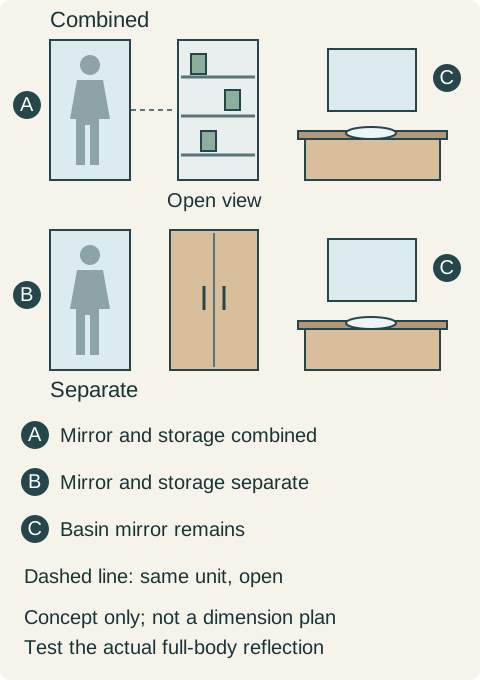
Diagram Conceptual bathroom elevations. A combines a full-length mirrored door with storage, shown beside it as a separate open-state sketch; the dashed line identifies the same unit, not an extra purchased cabinet. B uses a plain dressing mirror and a separate storage cabinet. The basin and its grooming mirror remain in both plans. These are functional arrangements, not optical or installation dimensions.
A full-length label does not establish the user's full-length view
Test the intended reflection from the actual standing position. Include the person's head, clothing and feet, with the vanity, chair, baskets and other objects in place. A tall mirrored surface partly hidden behind a vanity is not equivalent to an unobstructed dressing mirror. Nor does a narrow gap in the room necessarily provide a comfortable place to look at an outfit.
Use a real mirror for that trial. A paper outline can show the physical extent and door clearance, but it cannot confirm the reflected view. Evaluate ordinary lighting as well. A person can be visible from head to toe while the light still makes it difficult to judge the clothing in the way they want.
For the combined cabinet, repeat the trial with its door opened to the position needed for retrieval. The outer reflecting surface moves. An interior mirror may remain useful, but the shelf contents, door angle and person's position can change what is seen. Do not assume either that all reflection disappears or that the open state preserves the same uninterrupted outfit view.
Sharing a surface also shares the moment of use
Consider whether one person wants to check clothing while someone else retrieves supplies. If those tasks regularly overlap, the cabinet door and the person reaching inside may interrupt the dressing view. A separate mirror can keep that function available while storage is open. That benefit matters only if the room actually permits both users to occupy their intended positions.
If the household uses the two functions sequentially, integration may work comfortably. Take out the needed item, close the cabinet and use the dressing reflection. There is no reason to reject a combined product merely because its doors move. The question is whether that sequence suits the household, not whether a photograph shows everything closed.
Check low and high shelves with the items assigned to them. A tall cabinet can contain useful levels and inconvenient ones in the same product. Keep the decision tied to the actual reach and retrieval task; a full-height door does not make every shelf equally convenient. Avoid packing the unit with a nominal inventory that cannot come out comfortably.
A household buys the combined unit and keeps the basin mirror
Consider a hypothetical primary bathroom with a clear side wall, an existing dressing position and a vanity that already handles daily washing supplies. The owners want a full-body view and additional enclosed storage for their selected small supplies. They compare a full-length mirror cabinet with a plain dressing mirror plus a separate shallow cabinet. Neither option is expected to store their large bath-linen collection.
The separate arrangement occupies two wall areas and places the added cabinet farther from the intended retrieval position. The combined unit keeps both functions on the chosen side wall. In the actual-mirror trial, each owner can inspect clothing from the intended standing position without the vanity blocking the lower view. The selected supplies fit the reviewed shelf arrangement, and the project installer confirms the mounting scope for that location.
The open-door trial shows that the stored objects interrupt part of the interior reflection. The owners accept this because they take out what they need before dressing and do not share those tasks simultaneously. They choose the combined unit, omit the separate mirror and added cabinet, and retain the grooming mirror above the basin. The decision uses the integrated product for its own pair of functions without pretending it replaces every mirror or storage volume in the room.
If another household needs the dressing view while someone retrieves shared supplies, the same open-door finding could favor separation. Buy the arrangement whose normal occupied state works. Keep the accepted mirror location, cabinet contents and basin-mirror role together in the order so that a later substitute does not quietly undo the reason for combining them.
Pure White
Cream White
Light Warm Gray
Gray
Navy
Black
Oak Tone
Dark Walnut Tone
Design study These finish studies are design references, not a list of currently orderable colors. Screens and lighting change the appearance; compare a physical sample before choosing.See all finish options →
Place the tower where its door, contents and tall side panel work with basin use, light and the room's approach; compare complete positions rather than simply filling leftover wall space.
The sample shows the door frame, a separate center panel, the face frame and the cabinet box. Each component has its own place in this Shaker construction.
Shaker construction: door frame, center panel, face frame and cabinet box. The cutaway helps locate these parts; confirm each material in the specifications for the selected cabinet.
01 / Door frame
The Shaker door has rails and stiles around a separate center panel. The frame and center panel are different components; confirm their materials in the specifications for the selected cabinet.
02 / Face frame
The face frame surrounds the opening at the front of the cabinet box and sits behind the doors. The face frame, door frame and cabinet box are separate parts.
03 / Cabinet box
The sample exposes the cabinet sides, interior surfaces and layered edges. The image does not establish the wood species or material specification of a selected cabinet.