

Construction & materials
Pressed-metal backsplash panels: choose the relief, repeat and finished perimeter
A stamped motif repeats within a larger panel. Compare the cuts and seams on your wall, including the actual coating on every exposed trim.
Choose pressed-metal backsplash panels when you want the light and shadow of a formed surface and accept the way its motif is cut and joined on your wall. A flat finish swatch cannot show that result. The relief, larger panel boundaries and exposed ends all matter. What appears to be many small metal tiles may actually be larger panels containing several decorative repeats.
American Tin Ceilings distinguishes panel size from the pattern repeated within it. Its guidance also addresses cut panels, possible dents and sealed edges. That supports reviewing a complete assembly; it does not establish one installation or care routine for all metal walls.
Reading note: American Tin Ceilings: Backsplash FAQs.
Separate the motif from the panel
Begin with a formed sample rather than only a painted card. Stand it vertically under the intended light. Raised and recessed areas catch light differently, and a finish that looks quiet on a flat swatch may become more active across the actual relief. Decide whether that sculptural effect is part of the attraction.
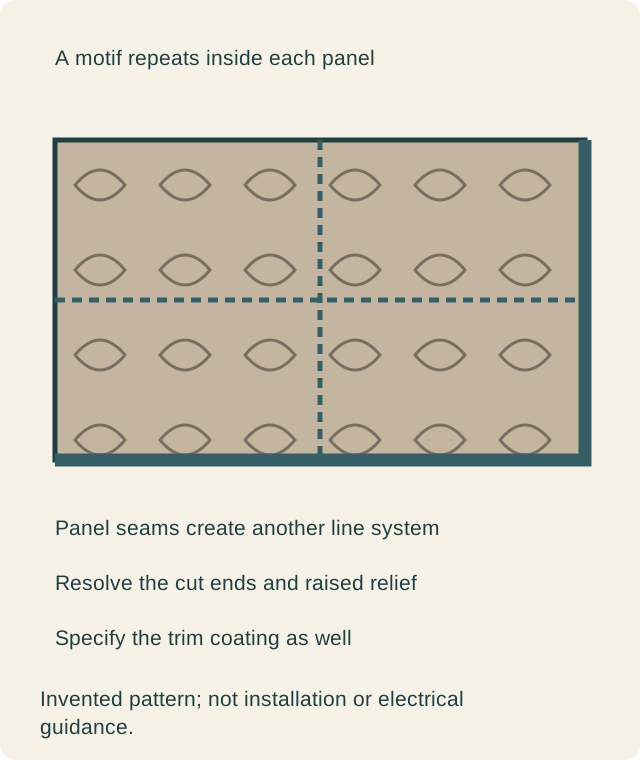
Ask which lines are decorative and which indicate the edges of a panel. A stamped grid is not a grout joint, and a panel seam does not disappear because it follows a grid. Show both on the proposed elevation, especially where windows and tall cabinets divide the backsplash into short areas.
Cut the pattern on paper first
Place the motif over the real wall outline. A broad medallion may look excellent on a loose panel yet become disconnected arcs beneath wall cabinets. A tighter repeat might remain recognizable in the same space. This is a comparison of the actual cuts, not a rule that small patterns always work better.
Centering the entire wall also does not guarantee preferred cuts at every end. Inspect the most visible return, window edge and cabinet side. You may choose to prioritize a central feature and accept a partial pattern elsewhere. The drawing should reveal that tradeoff before the metal is cut.
Include adjacent wall lengths in the same review. Starting each segment with a whole motif can create a poor meeting at a corner. Decide where the pattern continues and where it deliberately stops. A supplier or installer can then explain the proposed junction rather than leaving a decorative conflict for the installation day.
Relief changes the interruptions
A cover or fitting may land on a raised crest or a flatter part of the pattern. Mark its position so the responsible installer can resolve that junction with the actual products. A decorative sketch is not permission to alter electrical components or select their mounting method.
Put ordinary objects in the view. A shelf bracket, rail or countertop appliance can conceal the center you liked and expose only fragmented edges. Evaluate the occupied wall, not only an empty showroom panel. If the preferred effect depends on keeping the entire wall bare, decide whether that suits the household's routine.
Buy a finished perimeter
Resolve the exposed side and top edges as part of the purchase. Ask to see the proposed trim against the formed panel, including how it meets the highest relief. A color match alone does not describe that physical relationship. The most attractive face sample can still leave an unresolved end.
American Tin Ceilings identifies trim for exposed cuts. Its care note distinguishes clear-coated Artisan backsplash panels from other panels and moldings requiring gentler dusting unless separately coated. Matching colors therefore do not automatically establish matching cleaning instructions.
Reading note: American Tin Ceilings: Tin Trims & Moldings 101.
This matters near a working counter. If the family wants to wipe the complete assembly using one routine, compare the actual panel and trim instructions. A supported coating option may change the proposal. Do not apply an improvised clear coat after delivery and assume that its appearance or suitability follows from the original finish.
Metal color does not identify material
A copper-colored painted panel, a plated product and solid copper are different offers, even if their photographs share a warm tone. Ask what the named product contains and how its face is finished. Do not infer composition from a color name or treat a distressed paint effect as evidence of natural aging.
Discuss reflections, splash marks and cleaning preferences using the sample. Avoid universal rankings of all metal surfaces. A deep relief may be exactly what one buyer wants, while another prefers a flatter wall. Neither preference needs a promise that the chosen category is effortless or automatically more durable than an unspecified alternative.
A hypothetical kitchen changes the repeat
Imagine owners who want metal relief beside simple cabinet fronts. Their first choice has a broad decorative center. On the actual elevation, the low strip beneath the cabinets removes most of that center, while the visible end leaves an awkward partial crest. Changing the cabinet color would not repair those cuts.
They compare a tighter repeat in a similar finish. It remains legible in the short wall area and meets the proposed trim more comfortably. They choose that panel and its specified trim coating, keeping the cabinets and countertop. The problem concerned the pattern's fit, not the palette.
Another room could retain the larger motif on a generous open wall. The rejected product was not defective; its most appealing feature did not survive this kitchen's cuts. That distinction is useful because it ties the choice to a visible result rather than a generic claim about metal backsplashes.
Keep a complete wall record
Identify panel, finish, orientation, trim, corners and relevant preparation and installation in the proposal. Product-specific instructions govern attachment and seam treatment. The responsible professionals coordinate actual requirements around appliances and other equipment; a decorative article cannot supply them for an unidentified system.
Retain the selected layout and finish records. If the panel changes, review the motif and perimeter again. The successful result gives the family the relief it wanted in the portions it actually sees, with finished ends and a care routine that belongs to the purchased assembly.
Sources & further reading
- American Tin Ceilings: Backsplash FAQs
- American Tin Ceilings: Tin Trims & Moldings 101