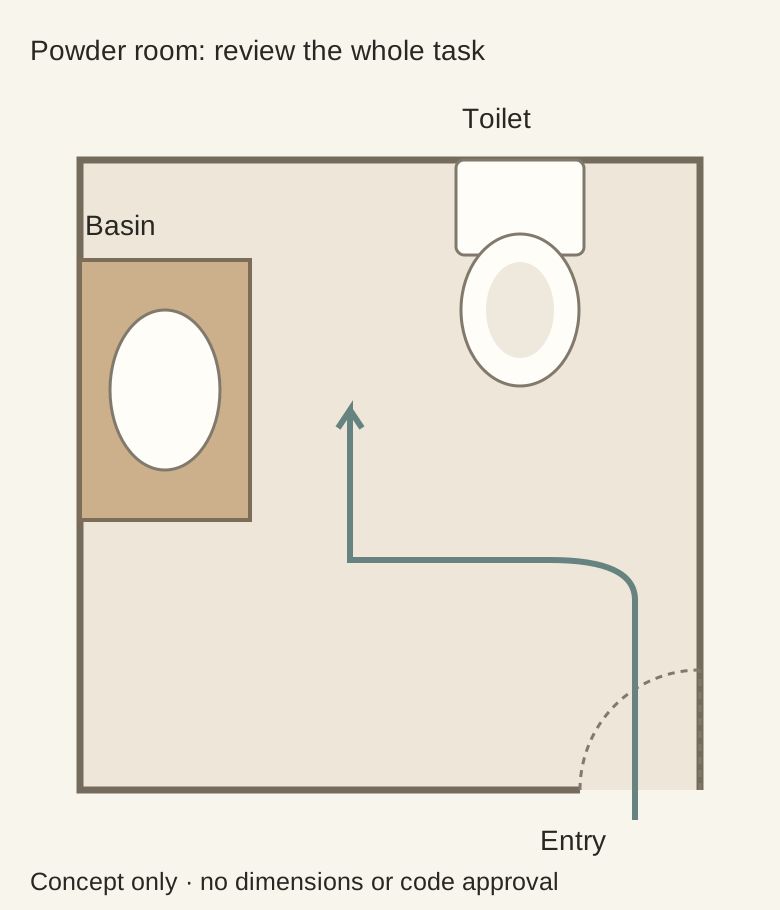
Give a guest a recognizable place for a bag before choosing the powder room’s decorative accessories. The basin rim, faucet area and hand towel should not become the default landing just because every other surface is occupied. A suitable shelf, ledge, hook or combination can help, but the choice depends on what it supports and how it affects the room.
Follow the bag from entry to departure
Review entering while carrying it, closing the door, setting it down or hanging it, washing hands and picking it up to leave. A position that looks convenient from the doorway may be trapped behind the open door or require reaching across the wet basin later. Test the complete sequence rather than only the parked bag.
Diagram Check a proposed bag location against the whole route. The diagram does not show a bag support or establish load capacity, reach or required clearances.
Use representative ordinary bag shapes without collecting personal contents. Include a structured bag that wants a flat base and a soft bag with a usable strap. They may need different support. A phone or clutch may not hang at all, so a hook alone may leave the original landing problem unresolved.
A flat landing should remain usable during handwashing
Try the proposed shelf or top area with a bag outline and the actual soap and drying arrangement. The bag should not cover the faucet control, require moving the towel or block a cabinet that must be opened during the visit. Keep the surface suitable for its intended use and follow its care instructions.
Imagine a powder-room top with a broad-looking side area occupied by flowers and a soap tray. The guest puts a bag against the basin because the remaining strip cannot support it. Removing or relocating the decorative object may create a useful landing without buying a larger vanity. Expanding cabinetry solely to preserve every decoration is a different, deliberate tradeoff.
Check the strap, hanging shape and specified support
For a hook option, test whether representative handles or straps can be placed and removed comfortably. Some short or stiff handles do not work like a long shoulder strap. Include the hanging body of the bag, not just the small hook footprint; it can project into the approach or cover a control.
Select hardware and attachment appropriate to the stated use and substrate, with the supplier or installer confirming the relevant requirements. Do not treat a towel accessory, cabinet pull or adhesive decoration as a bag support without that confirmation. A generic photograph cannot establish the loading of a particular installation.
Keep the landing distinct from room supplies
An obvious open place lets a visitor use it without searching through private cabinet storage. Avoid making a closed drawer the only option unless its purpose is genuinely clear. The guest should not have to guess whether opening it is welcome or whether the contents can be moved.
If the room also needs a place for a small item, check that separately. A broad bag shelf may work, but a sloped or interrupted surface can behave differently for a phone. Do not promise security or damage prevention from the arrangement; choose an appropriate stable place and assess the actual surface.
Keep the useful place after the room is styled
Review the final room with all intended accessories present. Recheck door movement and the user’s route with a representative bag on its support. A convenient empty shelf loses its purpose if the completed styling fills it with decor or reserve towels.
Add the bag location to the vanity brief alongside soap, drying and the room’s essential reserve. It may call for rearranging the current top, a suitable separate support or a different assembly. The useful result is a clear place that remains available throughout the visit, not another accessory that competes with handwashing.
Pure White
Cream White
Light Warm Gray
Gray
Navy
Black
Oak Tone
Dark Walnut Tone
Design study These finish studies are design references, not a list of currently orderable colors. Screens and lighting change the appearance; compare a physical sample before choosing.See all finish options →
A door can miss the cabinet box and still hit a top or handle—or leave the person nowhere useful to stand. Diagnose the collision before changing the door or cabinet.
Outside dimensions show whether a sink fits the room. The usable bowl, faucet position and soap-to-towel movement show whether it works for handwashing.
The sample shows the door frame, a separate center panel, the face frame and the cabinet box. Each component has its own place in this Shaker construction.
Shaker construction: door frame, center panel, face frame and cabinet box. The cutaway helps locate these parts; confirm each material in the specifications for the selected cabinet.
01 / Door frame
The Shaker door has rails and stiles around a separate center panel. The frame and center panel are different components; confirm their materials in the specifications for the selected cabinet.
02 / Face frame
The face frame surrounds the opening at the front of the cabinet box and sits behind the doors. The face frame, door frame and cabinet box are separate parts.
03 / Cabinet box
The sample exposes the cabinet sides, interior surfaces and layered edges. The image does not establish the wood species or material specification of a selected cabinet.