

Construction & materials
Polished, honed or leathered stone countertops: choosing a finish
Distinguish smooth reflection, smooth low sheen and actual texture on the selected stone. Keep the mechanical finish separate from oiling, sealing and promises about future repair.
Choose a natural-stone countertop finish by deciding how much reflection you want and whether you want actual texture under your hand. A low-sheen smooth surface and a low-sheen textured surface are different choices. The useful comparison uses the selected stone in representative finished examples, rather than comparing a polished dark stone with an unrelated pale textured one and attributing every difference to finish.
Use Natural Stone distinguishes polished reflection, smooth honed surfaces and leathered texture produced with brushes. It notes that leathered texture varies among stones. The names identify useful directions; they do not establish identical tactile results on every slab.
Reading note: Use Natural Stone: Selecting the Ideal Stone Finish.
Separate sheen from texture
A smooth surface can be reflective or comparatively subdued. That is a different question from whether the surface has physical relief. If the family says it wants matte, ask whether it means less reflection, a textured feel or both. The answer helps avoid selecting the wrong sample for the right-sounding word.
Do not assume that all textured finishes have the same intensity. Touch a relevant finished example where permitted and look across it under light. Decide whether you like its actual variation. A picture can show shadows but cannot tell you exactly how that particular finish feels when you set your hand on the top.
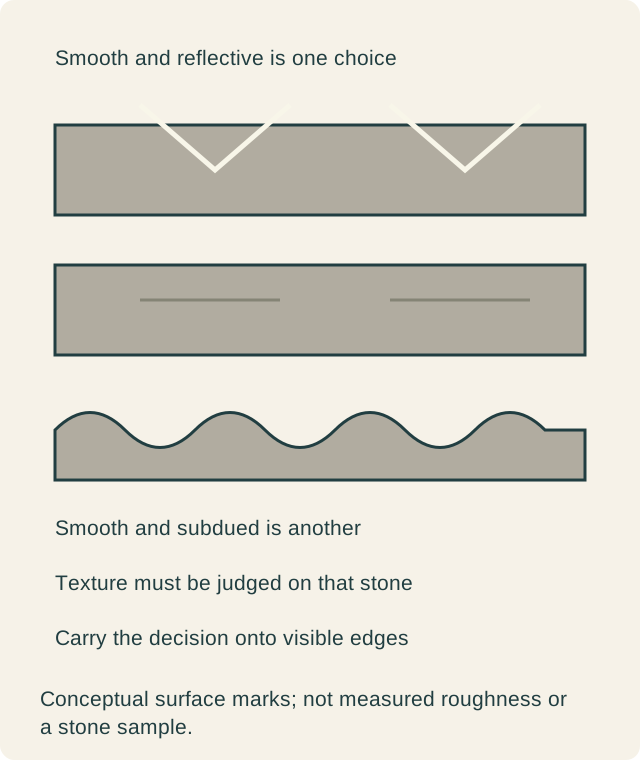
Keep the stone constant where possible
Polycor's Caledonia page shows separate Polished, Honed and Antique finish examples for the same named granite. This is a manufacturer example of finish choices within a stone, not a promise that every stone is offered in every finish or that all textured names are interchangeable.
Reading note: Polycor: Caledonia, Explore Finishes.
Compare relevant examples from the proposed stone selection. If only different stones are available to view, acknowledge that limitation. You can explore preferences, but you have not isolated the effect of finish. Do not reject the selected stone because another material's textured sample has a character its own geology and processing helped create.
Follow the room's reflections
Put the samples horizontally under conditions resembling the kitchen, with the cabinet reference nearby. Look from standing and seated positions. A window or light fixture can become part of the reflected scene. Decide whether that effect is attractive, distracting or simply unimportant to the household.
A subdued face may support a quieter composition; a polished surface may be precisely what another family likes. Avoid declaring either one more current or more luxurious. Your actual sight line is more useful evidence than a style label. The finish should work with the room's light instead of being chosen from a sample held at a flattering angle.
Touch the places you will use
Consider how the household meets the counter: resting a forearm at an island, moving a tray, wiping the area around a board or touching the front edge while standing. Use a non-damaging sample review that the supplier allows. The goal is to know the preferred surface, not to perform an improvised abrasion experiment.
If a family likes a textured feature but wants a smoother working area, compare that material allocation openly. Different areas can have different finishes when the actual supply and fabrication support it. Show the boundary and decide whether the change looks deliberate. A vague request for the same stone everywhere can conceal a finish difference the household never approved.
The front and opening need their own finish decision
Ask how the chosen top finish meets the exposed front, corners and sink opening. A textured face does not automatically describe a long edge, and a polished sample edge may not represent the proposed top. The buyer should see the completed transition, not imagine it from the broad face alone.
A deliberate contrast can be acceptable. A family might prefer a smoother edge beside a textured top if the actual fabricator offers that combination and the household likes it. The important point is to name and view the result. Do not discover the difference only when the edge reflects light differently from the rest of the counter.
Mechanical finishing is not an optional treatment routine
Keep finish separate from any oil, wax, enhancer or sealer on the sample. Those are additional conditions that can alter appearance or care. Ask how the example was prepared, so you do not approve a treated state while the project is quoted in a different one.
Nor does a mechanically textured or subdued finish establish protection against every mark. The stone's identity and applicable instructions remain relevant. This guide does not rank stain resistance or prescribe a universal sealing interval. A preferred appearance still needs a care plan for the actual stone and treatment.
A hypothetical family chooses smooth low sheen
Imagine owners who dislike a strong window reflection on a polished reference. They initially request leathered stone because they use matte as a general term. When they compare actual finished examples, they discover they want the quieter reflection but do not prefer the offered physical texture at the island seat.
They choose the supported honed proposal and review its completed front edge with the cabinet sample. Their stone preference stays, while the surface specification becomes more precise. The decision is not a rejection of all leathered finishes; the particular texture did not serve the experience they wanted.
Another family could choose the textured example for the tactile character itself. Its choice should include the real edge and care instructions too. Neither family needs a universal claim that its finish hides every mark or will always be easier to maintain than the alternatives.
Approve a finished surface, not a future experiment
If changing an already selected slab's finish is proposed, have the responsible fabricator explain the actual scope and demonstrate the relevant result before commitment. Do not assume a finished countertop can be converted casually on site without other consequences. A purchase guide is not a refinishing procedure.
Keep the stone identity, mechanical finish, treatment state and accepted edge examples together. The successful choice can be described plainly: how it reflects the room, whether it has texture and what the hand meets around the visible perimeter. That record is more useful than the single word matte.
Sources & further reading
- Use Natural Stone: Selecting the Ideal Stone Finish
- Polycor: Caledonia, Explore Finishes