A paper-towel drawer must accept the full new roll and its refill movement
A dedicated dispenser can clear the counter but consumes a drawer position. Compare the roll diameter, dowel removal and backup-roll access before assigning that space.
A paper-towel drawer can remove a freestanding holder from the counter, but it takes a cabinet position that might otherwise hold utensils. Before making that trade, confirm the diameter of a fresh roll and how the complete dispenser is refilled. A partly used roll in a showroom is not the demanding condition.
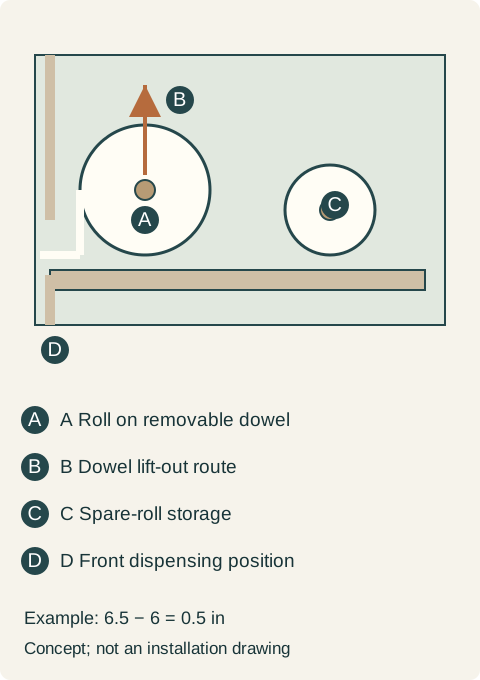
Rev-A-Shelf's plain paper-towel drawer uses a removable dowel and provides storage behind the active roll. The dowel is part of the refill operation, so the space above and around it matters as well as the paper visible at the front.
The manufacturer's description for the plain 4PTD system specifies a standard roll with a 6-inch diameter. Apply that statement to the named system; the word “standard” on an unrelated paper package does not prove compatibility.
Refill is a different movement from dispensing
For ordinary use, check the specified front arrangement and the hand motion for drawing and separating a sheet. For replacement, extend the assembly as instructed, remove the dowel and exchange the roll. The countertop edge, an upper drawer or surrounding fronts must not prevent that sequence. Spare rolls at the back also need to be reachable; their presence should not obstruct the dowel or the running roll.
The cabinet quote should identify whether it includes the complete drawer system and its intended front treatment. A hole cut in a normal drawer front does not automatically reproduce the holder or refill arrangement. Do not combine the plain system's details with a different tiered organizer merely because both dispense paper.
Teaching example Conceptual dispenser section: the full roll turns on a removable dowel, while replacement requires opening the assembly and lifting the dowel clear. The hypothetical example compares a 6.5-inch roll with a stated 6-inch product diameter; the excess is 0.5 inch.
Check the largest new roll, not the label
For a hypothetical household, the current fresh roll measures 5.5 inches across, while a bulk replacement measures 6.5 inches. Against the stated 6-inch product diameter, the replacement is 6.5 − 6 = 0.5 inch larger. It is not accepted as fitting that specification. This compares outside diameters; it does not describe the clearance around the spindle or approve the smaller roll without its other fit checks.
The household intends to keep buying the larger roll. The dedicated drawer is therefore omitted, and the existing countertop holder remains. The released drawer position is assigned to daily preparation tools. If the household instead commits to a compatible roll and the refill trial works, the dispenser becomes a valid alternative with an explicit supply constraint.
A clear counter has a storage cost
Compare the actual counter area released with the drawer contents displaced. Keep the active roll, spares and replacement path in the same drawing. The cabinet feature is useful when those choices suit the routine; it should not depend on compressing a roll, removing part of the mechanism or silently changing the household's supplies after installation.
Pure White
Cream White
Light Warm Gray
Gray
Navy
Black
Oak Tone
Dark Walnut Tone
Design study These finish studies are design references, not a list of currently orderable colors. Screens and lighting change the appearance; compare a physical sample before choosing.See all finish options →
Front proportions do not tell you the usable height inside. Group the actual objects, test their stored and removal positions, then compare the drawer combinations the selected cabinet system supports.
The sample shows the door frame, a separate center panel, the face frame and the cabinet box. Each component has its own place in this Shaker construction.
Shaker construction: door frame, center panel, face frame and cabinet box. The cutaway helps locate these parts; confirm each material in the specifications for the selected cabinet.
01 / Door frame
The Shaker door has rails and stiles around a separate center panel. The frame and center panel are different components; confirm their materials in the specifications for the selected cabinet.
02 / Face frame
The face frame surrounds the opening at the front of the cabinet box and sits behind the doors. The face frame, door frame and cabinet box are separate parts.
03 / Cabinet box
The sample exposes the cabinet sides, interior surfaces and layered edges. The image does not establish the wood species or material specification of a selected cabinet.