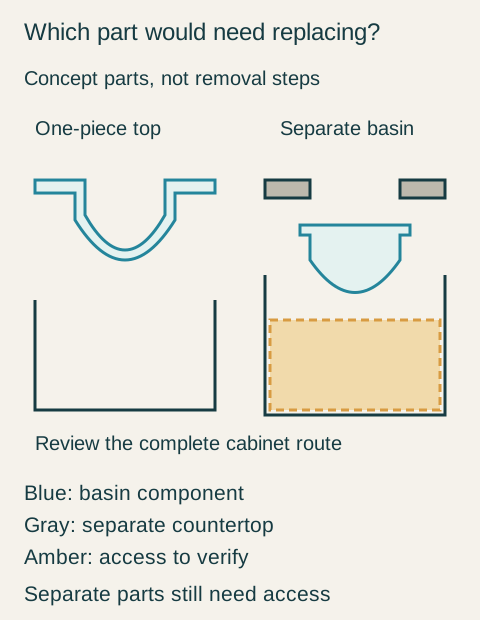
Choose a one-piece basin top when its complete form suits the room and you accept that the bowl belongs to that larger component. Choose a separately mounted basin when independent component selection matters, but verify the cabinet access before counting basin-only replacement as a benefit. Separate purchasing identities do not guarantee that a fitted bowl can leave the cabinet without disturbing the top.
Find the actual joint in the product information
KOHLER describes Ceramic/Impressions as a one-piece basin-and-top construction. Its documented bowl is part of the surrounding ceramic top, rather than a separate bowl attached beneath a cutout. This historical product illustrates the structure; its companion specification is marked discontinued.
If replacement of that bowl is eventually required, do not budget the work as though it were an ordinary detachable undermount. There is no basin-to-top mounting joint to release in this one-piece structure. That does not decide whether a particular chip or other condition can be repaired; condition assessment and permitted repair methods are separate questions for the appropriate specialist.
The word seamless is less specific. A bonded assembly can look continuous while containing joined components. Ask whether the selected product is formed as one piece, uses a separately attached bowl, or has another documented construction. Do not apply one material's repair or separation possibilities to another assembly merely because both appear smooth from above.
KOHLER's Verticyl specification shows a separate undermount basin, lists basin clamps and requires the applicable current template for the countertop cutout. It illustrates the different relationship between a bowl, its mounting and a separately made top.
Teaching example Concept assembly comparison. Left: the blue bowl and surrounding top are one continuous component. Right: a blue basin is shown separated beneath a gray top to identify two components; the amber box marks cabinet space whose access and extraction route must be reviewed. The gap is an exploded-view convention, not an installed joint, removal direction or replacement guarantee.
For the separate-basin proposal, ask the installer to review the whole service path. Access to the drain connection does not establish access to the bowl's attachment, room to support it during work, or a route for the complete basin to leave. The outside rim is larger than the visible washing opening and must be included in that review.
A drawer can be removable while its surrounding rail or partition remains fixed. Those members may control the extraction route. Do not assume that a future installer can cut cabinet structure to recover a bowl. Compare a cabinet configuration designed to provide the needed access, or accept that the top may need to be disturbed as part of the work.
Even a reviewed path cannot guarantee that separation years later will leave every adjoining part undamaged. Attachment condition, the actual failure and the replacement available then still matter. The useful promise is a documented arrangement with practical access, not certainty about every future repair.
A preferred drawer layout loses its claimed replacement advantage
Consider a hypothetical buyer who wants to preserve a chosen countertop if the basin ever needs replacement. She initially favors a separate undermount over a one-piece ceramic top for that reason. The preferred drawer-heavy cabinet, however, has fixed internal members that prevent the installer from confirming a basin extraction route beneath the retained top. Removing the drawer boxes does not resolve those members.
That proposal cannot honestly be sold to her as straightforward basin-only renewal. She compares an alternative cabinet with a door bay beneath the basin and drawers beside it. For the exact bowl, mounting and cabinet proposed, the installer confirms an accessible attachment arrangement and a workable route for the bowl after the appropriate plumbing work. The review does not require cutting fixed cabinet structure.
She tests the storage change before accepting it. The door bay accommodates her existing cleaning caddy, and the side drawers hold her daily items without reducing their assigned capacity. She selects this coordinated separate-basin arrangement, accepting a door beneath the bowl instead of the original continuous drawer composition. Her decision preserves a reviewed service option; it does not guarantee future parts supply or damage-free work.
A replacement still has to fit the retained top
Keep the exact basin identification and accepted cutout information with the cabinet records. Another basin with a similar advertised width may have a different rim, opening or support arrangement. A new bowl's availability does not establish that it fits the old cutout, and buying a spare is not a substitute for confirming the assembly.
An owner who values the continuous one-piece surface more than a separately replaceable bowl may reasonably choose differently. Compare the initial routine and the scope of future disturbance together, without inventing a lifetime cost advantage. The purchase should state which components form one unit and which service paths the chosen cabinet actually preserves.
Pure White
Cream White
Light Warm Gray
Gray
Navy
Black
Oak Tone
Dark Walnut Tone
Design study These finish studies are design references, not a list of currently orderable colors. Screens and lighting change the appearance; compare a physical sample before choosing.See all finish options →
Match the fixed bowl position, underside shape and required support to the actual cabinet, rather than treating similar overall widths as compatibility.
Have the plumber define the access and removal space for the actual drain assembly, then allocate storage around that task instead of guessing a universal gap.
The sample shows the door frame, a separate center panel, the face frame and the cabinet box. Each component has its own place in this Shaker construction.
Shaker construction: door frame, center panel, face frame and cabinet box. The cutaway helps locate these parts; confirm each material in the specifications for the selected cabinet.
01 / Door frame
The Shaker door has rails and stiles around a separate center panel. The frame and center panel are different components; confirm their materials in the specifications for the selected cabinet.
02 / Face frame
The face frame surrounds the opening at the front of the cabinet box and sits behind the doors. The face frame, door frame and cabinet box are separate parts.
03 / Cabinet box
The sample exposes the cabinet sides, interior surfaces and layered edges. The image does not establish the wood species or material specification of a selected cabinet.