

Buying cabinets
Office breakroom or staffed meal kitchen: choose the service before ordering cabinets
Individual lunches and employee drinks need a different cabinet plan from staff preparing or portioning shared meals. Compare receiving, peak use, storage, return and the people responsible for keeping the room working.
Order for the meal service the business actually intends
Choose a self-service breakroom when employees mainly handle their own lunches and drinks, and the business accepts the shared replenishment and cleanup arrangement. Develop a staffed meal kitchen when an assigned operator will prepare, portion or distribute shared meals and the project can provide the working, storage and return arrangements that operation needs.
The difference is a service decision before it is a cabinet quantity. A neat line of cabinets, refrigerator and microwave does not establish who receives food, who prepares it or who deals with the dishes afterward. Equally, adding more appliances does not turn an unstaffed room into an operated meal service.
Define what arrives and what happens to it
For the self-service proposal, describe employee lunch containers, shared drinks and the supplies the company provides. Separate food brought from home from purchases the office manages. Identify whether the intended routine includes reheating, assembling a meal or another specific activity.
For the staffed proposal, describe the actual menu and delivery form with the intended operator. Ingredients, prepared trays and individually packed meals lead to different receiving, storage and preparation tasks. Do not buy for a vague future catering capability while the business has not chosen what it will provide.
Have the actual project team determine the facility and product requirements for that defined use. The cabinet brief should state the operation accurately so those decisions can be made. This article supplies no food-service permission or universal construction detail for either model.
Allocate storage to packages and tools
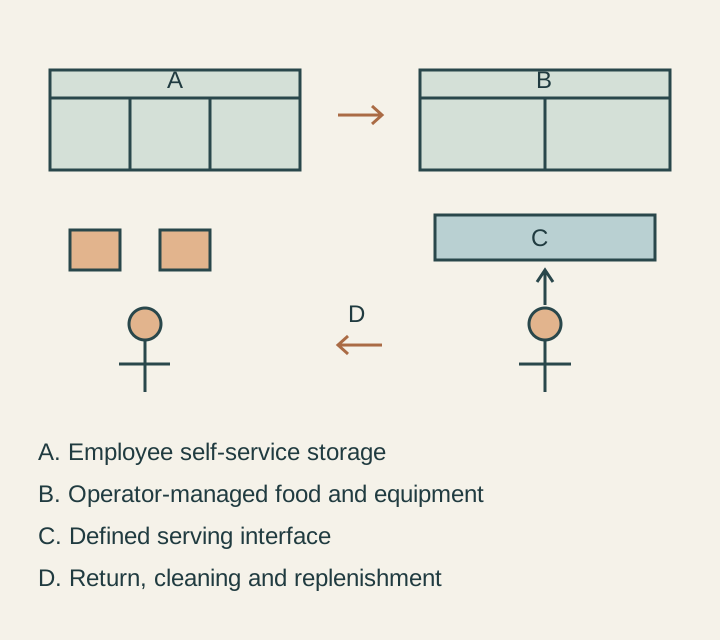
In a self-service room, test a representative full-day group of individual containers in the selected cold storage and cabinets. Include the company cups, tea supplies and other real shared objects without assuming personal lunches will all arrive in uniform packages.
In a staffed kitchen, use the operator's receiving packages, preparation vessels, serving pieces and replacement supplies. A shelf that comfortably stores employee mugs may be the wrong shape for a covered service tray. Test actual groups rather than using employee headcount alone as a cabinet-sizing rule.
Keep reserve supplies separate from the items in immediate use. The person replenishing the coffee or serving area needs a known place to retrieve the next package. Count the receiving cabinet's existing contents so the same shelf is not assigned both reserve food and equipment waiting to be stored.
Model the busiest ordinary meal period
For self-service, follow arrival, lunch retrieval, heating where intended, adding a drink and leaving. Include people returning used containers. Observe which action actually creates waiting; the business may need another usable approach or a different storage assignment rather than another cooking appliance.
For staffed service, mark the operator's preparation position, the employee receiving position and the way the meal leaves. Then add replenishment during service. A counter that works for a staged empty tray may fail when a full serving group and waiting employees are present.
Keep the operator's necessary storage accessible while people collect meals. Do not put the only replenishment drawer behind the queue and assume it remains convenient. Compare the layout with fronts open and actual users standing in their working positions.
Specify the serving interface instead of calling every counter shared
A self-service counter may be used successively by different employees. Determine what stays there and what returns to a cabinet after each use. If lunch containers routinely occupy the only drink-preparation surface, separate those tasks on the plan or accept a clear sequence.
A staffed proposal needs an agreed boundary between the operator's work and employee collection. Decide where the employee receives a meal, obtains any shared utensils and moves away. The required arrangement belongs with the actual operation and project requirements; a decorative island is not automatically a serving counter.
Consider delivered meals as their own defined alternative if the business does not intend on-site preparation. Receiving and distributing prepared packages still need space and responsibility, but should not silently acquire the equipment and cabinet order for a different menu.
Finish the return and cleaning plan
State which objects return, who handles them and where they wait. Individual containers leaving with employees create a different room from shared plates returning to an operator. Do not erase the post-meal collection because it occurs after the rendering's attractive serving scene.
Follow washing, drying where applicable and the return of clean objects under the actual proposed equipment and project arrangements. Check the cabinet destinations with other contents present. The dish-storage cabinet must open from the position available while the selected appliance or return station is in use.
Waste and cleaning supplies also need defined homes and an assigned routine. Do not leave that work with an assumed volunteer. In an office, the facilities team, meal operator and employees may have different responsibilities; record the agreement before cabinet interiors are divided.
Select products for the specific workplace use
IKEA notes that its business page can mix products developed for commercial and residential use and asks buyers to verify individual product suitability and tests. A business-themed image does not certify every cabinet shown for a particular operation.
Reading note: IKEA USA — IKEA for Business, individual product suitability note.
Give the supplier the actual use, expected handling and specified cleaning requirements. Obtain the relevant product information and have the responsible project team confirm suitability. Do not turn a material name, a residential kitchen photograph or an unrelated test into a claim that the proposed room meets all its requirements.
Coordinate the selected appliances, sink and other equipment with their actual openings, connections and service needs. A staff-operated proposal may have a different equipment schedule from the breakroom alternative. Do not keep the same cabinet order while changing the service behind its fronts.
Compare complete provision and ongoing responsibility
Price the complete cabinets, fronts, counters, equipment and required project work for each service. Identify who supplies installation, receiving and room completion. If one proposal depends on staff or an outside operator, include that operational arrangement in the business's decision rather than making it disappear behind an equipment total.
Keep possible expansion separate from a guaranteed future conversion. If the office wants to change services later, identify what the current plan genuinely preserves and what remains unknown. Empty-looking cabinet space does not establish future equipment compatibility.
In a hypothetical office, the buyer initially asks for a staffed meal kitchen to improve lunch. The proposed operator demonstrates a shared-meal service, but the business does not intend to fund or manage that ongoing operation. Most employees actually want dependable access to their individual lunches and drinks.
The buyer selects the tested self-service plan, assigns restocking and cleaning, and preserves separate places for lunch handling and drink supplies. A different business with an accepted operator and menu may buy the staffed arrangement. Keep the chosen service, real package groups, peak-use trial and assigned responsibilities with the cabinet order so the room can do the work it was bought for.
Sources & further reading
- IKEA USA — IKEA for Business, individual product suitability note